



 Chat with AI
Exam 5: Risk and Portfolio Management

Exam 1: An Introduction to Investments19 Questions
Exam 2: Securities Markets77 Questions
Exam 3: The Time Value of Money41 Questions
Exam 4: Financial Planning, Taxation and the Efficiency of Financial Markets57 Questions
Exam 5: Risk and Portfolio Management56 Questions
Exam 6: Investment Companies: Mutual Funds65 Questions
Exam 7: Closed-End Investment Companies, Real Estate Investment Trusts Reits, and Exchange-Traded Funds Etfs50 Questions
Exam 8: Stock104 Questions
Exam 9: The Valuation of Common Stock35 Questions
Exam 10: Investment Returns and Aggregate Measures of Stock Markets42 Questions
Exam 11: The Macroeconomic Environment for Investment Decisions36 Questions
Exam 12: Behavioral Finance and Technical Analysis34 Questions
Exam 13: The Bond Market64 Questions
Exam 14: The Valuation of Fixed-Income Securities64 Questions
Exam 15: Government Securities50 Questions
Exam 16: Convertible Bonds and Convertible Preferred Stock47 Questions
Exam 17: An Introduction to Options85 Questions
Exam 18: Option Valuation and Strategies40 Questions
Exam 19: Commodity and Financial Futures47 Questions
Exam 20: Financial Planning and Investing in an Efficient Market Context22 Questions
Select questions type


Inflation, which is a general decline in prices, is the source of financial risk.
(True/False)
4.9/5  (83)
(83) (This problem illustrates the computation of beta coefficients may be solved using a statistics program or Excel.)The returns on the market and stock A and stock B are as follows:
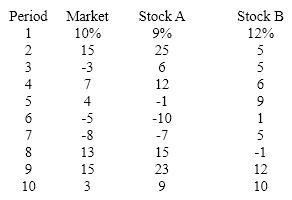 Compute the beta coefficient for each stock and interpret the results of the computations.
 (Essay)
4.8/5 (76)
(76) By accepting more risk, the investor will increase the realized return.
(True/False)
4.8/5 (78)
(78) Unsystematic risk refers to factors that are unique to the specific asset.
(True/False)
4.8/5 (85)
(85) Investors who want to bear less risk should acquire stocks whose beta coefficients are
(Multiple Choice)
4.8/5 (73)
(73) If the return on two stocks is highly and positively correlated (i.e., correlation coefficient=+1.0), combining these stocks will reduce the risk associated with the portfolio.
(True/False)
4.9/5 (72)
(72) The tendency of individual stock prices to move together is one source of systematic risk.
(True/False)
4.9/5 (88)
(88) Exchange rate risk refers to fluctuations in the prices of foreign currencies (i.e., foreign exchange).
(True/False)
4.9/5 (76)
(76) If a stock's return has a large standard deviation, that suggests the stock has little risk.
(True/False)
4.9/5 (85)
(85) 
Filters
- Essay(0)
- Multiple Choice(0)
- Short Answer(0)
- True False(0)
- Matching(0)