



 Chat with AI
Exam 22: Frontiers in Microeconomics.

Exam 1: Ten Principles of Economics.349 Questions
Exam 2: Thinking Like an Economist.535 Questions
Exam 3: Interdependence and the Gains from Trade.443 Questions
Exam 4: The Market Forces of Supply and Demand.571 Questions
Exam 5: Elasticity and Its Application510 Questions
Exam 6: Supply, Demand, And Government Policies.557 Questions
Exam 7: Consumers, Producers, and the Efficiency of Markets.460 Questions
Exam 8: Application: The Costs of Taxation.424 Questions
Exam 9: Application: International Trade.410 Questions
Exam 10: Externalities.441 Questions
Exam 11: Public Goods and Common Resources.349 Questions
Exam 12: The Design of the Tax System.478 Questions
Exam 13: The Costs of Production.533 Questions
Exam 14: Firms in Competitive Markets.478 Questions
Exam 15: Monopoly.526 Questions
Exam 16: Monopolistic Competition.497 Questions
Exam 17: Oligopoly.410 Questions
Exam 18: The Market For the Factors of Production.463 Questions
Exam 19: Earnings and Discrimination.398 Questions
Exam 20: Income Inequality and Poverty.374 Questions
Exam 21: The Theory of Consumer Choice.462 Questions
Exam 22: Frontiers in Microeconomics.353 Questions
Select questions type


Table 22-4
Five voters must choose from among four options: A, B, C, or D. Each voter's preferences are summarized in the table below. Options higher in the table are more preferred by the voter.
 -Refer to Table 22-4.Which pairwise voting scheme would result in outcome B?
 (Multiple Choice)
4.9/5  (100)
(100) Table 22-10
Three family members -- Seamus, Maeve, and Siobhan -- are deciding what type of movie to attend. The three choices are an action adventure, comedy, or horror. The first, second, and third choices for each person are as indicated in the table below.
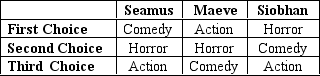 -Refer to Table 22-10.Suppose the three decide to make the decision based on pairwise majority voting.If they first choose between Action and Horror and then choose between the winner of the first vote and Comedy,which movie alternative will win?
 (Multiple Choice)
4.8/5 (78)
(78) Scenario 22-2
The following table shows the preferences for the five voters in a city regarding how to deal with the city's diseased trees.
 A = do nothing
B = follow the expert's advice to remove every tree
C = remove every 4th tree now and perhaps more later
D = use an untested spraying alternative
-Refer to Scenario 22-2.Consider the public policy for dealing with the diseased trees.Using a Borda count with 4 points assigned to the first choice,3 points assigned to the second choice,2 points assigned to the third choice,and 1 point assigned to the fourth choice,which policy wins?
A = do nothing
B = follow the expert's advice to remove every tree
C = remove every 4th tree now and perhaps more later
D = use an untested spraying alternative
-Refer to Scenario 22-2.Consider the public policy for dealing with the diseased trees.Using a Borda count with 4 points assigned to the first choice,3 points assigned to the second choice,2 points assigned to the third choice,and 1 point assigned to the fourth choice,which policy wins? (Multiple Choice)
4.8/5 (80)
(80) Under majority rule,the order in which items are voted on is
(Multiple Choice)
4.8/5 (77)
(77) Economists have found that asymmetric information is not very prevalent.
(True/False)
4.8/5 (89)
(89) Which of the following students exhibits satisficing behavior?
(Multiple Choice)
4.9/5 (78)
(78) Which of the following sets of preferences can not satisfy the property of transitivity?
(Multiple Choice)
4.8/5 (77)
(77) Arrow's impossibility theorem shows that it is impossible to find a better voting system than pairwise majority voting.
(True/False)
4.9/5 (77)
(77) A person's tendency to smoke a cigarette after promising himself that he will quit is an example of the behavioral economics insight that people are inconsistent over time
(True/False)
4.9/5 (72)
(72) The Condorcet paradox implies that the order in which items are voted on under majority rule is unimportant.
(True/False)
4.8/5 (70)
(70) Table 22-11
The following table shows the preferences of four types of voters over four possible alternatives as well as the percentage of the electorate with the given preferences.
 -Refer to Table 22-11.Suppose before any voting takes place that alternative W is eliminated as an option.Based on this information,the median voter's first choice is
 (Multiple Choice)
4.8/5 (76)
(76) Informational asymmetry may apply to a hidden action or hidden characteristic where the informed party may be reluctant to reveal relevant information.
(True/False)
4.7/5 (75)
(75) Which of the following is not a common response to the moral hazard problem that employers face?
(Multiple Choice)
4.9/5 (79)
(79) When each voter has a most-preferred outcome for the expenditure on a particular government program,majority rule will produce the outcome
(Multiple Choice)
4.8/5 (70)
(70) The two major problems caused by asymmetric information are the moral-hazard problem and the principal-agent problem.
(True/False)
4.9/5 (72)
(72) 
Filters
- Essay(0)
- Multiple Choice(0)
- Short Answer(0)
- True False(0)
- Matching(0)