



 Chat with AI
Exam 22: Frontiers in Microeconomics.

Exam 1: Ten Principles of Economics.349 Questions
Exam 2: Thinking Like an Economist.535 Questions
Exam 3: Interdependence and the Gains from Trade.443 Questions
Exam 4: The Market Forces of Supply and Demand.571 Questions
Exam 5: Elasticity and Its Application510 Questions
Exam 6: Supply, Demand, And Government Policies.557 Questions
Exam 7: Consumers, Producers, and the Efficiency of Markets.460 Questions
Exam 8: Application: The Costs of Taxation.424 Questions
Exam 9: Application: International Trade.410 Questions
Exam 10: Externalities.441 Questions
Exam 11: Public Goods and Common Resources.349 Questions
Exam 12: The Design of the Tax System.478 Questions
Exam 13: The Costs of Production.533 Questions
Exam 14: Firms in Competitive Markets.478 Questions
Exam 15: Monopoly.526 Questions
Exam 16: Monopolistic Competition.497 Questions
Exam 17: Oligopoly.410 Questions
Exam 18: The Market For the Factors of Production.463 Questions
Exam 19: Earnings and Discrimination.398 Questions
Exam 20: Income Inequality and Poverty.374 Questions
Exam 21: The Theory of Consumer Choice.462 Questions
Exam 22: Frontiers in Microeconomics.353 Questions
Select questions type


How have insights from the field of psychology influenced the thinking of economists in recent years?
(Essay)
4.9/5  (69)
(69) In his 1951 book,Social Choice and Individual Values,Kenneth Arrow used the term "unanimity" to mean
(Multiple Choice)
4.7/5 (75)
(75) Your friend works at a coffee shop on campus and regularly gives away free coffee to you and your friends when you visit.This is an example of
(Multiple Choice)
4.9/5 (82)
(82) Table 22-8
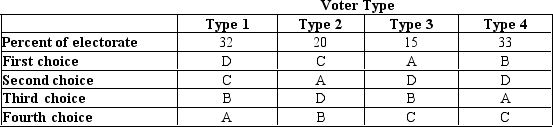 -Refer to Table 22-8.The table shows the preferences of four types of voters over four possible outcomes: A,B,C,D.In addition,the table shows the percentage of voters of each type.Based on this information,which of the following statements is false?
 (Multiple Choice)
4.8/5 (89)
(89) The classic example of adverse selection is the market for used cars.
(True/False)
4.9/5 (83)
(83) Economic experiments show that people care more about winning a game than about its intrinsic fairness.
(True/False)
4.9/5 (94)
(94) Eli and Peyton are playing the ultimatum game,starting with $100.The coin flip results in Eli being the one to propose a division of the $100.If Eli acts as experimental evidence shows,he will likely propose that
(Multiple Choice)
4.9/5 (76)
(76) Table 22-14
The Johnson family is planning a vacation and, though Mr. and Mrs. Johnson will be paying for the trip, they have decided to use a democratic voting process to choose their destination. The family members' preferences are reflected in the table below.
 -Refer to Table 22-14.If the family uses a Borda count to make their decision,what is their vacation destination?
 (Multiple Choice)
4.8/5 (75)
(75) In the case of a moral-hazard problem,which of the following is not a way for the principal to encourage the agent to act more responsibly?
(Multiple Choice)
4.9/5 (75)
(75) Arrow's impossibility theorem states that the majority rule fails to produce transitive preferences for society.
(True/False)
4.9/5 (95)
(95) In a vote between options A,B,and C,option C wins.When option B is eliminated and a vote is taken between option A and option C,option A wins.The voting system used fails to satisfy which of Arrow's properties of a desirable voting system?
(Multiple Choice)
4.9/5 (89)
(89) Majority rule will produce the outcome most preferred by the median voter,as demonstrated by the
(Multiple Choice)
4.8/5 (74)
(74) Majority rule will produce the outcome most preferred by the median voter.
(True/False)
4.8/5 (68)
(68) Suppose that an economics professor selects two students,Byron and Regina,to participate in a classroom experiment.The professor gives Byron ten $1 bills.Byron must pick an allocation of the ten $1 bills to offer to Regina.If Regina accepts the allocation,each student keeps his or her portion of the money.If Regina rejects the allocation,the professor keeps the $10,and each student receives nothing.Byron selects $9 for himself and $1 for Regina.Based on the studies of human decision making,which of the following statements is correct?
(Multiple Choice)
4.7/5 (93)
(93) Which of the following is a characteristic of a corporation but not of a small family-owned business?
(Multiple Choice)
4.8/5 (82)
(82) Explain what is meant by "asymmetric information." Identify and explain the two basic types of problems that arise when there is asymmetric information.
(Essay)
4.8/5 (90)
(90) The suggestion that people are "satisficers" is similar to the view that people
(Multiple Choice)
4.9/5 (76)
(76) Table 22-1
Three friends -- Tricia, Sarah, and Katie -- are deciding where to go together for vacation. They all agree that they should go to one of three places: Ireland, Italy, or Greece. They also agree that they will have two pairwise votes to determine where to go on vacation, with the majority determining the outcome on each vote. The first, second, and third choices for each person are as indicated in the table below.
 -Refer to Table 22-1.If the friends change their minds and decide to choose a vacation destination using a Borda count,then
 (Multiple Choice)
4.8/5 (94)
(94) 
Filters
- Essay(0)
- Multiple Choice(0)
- Short Answer(0)
- True False(0)
- Matching(0)