



 Chat with AI
Exam 22: Frontiers in Microeconomics.

Exam 1: Ten Principles of Economics.349 Questions
Exam 2: Thinking Like an Economist.535 Questions
Exam 3: Interdependence and the Gains from Trade.443 Questions
Exam 4: The Market Forces of Supply and Demand.571 Questions
Exam 5: Elasticity and Its Application510 Questions
Exam 6: Supply, Demand, And Government Policies.557 Questions
Exam 7: Consumers, Producers, and the Efficiency of Markets.460 Questions
Exam 8: Application: The Costs of Taxation.424 Questions
Exam 9: Application: International Trade.410 Questions
Exam 10: Externalities.441 Questions
Exam 11: Public Goods and Common Resources.349 Questions
Exam 12: The Design of the Tax System.478 Questions
Exam 13: The Costs of Production.533 Questions
Exam 14: Firms in Competitive Markets.478 Questions
Exam 15: Monopoly.526 Questions
Exam 16: Monopolistic Competition.497 Questions
Exam 17: Oligopoly.410 Questions
Exam 18: The Market For the Factors of Production.463 Questions
Exam 19: Earnings and Discrimination.398 Questions
Exam 20: Income Inequality and Poverty.374 Questions
Exam 21: The Theory of Consumer Choice.462 Questions
Exam 22: Frontiers in Microeconomics.353 Questions
Select questions type


Table 22-11
The following table shows the preferences of four types of voters over four possible alternatives as well as the percentage of the electorate with the given preferences.
 -Refer to Table 22-11.Suppose voters first choose in a majority vote between W and X.Second,voters choose in a majority vote between the winner of the first vote and Y.Third,voters choose in a majority vote between the winner of the second vote and Z.Which alternative will win?
 (Multiple Choice)
5.0/5  (81)
(81) Signaling is an action taken by an uninformed party to induce an informed party to reveal information.
(True/False)
4.8/5 (65)
(65) When a jeweler sells a low quality diamond to a young man who believes the diamond is the highest quality,she is engaging in
(Multiple Choice)
4.8/5 (84)
(84) Insurance companies charge annual premiums to collect revenue,which they then use to pay customers who file claims for damages they incur.Because of the moral hazard problem insurance companies separate customers into groups.Group 1: customers who file few claims & Group 2: customers that file a lot of claims.After creating these groups,what happens to the average annual premium within a group?
(Multiple Choice)
4.9/5 (80)
(80) Table 22-8
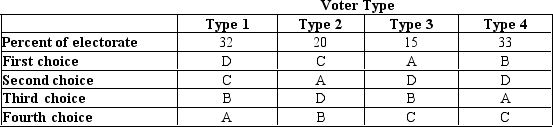 -Refer to Table 22-8.The table shows the preferences of four types of voters over four possible outcomes: A,B,C,and D.In addition,the table shows the percentage of voters of each type.If the election is an instant runoff,the winner will be
 (Multiple Choice)
4.8/5 (82)
(82) The Condorcet paradox shows that there is no scheme for aggregating individual preferences into a valid set of social preferences.
(True/False)
4.9/5 (80)
(80) An example of an information asymmetry is when a worker knows more than his employer about his work effort.
(True/False)
5.0/5 (74)
(74) Your city newspaper publishes a "Best of" poll that lists its readers' favorite restaurants.Mundo Bar and Grill is ranked as the best casual restaurant.Your best friend had dinner at Mundo Bar and Grill last week and commented that the food was mediocre and the service was slow.You decide not to have dinner at Mundo Bar and Grill based on your friend's experience.Your decision illustrates that people
(Multiple Choice)
4.9/5 (71)
(71) A driver knows more than his auto insurer about how cautiously he drives.This is an example of
(Multiple Choice)
4.8/5 (71)
(71) Evidence points to the fact that,in the real world,people appear to care about fairness
(Multiple Choice)
4.8/5 (82)
(82) Evidence from experiments in which real people play the ultimatum game supports the idea that people care about fairness as well as about maximization of their personal wealth.
(True/False)
4.8/5 (79)
(79) Table 22-9
 -Refer to Table 22-9.The table shows the preferences of 100 voters over three possible outcomes: A,B,and C.In pairwise majority voting in which voters choose first between A and B and then choose between the winner of the first vote and C,
 (Multiple Choice)
5.0/5 (82)
(82) When asymmetric information affects a relationship between two parties,it is always the case that
(Multiple Choice)
4.8/5 (77)
(77) In economics,a difference in access to relevant knowledge is called a behavioral asymmetry.
(True/False)
4.9/5 (82)
(82) Table 22-15
The town of Portsmouth is considering a renovation to the high school. The voters in Portsmouth have different preferences on the budget for the renovation as displayed below.
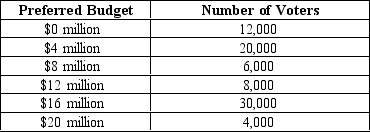 -Refer to Table 22-15.If there is a vote between a budget of $12 million and $16 million,the median voter will vote to spend
 (Multiple Choice)
4.9/5 (77)
(77) Scenario 22-3
Three candidates, Frank, Brian, and Wanda, are running for office. There are three voters in the upcoming election: Henry, Diane, and Linda. Henry prefers Brian over Frank and Frank over Wanda. Diane prefers Wanda over Brian and Brian over Frank. Linda prefers Frank over Brian and Brian over Wanda.
-Refer to Scenario 22-3.If the voters were given a choice of Frank versus Brian first,then the winner was in a second election versus Wanda,who would win?
(Multiple Choice)
4.8/5 (68)
(68) 
Filters
- Essay(0)
- Multiple Choice(0)
- Short Answer(0)
- True False(0)
- Matching(0)