



 Chat with AI
Exam 22: Frontiers in Microeconomics.

Exam 1: Ten Principles of Economics.349 Questions
Exam 2: Thinking Like an Economist.535 Questions
Exam 3: Interdependence and the Gains from Trade.443 Questions
Exam 4: The Market Forces of Supply and Demand.571 Questions
Exam 5: Elasticity and Its Application510 Questions
Exam 6: Supply, Demand, And Government Policies.557 Questions
Exam 7: Consumers, Producers, and the Efficiency of Markets.460 Questions
Exam 8: Application: The Costs of Taxation.424 Questions
Exam 9: Application: International Trade.410 Questions
Exam 10: Externalities.441 Questions
Exam 11: Public Goods and Common Resources.349 Questions
Exam 12: The Design of the Tax System.478 Questions
Exam 13: The Costs of Production.533 Questions
Exam 14: Firms in Competitive Markets.478 Questions
Exam 15: Monopoly.526 Questions
Exam 16: Monopolistic Competition.497 Questions
Exam 17: Oligopoly.410 Questions
Exam 18: The Market For the Factors of Production.463 Questions
Exam 19: Earnings and Discrimination.398 Questions
Exam 20: Income Inequality and Poverty.374 Questions
Exam 21: The Theory of Consumer Choice.462 Questions
Exam 22: Frontiers in Microeconomics.353 Questions
Select questions type


Table 22-2
Three longtime friends-Jack, Ryan, and Colin-are deciding how they will spend their Sunday afternoon. They all agree that they should do one of three things: go to a movie, go to the zoo, or go to a museum. They also agree that they will have two pairwise votes to determine how to spend their evening, with the majority determining the outcome on each vote. The first, second, and third choices for each person are as indicated in the table below.
 -Refer to Table 22-2.If (1)the first vote pits "baseball game" against "movie," and (2)the second vote pits "zoo" against the winner of the first vote,then the outcome is as follows:
 (Multiple Choice)
4.8/5  (71)
(71) The problem that arises when one person performs a task on behalf of another person is called the lemons problem.
(True/False)
4.8/5 (79)
(79) Condorcet explained his paradox in a 1951 book called Social Choice and Individual Values.
(True/False)
4.9/5 (69)
(69) Advocates of a tax on soda and other sugary drinks argue that such a tax
(Multiple Choice)
4.8/5 (91)
(91) Table 22-2
Three longtime friends-Jack, Ryan, and Colin-are deciding how they will spend their Sunday afternoon. They all agree that they should do one of three things: go to a movie, go to the zoo, or go to a museum. They also agree that they will have two pairwise votes to determine how to spend their evening, with the majority determining the outcome on each vote. The first, second, and third choices for each person are as indicated in the table below.
-Refer to Table 22-2.Which of the following statements is correct regarding the Condorcet paradox and the results of pairwise voting by Jack,Ryan,and Colin?
-Refer to Table 22-2.Which of the following statements is correct regarding the Condorcet paradox and the results of pairwise voting by Jack,Ryan,and Colin? (Multiple Choice)
4.8/5 (72)
(72) A brand of wine is priced at only $5 per bottle,far below the market price of most high quality wines.Before any reputation exists for the wine,consumers buy very little of this inexpensive wine because they interpret the low price to mean that the wine is of poor quality.The company decides to change the label on the wine to show that it has won awards for quality.This label change is an example of
(Multiple Choice)
4.8/5 (63)
(63) The 2001 Nobel prize in economics was awarded to George Akerlof,Michael Spence,and Joseph Stiglitz for their work on
(Multiple Choice)
4.8/5 (78)
(78) Table 22-3
The citizens of Anytown will decide whether to build a new library, a new community center, or a new ice rink. Exactly one of the three choices will prevail, and the choice will be made by way of pairwise voting, with the majority determining the outcome on each vote. The preferences of the voters are summarized in the table below.
 -Refer to Table 22-3.Which of the following statements is correct?
 (Multiple Choice)
4.8/5 (77)
(77) The tendency of many people to procrastinate supports the view that people are consistent over time.
(True/False)
4.9/5 (77)
(77) In a dictator game,player A must divide $100 between player A and player B.In this game,player B does not have the opportunity to reject an offer - he or she goes home with whatever player A offers.Experiments have observed that when player A splits the $100,he or she consistently offers over $10 to player B.Which of the following comments fits best.
(Multiple Choice)
4.8/5 (84)
(84) Table 22-8
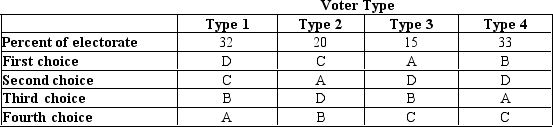 -Refer to Table 22-8.The table shows the preferences of four types of voters over four possible outcomes: A,B,C,and D.In addition,the table shows the percentage of voters of each type.Suppose a Borda count election is held in which each voter ranks the four outcomes,giving 1 point to last place,2 points to second to last,3 points to the second best,and 4 points to the best.In this case,which outcome would win?
 (Multiple Choice)
4.9/5 (87)
(87) The field of behavioral economics applies the methods of economics to study how government works.
(True/False)
4.8/5 (86)
(86) A home has been on the market for an extended amount of time without much interest from buyers.The sellers decide to purchase and include a home warranty insuring against major defects with the home.The warranty is an example of a(n)
(Multiple Choice)
4.8/5 (81)
(81) Table 22-14
The Johnson family is planning a vacation and, though Mr. and Mrs. Johnson will be paying for the trip, they have decided to use a democratic voting process to choose their destination. The family members' preferences are reflected in the table below.
 -Refer to Table 22-14.Suppose that before the family can arrive at their decision,Opryland announced that it will be closed for the season due to flooding.Mr.Johnson recommends using a vote by majority rule and proposes first choosing between the Grand Canyon and Sea World,and then choosing between the winner of the first vote and Disneyland.If everyone votes according to their preferences,
 (Multiple Choice)
4.9/5 (77)
(77) Table 22-15
The town of Portsmouth is considering a renovation to the high school. The voters in Portsmouth have different preferences on the budget for the renovation as displayed below.
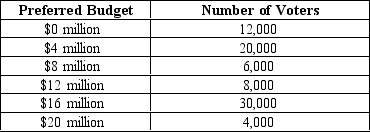 -Refer to Table 22-15.The median voter is one who prefers to spend
 (Multiple Choice)
4.7/5 (88)
(88) Which of the following is a plausible explanation for a firm paying above-equilibrium wages to its workers?
(Multiple Choice)
5.0/5 (86)
(86) Peter was recently hired as a salesman for a national consulting firm.His job involves spending a significant portion of his time out of the office visiting prospects and attending conferences.Which of the following is a strategy the consulting firm may employ to discourage Peter from shirking his responsibilities?
(Multiple Choice)
4.7/5 (75)
(75) 
Filters
- Essay(0)
- Multiple Choice(0)
- Short Answer(0)
- True False(0)
- Matching(0)