



 Chat with AI
Exam 21: The Theory of Consumer Choice.

Exam 1: Ten Principles of Economics.349 Questions
Exam 2: Thinking Like an Economist.535 Questions
Exam 3: Interdependence and the Gains from Trade.443 Questions
Exam 4: The Market Forces of Supply and Demand.571 Questions
Exam 5: Elasticity and Its Application510 Questions
Exam 6: Supply, Demand, And Government Policies.557 Questions
Exam 7: Consumers, Producers, and the Efficiency of Markets.460 Questions
Exam 8: Application: The Costs of Taxation.424 Questions
Exam 9: Application: International Trade.410 Questions
Exam 10: Externalities.441 Questions
Exam 11: Public Goods and Common Resources.349 Questions
Exam 12: The Design of the Tax System.478 Questions
Exam 13: The Costs of Production.533 Questions
Exam 14: Firms in Competitive Markets.478 Questions
Exam 15: Monopoly.526 Questions
Exam 16: Monopolistic Competition.497 Questions
Exam 17: Oligopoly.410 Questions
Exam 18: The Market For the Factors of Production.463 Questions
Exam 19: Earnings and Discrimination.398 Questions
Exam 20: Income Inequality and Poverty.374 Questions
Exam 21: The Theory of Consumer Choice.462 Questions
Exam 22: Frontiers in Microeconomics.353 Questions
Select questions type


Bundle L contains 10 units of good X and 20 units of good Y.Bundle M contains 8 units of good X and 21 units of good Y.The consumer is indifferent between bundle L and bundle M.Assume that the consumer's preferences satisfy the four properties of indifference curves.Which of the following correctly expresses the marginal rate of substitution of good X for good Y between these two points?
(Multiple Choice)
4.9/5  (78)
(78) The substitution effect from an increase in wages is evident in a
(Multiple Choice)
4.8/5 (84)
(84) When the price of a good increases,all else equal,the higher price
(Multiple Choice)
4.9/5 (78)
(78) The indifference curves for perfect substitutes are right angles.
(True/False)
4.7/5 (84)
(84) Figure 21-19
The following graph illustrates a representative consumer's preferences for marshmallows and chocolate chip cookies:
 -Refer to Figure 21-19.Assume that the consumer has an income of $100 and currently optimizes at bundle A.When the price of marshmallows decreases to $5,which bundle will the optimizing consumer choose?
 (Multiple Choice)
4.8/5 (74)
(74) Two economists found empirical evidence that when the price of rice decreased in the Hunan province of China,local residents consumed less rice than before the price decrease.The study provides a real-world example of a(n)
(Multiple Choice)
4.9/5 (79)
(79) Suppose at the consumer's current consumption bundle the marginal rate of substitution of cheese for wine is 1/2 bottle of wine per pound of cheese.The price of one pound of cheese is $6,and the price of a bottle of wine is $10.The consumer should increase his consumption of
(Multiple Choice)
4.8/5 (70)
(70) When Phil's income increases,he purchases fewer spaghetti dinners than he did before his income increased.For Phil,spaghetti dinners are a(n)
(Multiple Choice)
4.9/5 (75)
(75) Figure 21-8
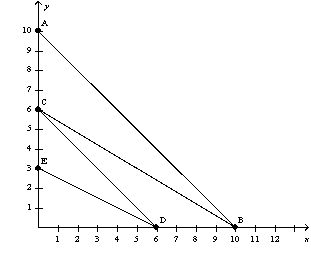 -Refer to Figure 21-8.If the price of good X is $3,and your budget constraint is BC,what is the price of good Y?
 (Multiple Choice)
4.7/5 (73)
(73) Draw indifference curves that reflect the following preferences.
a.pencils with white erasers and pencils with pink erasers
b.left shoes and right shoes
c.potatoes and rice
d.income and polluted water
(Essay)
4.9/5 (86)
(86) Figure 21-13
 -Refer to Figure 21-13.As the consumer moves from A to B to C,the marginal rate of substitution
 (Multiple Choice)
4.9/5 (75)
(75) Figure 21-5
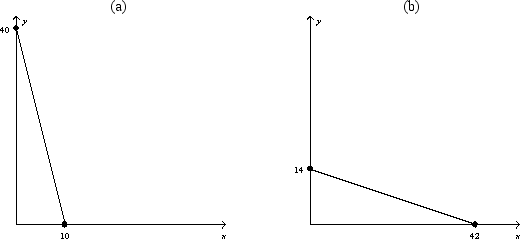 -Refer to Figure 21-5.In graph (b),what is the price of good X relative to good Y (i.e.,Pₓ/Pᵧ)?
 (Multiple Choice)
4.9/5 (79)
(79) Graphically demonstrate the conditions associated with a consumer optimum.Carefully label all curves and axes.
(Essay)
4.8/5 (76)
(76) If the relative price of a concert ticket is three times the price of a meal at a good restaurant,then the opportunity cost of a concert ticket can be measured by the
(Multiple Choice)
4.9/5 (85)
(85) Suppose the only two goods that Brett consumes are wine and cheese.When wine sells for $10 a bottle and cheese sell for $10 a pound,he buys 6 bottles of wine and 4 pounds of cheese - spending his entire income of $100.One day the price of wine falls to $5 a bottle and the price of cheese increases to $20 a pound,while his income does not change.The bundle of wine and cheese that he purchased at the old prices now costs
(Multiple Choice)
4.9/5 (78)
(78) 
Filters
- Essay(0)
- Multiple Choice(0)
- Short Answer(0)
- True False(0)
- Matching(0)