



 Chat with AI
Exam 21: The Theory of Consumer Choice.

Exam 1: Ten Principles of Economics.349 Questions
Exam 2: Thinking Like an Economist.535 Questions
Exam 3: Interdependence and the Gains from Trade.443 Questions
Exam 4: The Market Forces of Supply and Demand.571 Questions
Exam 5: Elasticity and Its Application510 Questions
Exam 6: Supply, Demand, And Government Policies.557 Questions
Exam 7: Consumers, Producers, and the Efficiency of Markets.460 Questions
Exam 8: Application: The Costs of Taxation.424 Questions
Exam 9: Application: International Trade.410 Questions
Exam 10: Externalities.441 Questions
Exam 11: Public Goods and Common Resources.349 Questions
Exam 12: The Design of the Tax System.478 Questions
Exam 13: The Costs of Production.533 Questions
Exam 14: Firms in Competitive Markets.478 Questions
Exam 15: Monopoly.526 Questions
Exam 16: Monopolistic Competition.497 Questions
Exam 17: Oligopoly.410 Questions
Exam 18: The Market For the Factors of Production.463 Questions
Exam 19: Earnings and Discrimination.398 Questions
Exam 20: Income Inequality and Poverty.374 Questions
Exam 21: The Theory of Consumer Choice.462 Questions
Exam 22: Frontiers in Microeconomics.353 Questions
Select questions type


List and briefly explain each of the four properties of indifference curves.
(Essay)
4.9/5  (88)
(88) Figure 21-14


 -Refer to Figure 21-14.Which of the graphs shown represent indifference curves for perfect complements?
 (Multiple Choice)
5.0/5 (82)
(82) Figure 21-16
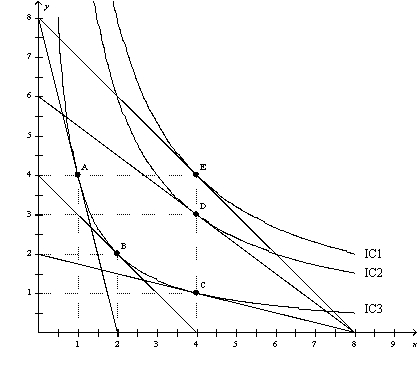 -Refer to Figure 21-16.When the price of X is $6,the price of Y is $24,and income is $48,Steve's optimal choice is point C.Then the price of Y decreases to $6.Steve's new optimal choice is point
 (Multiple Choice)
4.8/5 (86)
(86) Suppose a consumer has an income of $800 per month and that she spends her entire income each month on beer and bratwurst.The price of a pint of beer is $5,and the price of a bratwurst is $4.Which of the following combinations of beers and bratwursts represents a point that would lie to the exterior of the consumer's budget constraint?
(Multiple Choice)
4.8/5 (72)
(72) When considering household savings,the relative price between consuming when young and consuming when old is the
(Multiple Choice)
5.0/5 (78)
(78) When a consumer is purchasing the best combination of two goods,X and Y,subject to a budget constraint,we say that the consumer is at an optimal choice point.A graph of an optimal choice point shows that it occurs
(Multiple Choice)
4.8/5 (69)
(69) Suppose a consumer has preferences over two goods,X and Y,which are perfect substitutes.In particular,two units of X is equivalent to one unit of Y.If the price of X is $1,the price of Y is $3,and the consumer has $30 of income to allocate to these two goods,how much of each good should the consumer purchase to maximize satisfaction?
(Multiple Choice)
4.8/5 (88)
(88) A consumer likes two goods: pizza and beer.The four bundles shown in the table below lie on the same indifference curve for the consumer. 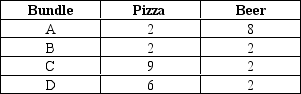 Which of the following statements regarding these bundles is correct?
 (Multiple Choice)
4.8/5 (99)
(99) An optimizing consumer will select the consumption bundle in which the marginal rate of substitution
(Multiple Choice)
4.9/5 (96)
(96) The indifference curves for nickels and dimes are straight lines.
(True/False)
4.9/5 (86)
(86) Pepsi and pizza are normal goods.When the price of pizza rises,the substitution effect causes Pepsi to be relatively
(Multiple Choice)
4.7/5 (67)
(67) Figure 21-8
 -Refer to Figure 21-8.You have $300 to spend on good X and good Y.If good X costs $30 and good Y costs $50,your budget constraint is
 (Multiple Choice)
4.8/5 (83)
(83) Casey consumes two goods,hamburgers and ice cream sandwiches.He has maximized his utility given his income.Ice cream sandwiches costs $2,and he consumes them to the point where the marginal utility he receives is 6.Hamburgers cost $4,and the relationship between the marginal utility that Casey gets from eating hamburgers and the number he eats per month is as follows:  How many hamburgers does Casey buy each month?
 (Multiple Choice)
4.8/5 (85)
(85) The slope at any point on an indifference curve equals the absolute price at which a consumer is willing to substitute one good for the other.
(True/False)
4.8/5 (68)
(68) If we observe that William's budget constraint has moved inward,then we know for certain that
(Multiple Choice)
4.9/5 (65)
(65) If a consumer consumes two goods,X and Y,and has indifference curves that are bowed inward,the consumer's optional choice occurs when
(Multiple Choice)
4.9/5 (78)
(78) 
Filters
- Essay(0)
- Multiple Choice(0)
- Short Answer(0)
- True False(0)
- Matching(0)