



 Chat with AI
Exam 21: The Theory of Consumer Choice.

Exam 1: Ten Principles of Economics.349 Questions
Exam 2: Thinking Like an Economist.535 Questions
Exam 3: Interdependence and the Gains from Trade.443 Questions
Exam 4: The Market Forces of Supply and Demand.571 Questions
Exam 5: Elasticity and Its Application510 Questions
Exam 6: Supply, Demand, And Government Policies.557 Questions
Exam 7: Consumers, Producers, and the Efficiency of Markets.460 Questions
Exam 8: Application: The Costs of Taxation.424 Questions
Exam 9: Application: International Trade.410 Questions
Exam 10: Externalities.441 Questions
Exam 11: Public Goods and Common Resources.349 Questions
Exam 12: The Design of the Tax System.478 Questions
Exam 13: The Costs of Production.533 Questions
Exam 14: Firms in Competitive Markets.478 Questions
Exam 15: Monopoly.526 Questions
Exam 16: Monopolistic Competition.497 Questions
Exam 17: Oligopoly.410 Questions
Exam 18: The Market For the Factors of Production.463 Questions
Exam 19: Earnings and Discrimination.398 Questions
Exam 20: Income Inequality and Poverty.374 Questions
Exam 21: The Theory of Consumer Choice.462 Questions
Exam 22: Frontiers in Microeconomics.353 Questions
Select questions type


Figure 21-3
In each case, the budget constraint moves from BC-1 to BC-2.


 -Refer to Figure 21-3.Which of the graphs in the figure reflects an increase in the price of good X only?
 (Multiple Choice)
4.8/5  (74)
(74) Scenario 21-3
Zach knows that he will ultimately face retirement. Assume that Zach will experience two periods in his life, one in which he works and earns income, and one in which he is retired and earns no income. Zach can earn $250,000 during his working period and nothing in his retirement period. He must both save and consume in his work period with an interest rate of 10 percent on savings.
-Refer to Scenario 21-3.Assume that Zach decides to consume $100,000 in the work period.How much money will he have available for consumption in his retirement period?
(Multiple Choice)
5.0/5 (76)
(76) A worker with a backward-bending labor supply curve responds to an increase in wages by working more hours.
(True/False)
4.8/5 (74)
(74) A consumer's preferences for right shoes and left shoes can be represented by indifference curves that are
(Multiple Choice)
4.8/5 (78)
(78) Figure 21-21
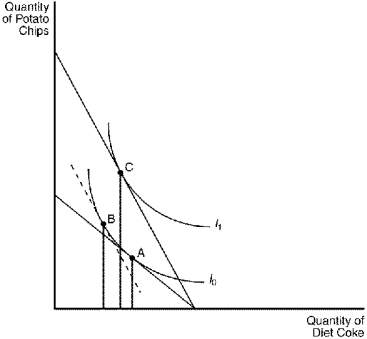 -Refer to Figure 21-21.If the consumer were initially at point A in the figure,a movement from point B to point C as a result of a decrease in the price of potato chips represents the
 (Multiple Choice)
4.8/5 (72)
(72) Figure 21-9
 -Refer to Figure 21-9.If the price of good X is $15,what is the price of good Y?
 (Multiple Choice)
4.8/5 (79)
(79) Figure 21-12
 -Refer to Figure 21-12.Which of the following statements is not correct?
 (Multiple Choice)
4.7/5 (82)
(82) Bill consumes two goods,iced tea and spaghetti.The price of iced tea is $4 per bottle,and the price of spaghetti is $6 per serving.His income is $1,000 per month.He spends all his income each month.He purchases 100 bottles of iced tea.How many servings of spaghetti can he purchase?
(Multiple Choice)
4.8/5 (70)
(70) Figure 21-5
 -Refer to Figure 21-5.In graph (a),what is the price of good X relative to good Y (i.e.,PX/PY)?
 (Multiple Choice)
4.9/5 (74)
(74) Suppose a consumer has an income of $800 per month and that she spends her entire income each month on beer and bratwurst.The price of a pint of beer is $5,and the price of a bratwurst is $4.Which of the following combinations of beers and bratwursts represents a point that would lie to the interior of the consumer's budget constraint?
(Multiple Choice)
4.8/5 (82)
(82) Angie is maximizing total utility while consuming food and clothing.Her marginal utility from food is 50,and her marginal utility from clothing is 25.If clothing is priced at $10 per unit,the price of food per unit must be
(Multiple Choice)
4.9/5 (77)
(77) If the price of a good increases,all else equal,consumers perceive
(Multiple Choice)
4.9/5 (83)
(83) The marginal rate of substitution between two goods always equals the
(Multiple Choice)
4.8/5 (71)
(71) If we observe that Jamie's budget constraint has moved outward,then we know for certain that
(Multiple Choice)
4.8/5 (76)
(76) Assume that a consumer faces the following budget constraints.
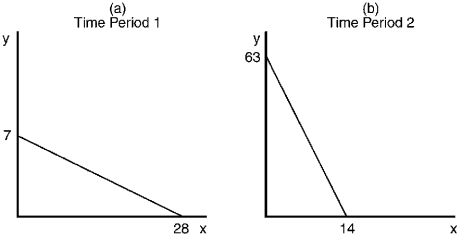 a.Assuming that income is the same on both occasions,describe the difference in relative prices between Panel A and Panel B.
b.If income in Panel B is $126,what is the price of good X?
c.If income in Panel A is $84,what is the price of good Y?
d.Assuming that the price of good X is the same on both occasions,describe the difference in income and price of good Y between Panel A and Panel B.
a.Assuming that income is the same on both occasions,describe the difference in relative prices between Panel A and Panel B.
b.If income in Panel B is $126,what is the price of good X?
c.If income in Panel A is $84,what is the price of good Y?
d.Assuming that the price of good X is the same on both occasions,describe the difference in income and price of good Y between Panel A and Panel B. (Essay)
4.8/5 (87)
(87) Figure 21-17
 -Refer to Figure 21-17.Bundle D represents a point where
 (Multiple Choice)
4.8/5 (80)
(80) Economists have found evidence of a Giffen good when studying the consumption of rice in the Chinese province of Hunan.
(True/False)
4.9/5 (88)
(88) Figure 21-2
 -Refer to Figure 21-2.A consumer who chooses to spend all of her income could be at which point(s)on the budget constraint?
 (Multiple Choice)
4.7/5 (85)
(85) Which of the following does not represent a tradeoff facing a consumer?
(Multiple Choice)
5.0/5 (73)
(73) As more units of an item are purchased,everything else equal,marginal satisfaction from consuming additional units will tend to
(Multiple Choice)
4.9/5 (77)
(77) 
Filters
- Essay(0)
- Multiple Choice(0)
- Short Answer(0)
- True False(0)
- Matching(0)