



 Chat with AI
Exam 21: The Theory of Consumer Choice.

Exam 1: Ten Principles of Economics.349 Questions
Exam 2: Thinking Like an Economist.535 Questions
Exam 3: Interdependence and the Gains from Trade.443 Questions
Exam 4: The Market Forces of Supply and Demand.571 Questions
Exam 5: Elasticity and Its Application510 Questions
Exam 6: Supply, Demand, And Government Policies.557 Questions
Exam 7: Consumers, Producers, and the Efficiency of Markets.460 Questions
Exam 8: Application: The Costs of Taxation.424 Questions
Exam 9: Application: International Trade.410 Questions
Exam 10: Externalities.441 Questions
Exam 11: Public Goods and Common Resources.349 Questions
Exam 12: The Design of the Tax System.478 Questions
Exam 13: The Costs of Production.533 Questions
Exam 14: Firms in Competitive Markets.478 Questions
Exam 15: Monopoly.526 Questions
Exam 16: Monopolistic Competition.497 Questions
Exam 17: Oligopoly.410 Questions
Exam 18: The Market For the Factors of Production.463 Questions
Exam 19: Earnings and Discrimination.398 Questions
Exam 20: Income Inequality and Poverty.374 Questions
Exam 21: The Theory of Consumer Choice.462 Questions
Exam 22: Frontiers in Microeconomics.353 Questions
Select questions type


As long as a consumer remains on the same indifference curve,
(Multiple Choice)
4.9/5  (95)
(95) The substitution effect of a wage decrease in the work-leisure model results in the worker choosing to
(Multiple Choice)
4.9/5 (91)
(91) Suppose a consumer consumes two goods,X and Y.The slope of the budget constraint equals the
(Multiple Choice)
4.9/5 (75)
(75) Figure 21-21
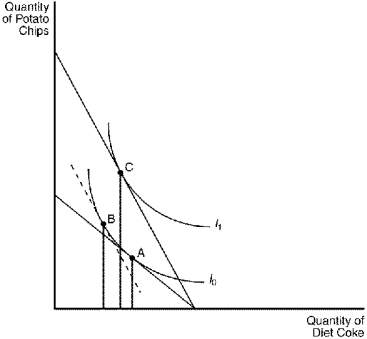 -Refer to Figure 21-21.If the consumer is currently at point A in the figure,a movement to point B as a result of a decrease in the price of potato chips represents the
 (Multiple Choice)
4.8/5 (84)
(84) Figure 21-25
The figure below illustrates the preferences for a representative consumer, Christopher.
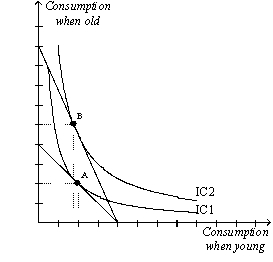 -Refer to Figure 21-25.Interest rates increase by 3 percent.Christopher's optimal choice point moves from A to B.Christopher consumes
 (Multiple Choice)
4.8/5 (84)
(84) Pepsi and pizza are normal goods.When the price of pizza falls,the substitution effect by itself will cause a
(Multiple Choice)
4.8/5 (82)
(82) When two goods are perfect complements,the indifference curves are right angles.
(True/False)
4.9/5 (77)
(77) An optimizing consumer will select the consumption bundle in which the marginal rate of substitution
(Multiple Choice)
4.8/5 (85)
(85) Which effect of a price change moves the consumer along the same indifference curve to a point with a new marginal rate of substitution?
(Multiple Choice)
4.9/5 (86)
(86) Figure 21-5
 -Refer to Figure 21-5.In graph (b),if income is equal to $420,the price of good Y is
 (Multiple Choice)
4.9/5 (83)
(83) For a typical consumer,most indifference curves are downward sloping.
(True/False)
4.7/5 (64)
(64) Assume that a college student spends her income on books and pizza.The price of a pizza is $8,and the price of a book is $15.If she has $100 in income,she could choose to consume
(Multiple Choice)
4.8/5 (74)
(74) An individual's demand curve for a good is derived by varying the
(Multiple Choice)
4.8/5 (84)
(84) Suppose a consumer is currently spending all of her available income on two goods: music CDs and DVDs.If the price of a CD is $9,the price of a DVD is $18,and she is currently consuming 10 CDs and 5 DVDs,what is the consumer's income?
(Multiple Choice)
4.7/5 (85)
(85) 
Filters
- Essay(0)
- Multiple Choice(0)
- Short Answer(0)
- True False(0)
- Matching(0)