



 Chat with AI
Exam 16: Monopolistic Competition.

Exam 1: Ten Principles of Economics.349 Questions
Exam 2: Thinking Like an Economist.535 Questions
Exam 3: Interdependence and the Gains from Trade.443 Questions
Exam 4: The Market Forces of Supply and Demand.571 Questions
Exam 5: Elasticity and Its Application510 Questions
Exam 6: Supply, Demand, And Government Policies.557 Questions
Exam 7: Consumers, Producers, and the Efficiency of Markets.460 Questions
Exam 8: Application: The Costs of Taxation.424 Questions
Exam 9: Application: International Trade.410 Questions
Exam 10: Externalities.441 Questions
Exam 11: Public Goods and Common Resources.349 Questions
Exam 12: The Design of the Tax System.478 Questions
Exam 13: The Costs of Production.533 Questions
Exam 14: Firms in Competitive Markets.478 Questions
Exam 15: Monopoly.526 Questions
Exam 16: Monopolistic Competition.497 Questions
Exam 17: Oligopoly.410 Questions
Exam 18: The Market For the Factors of Production.463 Questions
Exam 19: Earnings and Discrimination.398 Questions
Exam 20: Income Inequality and Poverty.374 Questions
Exam 21: The Theory of Consumer Choice.462 Questions
Exam 22: Frontiers in Microeconomics.353 Questions
Select questions type


In a monopolistically competitive industry,firms set price
(Multiple Choice)
4.8/5  (94)
(94) Senator Hubris wants to pass a law that would require all monopolistically competitive firms to operate at their efficient scale.If this law were to pass and be enforced,we would expect that monopolistically competitive firms would
(Multiple Choice)
4.8/5 (66)
(66) Figure 16-3
 -Refer to Figure 16-3.At the profit-maximizing,or loss-minimizing,output level,the firm in this figure has total costs of approximately
 (Multiple Choice)
4.9/5 (88)
(88) For a profit-maximizing monopolistically competitive firm,price exceeds marginal cost in
(Multiple Choice)
4.9/5 (78)
(78) Monopolistically competitive markets differ from perfectly competitive markets due to
(i)the number of sellers.
(ii)the barriers to entry.
(iii)the product differentiation among the sellers.
(Multiple Choice)
4.7/5 (85)
(85) Table 16-5
This table shows the demand schedule, marginal cost, and average total cost for a monopolistically competitive firm.
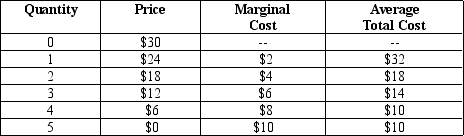 -Refer to Table 16-5.What is this firm's total cost at the profit-maximizing quantity?
 (Multiple Choice)
4.7/5 (80)
(80) Firms that spend the greatest percentage of their revenue on advertising tend to be firms that sell
(Multiple Choice)
4.8/5 (75)
(75) Which of the following market structures is considered a differentiated products market?
(Multiple Choice)
4.9/5 (79)
(79) Figure 16-9
The figure is drawn for a monopolistically-competitive firm.
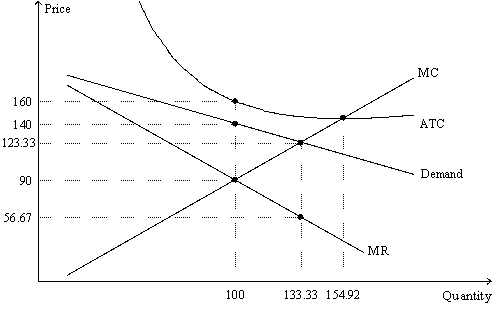 -Refer to Figure 16-9.If the firm were to produce 154.92 units of output,
 (Multiple Choice)
4.9/5 (68)
(68) Table 16-4
This table shows the demand schedule, marginal cost, and average total cost for a monopolistically competitive firm.
 -Refer to Table 16-4.If the government forces this firm to produce at its efficient output level,how much output will this firm produce?
 (Multiple Choice)
4.8/5 (93)
(93) Which of the following statements regarding monopolistic competition is not correct?
(Multiple Choice)
4.9/5 (79)
(79) A firm in a monopolistically competitive market is usually indifferent to an additional customer walking through the door,since a sale to that customer will not increase the firm's profit.
(True/False)
4.8/5 (85)
(85) Why does a typical monopolistically competitive firm face a downward-sloping demand curve?
(Essay)
4.8/5 (96)
(96) Table 16-3
The following table shows the output produced by each of the top eight firms in four industries as well as the total industry output for those industries.
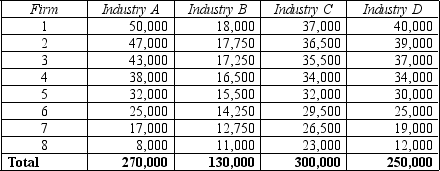 -Refer to Table 16-3.What is the concentration ratio for Industry C?
 (Multiple Choice)
4.8/5 (82)
(82) A monopolistically competitive industry is characterized by
(Multiple Choice)
4.8/5 (75)
(75) Figure 16-8
The figure is drawn for a monopolistically-competitive firm.
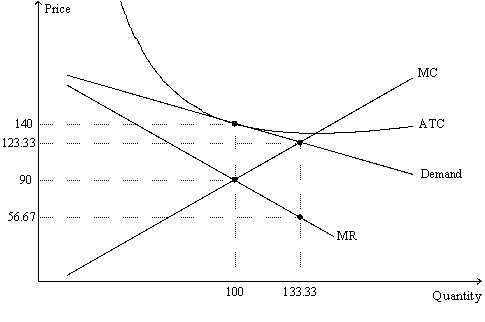 -Refer to Figure 16-8.Given this firm's cost curves,if the firm were perfectly competitive rather than monopolistically competitive,then in a long-run equilibrium it would produce
 (Multiple Choice)
4.9/5 (77)
(77) In a small college town,four microbreweries have opened in the last two years.Demonstrate the effect of new market entrants on demand for existing firms (microbreweries)that already served this market.Assume that the local community now places a moratorium on new liquor licenses for microbreweries.How will this moratorium affect the long-run profitability of incumbent firms?
(Essay)
4.9/5 (73)
(73) 
Filters
- Essay(0)
- Multiple Choice(0)
- Short Answer(0)
- True False(0)
- Matching(0)