



 Chat with AI
Exam 16: Monopolistic Competition.

Exam 1: Ten Principles of Economics.349 Questions
Exam 2: Thinking Like an Economist.535 Questions
Exam 3: Interdependence and the Gains from Trade.443 Questions
Exam 4: The Market Forces of Supply and Demand.571 Questions
Exam 5: Elasticity and Its Application510 Questions
Exam 6: Supply, Demand, And Government Policies.557 Questions
Exam 7: Consumers, Producers, and the Efficiency of Markets.460 Questions
Exam 8: Application: The Costs of Taxation.424 Questions
Exam 9: Application: International Trade.410 Questions
Exam 10: Externalities.441 Questions
Exam 11: Public Goods and Common Resources.349 Questions
Exam 12: The Design of the Tax System.478 Questions
Exam 13: The Costs of Production.533 Questions
Exam 14: Firms in Competitive Markets.478 Questions
Exam 15: Monopoly.526 Questions
Exam 16: Monopolistic Competition.497 Questions
Exam 17: Oligopoly.410 Questions
Exam 18: The Market For the Factors of Production.463 Questions
Exam 19: Earnings and Discrimination.398 Questions
Exam 20: Income Inequality and Poverty.374 Questions
Exam 21: The Theory of Consumer Choice.462 Questions
Exam 22: Frontiers in Microeconomics.353 Questions
Select questions type


Evidence from the market for eyeglasses suggests that advertising leads to
(Multiple Choice)
4.9/5  (79)
(79) Scenario 16-4
Consider the problem facing two firms, Burger Prince and McDaniel's, in the fast-food restaurant market. Each firm has just come up with an idea for a new fast-food menu item which it would sell for $5. Assume that the marginal cost for each new menu item is a constant $3, and the only fixed cost is for advertising. Each company knows that if it spends $16 million on advertising it will get 2 million consumers to try its new product. Burger Prince has done market research which suggests that its product does not have any "staying" power in the market. Even though it could get 2 million consumers to buy the product once, it is unlikely that they will continue to buy the product in the future. McDaniel's's market research suggests that its product is very good, and consumers who try the product will continue to be consumers over the ensuing year. On the basis of its market research, McDaniel's estimates that its initial 2 million customers will buy one unit of the product each month in the coming year, for a total of 32 million units.
-Refer to Scenario 16-4.If McDaniel's decides to advertise its product it can expect to
(Multiple Choice)
4.8/5 (79)
(79) Advertising during the Super Bowl is an example of information about quality contained primarily in the existence and expense of the advertising.
(True/False)
4.9/5 (68)
(68) New firms will likely enter a monopolistically competitive market when price exceeds
(Multiple Choice)
4.9/5 (82)
(82) Figure 16-2
This figure depicts a situation in a monopolistically competitive market.
 -Refer to Figure 16-2.How much consumer surplus will be derived from the purchase of this product at the monopolistically competitive price?
 (Multiple Choice)
4.8/5 (67)
(67) A monopolistically competitive firm's choice of output level is virtually identical to the choice made by
(Multiple Choice)
4.8/5 (80)
(80) On a vacation to China,you find yourself eating every meal at the local Burger King rather than buying a meal from one of the street vendors.Your traveling companion claims that you are irrational,since you never eat Burger King hamburgers when you are home,and Burger King's hamburgers cost more than the meals prepared and sold by China's street vendors.An economist would most likely explain your behavior by suggesting that
(Multiple Choice)
4.9/5 (79)
(79) Table 16-1
The following table shows the percentage of output supplied by the top eight firms in four different industries.
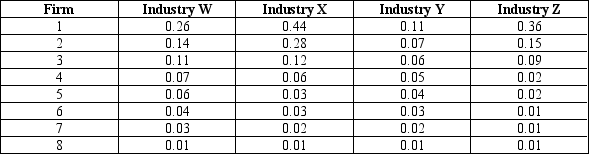 -Refer to Table 16-1.What is the concentration ratio in Industry Y?
 (Multiple Choice)
4.9/5 (77)
(77) Scenario 16-4
Consider the problem facing two firms, Burger Prince and McDaniel's, in the fast-food restaurant market. Each firm has just come up with an idea for a new fast-food menu item which it would sell for $5. Assume that the marginal cost for each new menu item is a constant $3, and the only fixed cost is for advertising. Each company knows that if it spends $16 million on advertising it will get 2 million consumers to try its new product. Burger Prince has done market research which suggests that its product does not have any "staying" power in the market. Even though it could get 2 million consumers to buy the product once, it is unlikely that they will continue to buy the product in the future. McDaniel's's market research suggests that its product is very good, and consumers who try the product will continue to be consumers over the ensuing year. On the basis of its market research, McDaniel's estimates that its initial 2 million customers will buy one unit of the product each month in the coming year, for a total of 32 million units.
-Refer to Scenario 16-4.If Burger Prince decides to advertise its product it can expect to
(Multiple Choice)
4.9/5 (75)
(75) In his 1944 book,The Road to Serfdom,Friedrich Hayek argued that
(Multiple Choice)
4.9/5 (82)
(82) If regulators required firms in monopolistically competitive markets to set price equal to marginal cost,
(Multiple Choice)
4.9/5 (73)
(73) Figure 16-3
 -Refer to Figure 16-3.What price will the monopolistically competitive firm charge in this market?
 (Multiple Choice)
4.8/5 (74)
(74) Which of the following conditions is characteristic of a monopolistically competitive firm in both the short-run and the long run?
(Multiple Choice)
4.9/5 (84)
(84) When the loss from a business-stealing externality exceeds the gain from a product-variety externality,
(Multiple Choice)
4.7/5 (88)
(88) When a firm's demand curve is tangent to its average total cost curve,the
(Multiple Choice)
4.7/5 (74)
(74) Which of the following pairs illustrates the two extreme examples of market structures?
(Multiple Choice)
4.9/5 (81)
(81) 
Filters
- Essay(0)
- Multiple Choice(0)
- Short Answer(0)
- True False(0)
- Matching(0)