



 Chat with AI
Exam 16: Monopolistic Competition.

Exam 1: Ten Principles of Economics.349 Questions
Exam 2: Thinking Like an Economist.535 Questions
Exam 3: Interdependence and the Gains from Trade.443 Questions
Exam 4: The Market Forces of Supply and Demand.571 Questions
Exam 5: Elasticity and Its Application510 Questions
Exam 6: Supply, Demand, And Government Policies.557 Questions
Exam 7: Consumers, Producers, and the Efficiency of Markets.460 Questions
Exam 8: Application: The Costs of Taxation.424 Questions
Exam 9: Application: International Trade.410 Questions
Exam 10: Externalities.441 Questions
Exam 11: Public Goods and Common Resources.349 Questions
Exam 12: The Design of the Tax System.478 Questions
Exam 13: The Costs of Production.533 Questions
Exam 14: Firms in Competitive Markets.478 Questions
Exam 15: Monopoly.526 Questions
Exam 16: Monopolistic Competition.497 Questions
Exam 17: Oligopoly.410 Questions
Exam 18: The Market For the Factors of Production.463 Questions
Exam 19: Earnings and Discrimination.398 Questions
Exam 20: Income Inequality and Poverty.374 Questions
Exam 21: The Theory of Consumer Choice.462 Questions
Exam 22: Frontiers in Microeconomics.353 Questions
Select questions type


Figure 16-8
The figure is drawn for a monopolistically-competitive firm.
 -Refer to Figure 16-8.In order to maximize its profit,the firm will choose to produce
 (Multiple Choice)
4.9/5  (92)
(92) Firms that sell highly differentiated consumer goods,such as soft drinks,breakfast cereals,and dog food,typically spend what percent of their revenues on advertising?
(Multiple Choice)
4.9/5 (86)
(86) If advertising reduces a consumer's price sensitivity between identical goods,it is likely to
(Multiple Choice)
4.9/5 (67)
(67) One way in which monopolistic competition differs from oligopoly is that
(Multiple Choice)
4.8/5 (66)
(66) Free entry eliminates long-run profits for firms in competitive and monopolistic industries.
(True/False)
4.8/5 (76)
(76) Figure 16-5
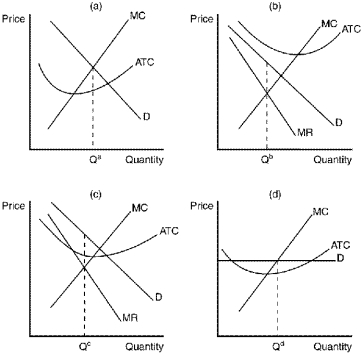 -Refer to Figure 16-5.Which of the graphs depicts a monopolistically competitive firm in long-run equilibrium?
 (Multiple Choice)
4.9/5 (83)
(83) Discuss how brand names may enhance the efficiency of markets in a less developed country.
(Essay)
4.8/5 (84)
(84) Consider monopoly,monopolistic competition,and perfect competition.In which of these three market structures does a profit-maximizing firm experience zero economic profit?
(Multiple Choice)
4.7/5 (83)
(83) Advertisements that appear to convey no information at all
(Multiple Choice)
4.9/5 (88)
(88) Figure 16-7
The lines in the figures below illustrate the potential effect of entry and exit in a monopolistically competitive market on either the demand curve or the marginal cost curve of existing firms.
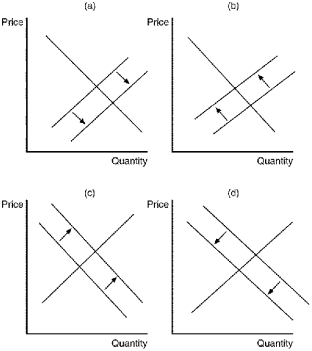 -Refer to Figure 16-7.Panel (d)illustrates the change that would occur if existing firms faced
 (Multiple Choice)
4.9/5 (83)
(83) Among the following situations,which one is least likely to apply to a monopolistically competitive firm?
(Multiple Choice)
4.8/5 (74)
(74) In the short run,a firm operating in a monopolistically competitive market can earn
(Multiple Choice)
4.9/5 (82)
(82) In Lee Benham's 1972 article examining the impact of advertising on the average price paid for a pair of eyeglasses,Benham found that
(Multiple Choice)
4.7/5 (85)
(85) One thing that both critics of advertising and defenders of advertising agree on is that advertising fosters competition.
(True/False)
4.8/5 (93)
(93) Firms that spend the greatest percentage of their revenue on advertising tend to be firms that sell
(Multiple Choice)
4.8/5 (69)
(69) Table 16-4
This table shows the demand schedule, marginal cost, and average total cost for a monopolistically competitive firm.
 -Refer to Table 16-4.What is this firm's profit maximizing level of output?
 (Multiple Choice)
4.9/5 (75)
(75) If firms in a particular market similar or sell identical products,then the market is
(i)perfectly competitive.
(ii)monopolistically competitive.
(iii)an oligopoly.
(Multiple Choice)
4.9/5 (74)
(74) 
Filters
- Essay(0)
- Multiple Choice(0)
- Short Answer(0)
- True False(0)
- Matching(0)