



 Chat with AI
Exam 16: Monopolistic Competition.

Exam 1: Ten Principles of Economics.349 Questions
Exam 2: Thinking Like an Economist.535 Questions
Exam 3: Interdependence and the Gains from Trade.443 Questions
Exam 4: The Market Forces of Supply and Demand.571 Questions
Exam 5: Elasticity and Its Application510 Questions
Exam 6: Supply, Demand, And Government Policies.557 Questions
Exam 7: Consumers, Producers, and the Efficiency of Markets.460 Questions
Exam 8: Application: The Costs of Taxation.424 Questions
Exam 9: Application: International Trade.410 Questions
Exam 10: Externalities.441 Questions
Exam 11: Public Goods and Common Resources.349 Questions
Exam 12: The Design of the Tax System.478 Questions
Exam 13: The Costs of Production.533 Questions
Exam 14: Firms in Competitive Markets.478 Questions
Exam 15: Monopoly.526 Questions
Exam 16: Monopolistic Competition.497 Questions
Exam 17: Oligopoly.410 Questions
Exam 18: The Market For the Factors of Production.463 Questions
Exam 19: Earnings and Discrimination.398 Questions
Exam 20: Income Inequality and Poverty.374 Questions
Exam 21: The Theory of Consumer Choice.462 Questions
Exam 22: Frontiers in Microeconomics.353 Questions
Select questions type


Figure 16-4
 -Refer to Figure 16-4.Which of the panels shown could illustrate the short-run situation for a monopolistically competitive firm?
 (Multiple Choice)
5.0/5  (73)
(73) In a long-run equilibrium,firms in both perfectly competitive markets and monopolistically competitive markets produce a quantity below the efficient scale of production.
(True/False)
4.8/5 (75)
(75) Which of the following represents the best government policy to reduce the deadweight loss associated with a monopolistically competitive market?
(Multiple Choice)
4.8/5 (78)
(78) A monopolistically competitive industry is characterized by
(Multiple Choice)
4.8/5 (72)
(72) Which of the following markets impose deadweight losses on society?
(i)perfect competition
(ii)monopolistic competition
(iii)monopoly
(Multiple Choice)
4.7/5 (71)
(71) Figure 16-1. The figure is drawn for a monopolistically competitive firm.
 -Refer to Figure 16-1.If the average total cost is $15 at the profit-maximizing quantity,then the firm's maximum profit is
 (Multiple Choice)
4.9/5 (86)
(86) Table 16-1
The following table shows the percentage of output supplied by the top eight firms in four different industries.
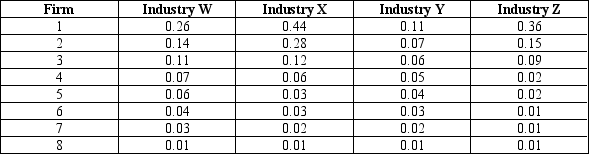 -Refer to Table 16-1.What is the concentration ratio in Industry X?
 (Multiple Choice)
4.9/5 (76)
(76) Figure 16-9
The figure is drawn for a monopolistically-competitive firm.
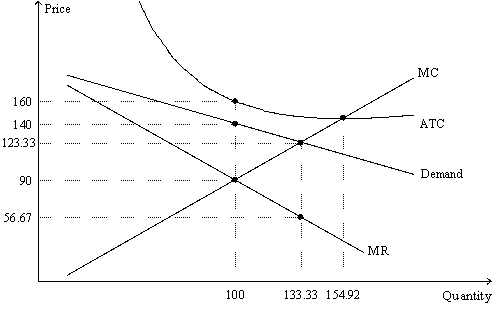 -Refer to Figure 16-9.In order to maximize its profit,the firm will choose to produce
 (Multiple Choice)
4.8/5 (80)
(80) Assume the role of a critic of advertising.Describe the characteristics of advertising that reduce the effectiveness of markets and decrease the social welfare of society.
(Essay)
4.8/5 (81)
(81) Figure 16-9
The figure is drawn for a monopolistically-competitive firm.
-Refer to Figure 16-9.As the figure is drawn,the firm is in
-Refer to Figure 16-9.As the figure is drawn,the firm is in (Multiple Choice)
4.8/5 (86)
(86) Compared to other firms,firms that sell highly differentiated products likely incur significant costs associated with
(Multiple Choice)
4.8/5 (81)
(81) When a firm operates with excess capacity,it must be in a monopolistically competitive market.
(True/False)
4.9/5 (85)
(85) A markup of price over marginal cost is inconsistent with free entry and zero profit.
(True/False)
4.9/5 (79)
(79) One key difference between an oligopoly market and a competitive market is that oligopolistic firms
(Multiple Choice)
4.9/5 (87)
(87) 
Filters
- Essay(0)
- Multiple Choice(0)
- Short Answer(0)
- True False(0)
- Matching(0)