



 Chat with AI
Exam 8: Perfect Competition

Exam 1: The Role and Method of Economics288 Questions
Exam 2: Scarcity, Trade-Offs, and Production Possibilities166 Questions
Exam 3: Supply and Demand122 Questions
Exam 4: Bringing Supply and Demand Together150 Questions
Exam 5: Elasticity116 Questions
Exam 6: Market Efficiency and Market Failure151 Questions
Exam 7: Production and Costs159 Questions
Exam 8: Perfect Competition155 Questions
Exam 9: Monopoly155 Questions
Exam 10: Monopolistic Competition and Oligopoly99 Questions
Exam 11: Labour Markets and the Distribution of Income188 Questions
Exam 12: The Environment49 Questions
Select questions type


FIGURE 8-4
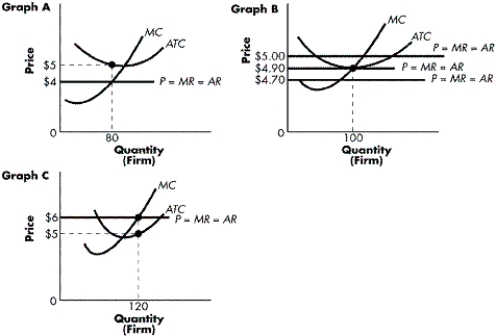 -Refer to Figure 8-4. If the market price decreased to $4.70 in Graph B, what action should this firm take?
 (Multiple Choice)
4.8/5  (80)
(80) What effect will the entry of new firms into an industry very likely have?
(Multiple Choice)
4.9/5 (73)
(73) FIGURE 8-3
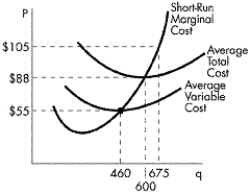 -Refer to Figure 8-3. When the market price equals $105 and the firm sells 675 units of output, what can we conclude about the firm?
 (Multiple Choice)
4.8/5 (79)
(79) If input costs remain the same as industry output expands, what would you expect to be the long-run impact of an increase in demand on an industry currently in long-run equilibrium?
(Multiple Choice)
5.0/5 (82)
(82) Economic losses caused several firms to leave the car wash business in Charlottetown, PEI. Though prices have risen, why are firms still leaving the industry?
(Multiple Choice)
4.8/5 (73)
(73) Perfectly competitive firms earn zero economic profit in the long run.
(True/False)
4.7/5 (71)
(71) For a perfectly competitive firm in short-run equilibrium, if the price is between AVC and ATC, what can we conclude?
(Multiple Choice)
4.9/5 (82)
(82) For a perfectly competitive firm, which of the following does NOT describe average revenue?
(Multiple Choice)
4.7/5 (73)
(73) In long-run equilibrium under perfect competition, which of the following is price NOT equal to?
(Multiple Choice)
4.7/5 (75)
(75) In short-run equilibrium in a perfectly competitive market, firms always make zero economic profit.
(True/False)
4.7/5 (81)
(81) Which of the following does NOT describe the long run under perfect competition?
(Multiple Choice)
5.0/5 (76)
(76) Which of the following best describes a constant cost industry?
(Multiple Choice)
4.9/5 (79)
(79) Which of the following best describes increasing cost industries?
(Multiple Choice)
4.7/5 (77)
(77) The long-run total cost schedule of a perfectly competitive firm that produces blueberries is as follows:
TABLE 8-2
 -Refer to Table 8-2. What is the average total cost of producing 2000 kilograms of blueberries in the long run?
 (Multiple Choice)
4.8/5 (73)
(73) FIGURE 8-1
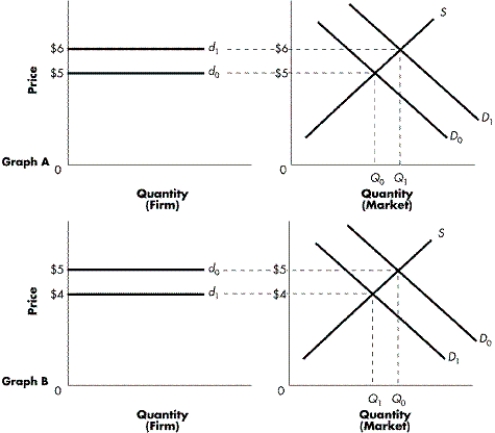 -Refer to Figure 8-1. Graphs A and B together demonstrate the effect that a change in market demand has on the demand curve. Which of the following describes the firm that faces this situation?
 (Multiple Choice)
4.9/5 (70)
(70) The long-run total cost schedule of a perfectly competitive firm that produces blueberries is as follows:
TABLE 8-2
-Refer to Table 8-2. What is a firm that expands from producing 5000 to 6000 kilograms of blueberries in the long run experiencing?
-Refer to Table 8-2. What is a firm that expands from producing 5000 to 6000 kilograms of blueberries in the long run experiencing? (Multiple Choice)
4.9/5 (79)
(79) In order to maximize profits, a firm should produce the level of output at which total revenue is maximized.
(True/False)
4.8/5 (82)
(82) The behaviour of an individual perfectly competitive firm has a perceptible influence on the market price.
(True/False)
4.8/5 (81)
(81) FIGURE 8-2
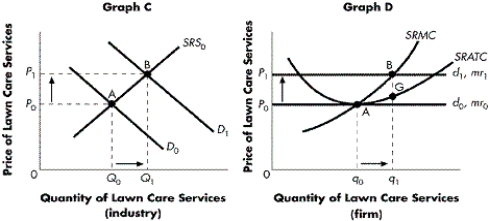 -Refer to Figure 8-2. As a result of the change illustrated by Graph C, what is the individual firm now experiencing in Graph D?
 (Multiple Choice)
4.7/5 (67)
(67) 
Filters
- Essay(0)
- Multiple Choice(0)
- Short Answer(0)
- True False(0)
- Matching(0)