



 Chat with AI
Exam 11: Pure Competition in the Long Run

Exam 1: Limits, Alternatives, and Choices107 Questions
Exam 2: The Market System and the Circular Flow287 Questions
Exam 3: Demand, Supply, and Market Equilibrium151 Questions
Exam 4: Market Failures Caused by Externalities Asymmetric Information229 Questions
Exam 5: Public Goods, Public Choice, and Government Failure268 Questions
Exam 6: Elasticity399 Questions
Exam 7: Utility Maximization358 Questions
Exam 8: Behavioral Economics311 Questions
Exam 9: Businesses and the Costs of Production445 Questions
Exam 10: Pure Competition in the Short Run342 Questions
Exam 11: Pure Competition in the Long Run250 Questions
Exam 12: Pure Monopoly407 Questions
Exam 13: Monopolistic Competition279 Questions
Exam 14: Oligopoly and Strategic Behavior362 Questions
Exam 15: Technology, RD, and Efficiency309 Questions
Exam 16: The Demand for Resources359 Questions
Exam 17: Wage Determination168 Questions
Exam 18: Rent, Interest, and Profit305 Questions
Exam 19: Natural Resource and Energy Economics337 Questions
Exam 20: Public Finance: Expenditures and Taxes336 Questions
Exam 21: Antitrust Policy and Regulation264 Questions
Exam 22: Agriculture: Economics and Policy265 Questions
Exam 23: Income Inequality, Poverty, and Discrimination324 Questions
Exam 24: Health Care280 Questions
Exam 25: Immigration259 Questions
Exam 26: International Trade347 Questions
Exam 27: The Balance of Payments, Exchange Rates, and Trade Deficits318 Questions
Exam 28: The Economics of Developing Countries277 Questions
Select questions type


If the price of product Y is $25 and its marginal cost is $18,
(Multiple Choice)
4.9/5  (76)
(76) Consumer surplus is the difference between the maximum price a consumer is willing to pay for a good and the market price of the product.
(True/False)
4.7/5 (83)
(83) The primary force encouraging the entry of new firms into a purely competitive industry is
(Multiple Choice)
4.8/5 (79)
(79) In purely competitive market, the entry and exit of firms will push price toward equality with marginal revenue.
(True/False)
4.8/5 (74)
(74) Allocative efficiency is achieved when the production of a good occurs where
(Multiple Choice)
4.8/5 (98)
(98) If a purely competitive constant-cost industry is realizing economic profits, we can expect industry supply to
(Multiple Choice)
4.9/5 (77)
(77) Describe the transition of the music listening industry in terms of creative destruction.
(Essay)
4.9/5 (59)
(59) An industry where a change in the number of firms does not affect the prices of the resources used in the industry will have a long-run supply curve that is
(Multiple Choice)
4.9/5 (90)
(90) 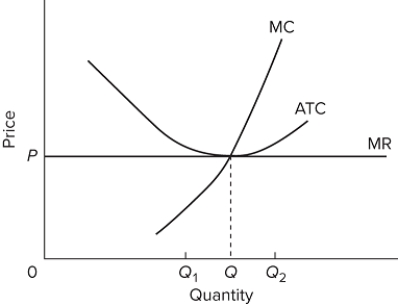 Refer to the diagram. At output level Q2,
Under what conditions would an increase in demand lead to a lower long-run equilibrium price?
(Multiple Choice)
4.8/5 (72)
(72) What is the basic conclusion that is to be drawn from the chapter? On what two facts is this conclusion based?
(Essay)
4.8/5 (80)
(80) If a purely competitive increasing-cost industry is realizing economic losses, we can expect industry supply to
(Multiple Choice)
4.9/5 (71)
(71) Assume that the market for soybeans is purely competitive. Currently, firms growing soybeans are earning positive economic profits. In the long run, we can expect
(Multiple Choice)
4.8/5 (91)
(91) If the price of bottled water is $2 and the marginal cost of producing it is $2.5,
(Multiple Choice)
4.9/5 (81)
(81) When a purely competitive firm is in long-run equilibrium, it is said to achieve allocative efficiency because
(Multiple Choice)
4.9/5 (74)
(74) 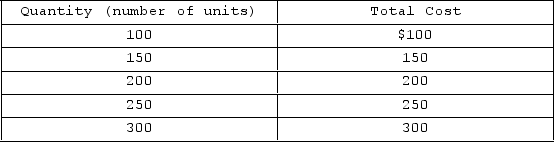 Suppose the table above represents the long-run cost structure for a firm in a perfectly competitive industry. Based on this information we can conclude that this firm operates in
 (Multiple Choice)
5.0/5 (89)
(89) 
Filters
- Essay(0)
- Multiple Choice(0)
- Short Answer(0)
- True False(0)
- Matching(0)