



 Chat with AI
Exam 28: The Economics of Developing Countries

Exam 1: Limits, Alternatives, and Choices107 Questions
Exam 2: The Market System and the Circular Flow287 Questions
Exam 3: Demand, Supply, and Market Equilibrium151 Questions
Exam 4: Market Failures Caused by Externalities Asymmetric Information229 Questions
Exam 5: Public Goods, Public Choice, and Government Failure268 Questions
Exam 6: Elasticity399 Questions
Exam 7: Utility Maximization358 Questions
Exam 8: Behavioral Economics311 Questions
Exam 9: Businesses and the Costs of Production445 Questions
Exam 10: Pure Competition in the Short Run342 Questions
Exam 11: Pure Competition in the Long Run250 Questions
Exam 12: Pure Monopoly407 Questions
Exam 13: Monopolistic Competition279 Questions
Exam 14: Oligopoly and Strategic Behavior362 Questions
Exam 15: Technology, RD, and Efficiency309 Questions
Exam 16: The Demand for Resources359 Questions
Exam 17: Wage Determination168 Questions
Exam 18: Rent, Interest, and Profit305 Questions
Exam 19: Natural Resource and Energy Economics337 Questions
Exam 20: Public Finance: Expenditures and Taxes336 Questions
Exam 21: Antitrust Policy and Regulation264 Questions
Exam 22: Agriculture: Economics and Policy265 Questions
Exam 23: Income Inequality, Poverty, and Discrimination324 Questions
Exam 24: Health Care280 Questions
Exam 25: Immigration259 Questions
Exam 26: International Trade347 Questions
Exam 27: The Balance of Payments, Exchange Rates, and Trade Deficits318 Questions
Exam 28: The Economics of Developing Countries277 Questions
Select questions type


Which of the following countries had the highest population growth rate in 2016-2017?
(Multiple Choice)
4.7/5  (78)
(78) All developing countries suffer from a critical shortage of
(Multiple Choice)
4.7/5 (75)
(75) Assume a DVC has a real per capita output of $1,000 as compared to $20,000 for an IAC. If both nations realize a 4 percent growth of their real per capita outputs, after one year the absolute real per capita output gap will
(Multiple Choice)
5.0/5 (81)
(81) 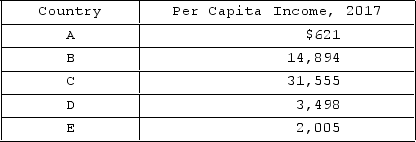 Refer to the table. Which of the following might reduce the per capita income gap between countries A and E?
 (Multiple Choice)
4.9/5 (68)
(68) At the present time, the largest percentage of the national incomes of the low-income DVCs is used for
(Multiple Choice)
4.8/5 (74)
(74) Development experts are less enthusiastic than they used to be about three decades ago about the positive role of DVC governments in promoting economic growth in their less-developed nations because of the
(Multiple Choice)
4.9/5 (67)
(67) Suppose that the average annual rate of population increase in Econland in recent years was about 2 percent. Based on this rate of growth, the population of Econland will double in about
(Multiple Choice)
4.7/5 (91)
(91) A recommended policy for developing countries to stimulate economic growth would be
(Multiple Choice)
4.9/5 (69)
(69) The World Bank has found that even households living in extreme poverty can provide for basic human needs like safe water and sturdy shelter.
(True/False)
4.8/5 (88)
(88) Reduction of tariff barriers against DVC imports would benefit both the DVCs and the IACs.
(True/False)
4.8/5 (91)
(91) Which of the following countries had the highest population density (population per square km)in 2017?
(Multiple Choice)
4.9/5 (75)
(75) A recommended policy for DVCs to implement that promotes economic growth is
(Multiple Choice)
4.9/5 (74)
(74) Which of the following countries had the highest per capita income (on a purchasing power parity basis)in 2017?
(Multiple Choice)
4.9/5 (76)
(76) At the beginning of the year, one developing country (DVC)has a real income per capita of $800. In a developed country (IAC), the real income per capita is $30,000. Both countries experience a 4 percent growth rate for the year. At the end of the year, the absolute income gap between these two countries will have increased from $29,200 to
(Multiple Choice)
4.9/5 (86)
(86) A major criticism of foreign aid to developing nations is that it
(Multiple Choice)
4.8/5 (78)
(78) Assume the total real income of a developing country increases from $8.5 billion to $8.5 billion, while its population expands from 14 to 15 million people from one year to the next. Over the year, per capita income has
(Multiple Choice)
4.8/5 (80)
(80) Which of the following is generally not an effective strategy to promote DVC growth?
(Multiple Choice)
4.9/5 (102)
(102) 
Filters
- Essay(0)
- Multiple Choice(0)
- Short Answer(0)
- True False(0)
- Matching(0)