



 Chat with AI
Exam 28: The Economics of Developing Countries

Exam 1: Limits, Alternatives, and Choices107 Questions
Exam 2: The Market System and the Circular Flow287 Questions
Exam 3: Demand, Supply, and Market Equilibrium151 Questions
Exam 4: Market Failures Caused by Externalities Asymmetric Information229 Questions
Exam 5: Public Goods, Public Choice, and Government Failure268 Questions
Exam 6: Elasticity399 Questions
Exam 7: Utility Maximization358 Questions
Exam 8: Behavioral Economics311 Questions
Exam 9: Businesses and the Costs of Production445 Questions
Exam 10: Pure Competition in the Short Run342 Questions
Exam 11: Pure Competition in the Long Run250 Questions
Exam 12: Pure Monopoly407 Questions
Exam 13: Monopolistic Competition279 Questions
Exam 14: Oligopoly and Strategic Behavior362 Questions
Exam 15: Technology, RD, and Efficiency309 Questions
Exam 16: The Demand for Resources359 Questions
Exam 17: Wage Determination168 Questions
Exam 18: Rent, Interest, and Profit305 Questions
Exam 19: Natural Resource and Energy Economics337 Questions
Exam 20: Public Finance: Expenditures and Taxes336 Questions
Exam 21: Antitrust Policy and Regulation264 Questions
Exam 22: Agriculture: Economics and Policy265 Questions
Exam 23: Income Inequality, Poverty, and Discrimination324 Questions
Exam 24: Health Care280 Questions
Exam 25: Immigration259 Questions
Exam 26: International Trade347 Questions
Exam 27: The Balance of Payments, Exchange Rates, and Trade Deficits318 Questions
Exam 28: The Economics of Developing Countries277 Questions
Select questions type


Early experiments with unconditional cash transfers have revealed that
(Multiple Choice)
4.8/5  (86)
(86) 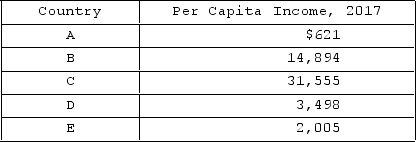 Refer to the table. If per capita income increases by 10 percent over five years in each of the nations shown, the per capita income gap between country C and country A
 (Multiple Choice)
4.9/5 (66)
(66) In contrast to international development efforts in most of the 20th century, more recent projects like microfinance, microcredit, and cash transfers in the last few decades represent a major shift. That is because these recent projects are
(Multiple Choice)
4.9/5 (85)
(85) Economists would most likely suggest that advanced nations can best assist in the economic development of developing nations by
(Multiple Choice)
4.9/5 (77)
(77) Which of the following is typically not a problem for low-income DVCs?
(Multiple Choice)
4.8/5 (81)
(81) In recent years, a greater proportion of private capital flows to DVCs has been direct foreign investment rather than loans to DVC governments.
(True/False)
4.9/5 (71)
(71) Economic growth may hinge on whether individuals and institutions within a nation want growth badly enough to change their traditional ways of doing things. This statement refers to
(Multiple Choice)
4.8/5 (83)
(83) The World Bank is the organization to which DVCs turn as a "last-resort" lending agency for projects that private institutions will not fund.
(True/False)
4.9/5 (81)
(81) Which attitude or custom is the most conducive to long-term economic growth?
(Multiple Choice)
4.8/5 (81)
(81) More than 75 percent of the world's income is earned by what percentage of the world's population?
(Multiple Choice)
4.9/5 (92)
(92) The richest 20 percent of the world's population receives more than 75 percent of the world's income, while the poorest 20 percent receives less than 2 percent of the world's income.
(True/False)
4.9/5 (61)
(61) Without an abundant endowment of natural resources, a nation cannot achieve rapid economic growth.
(True/False)
5.0/5 (76)
(76) The international organization, with 189 member nations, whose major objective is to help DVCs achieve economic growth is the
(Multiple Choice)
4.7/5 (79)
(79) Over the next 15 years, ___ out of every 10 people added to the world's population will be born in developing countries.
(Multiple Choice)
4.8/5 (79)
(79) 
Filters
- Essay(0)
- Multiple Choice(0)
- Short Answer(0)
- True False(0)
- Matching(0)