



 Chat with AI
Exam 28: The Economics of Developing Countries

Exam 1: Limits, Alternatives, and Choices107 Questions
Exam 2: The Market System and the Circular Flow287 Questions
Exam 3: Demand, Supply, and Market Equilibrium151 Questions
Exam 4: Market Failures Caused by Externalities Asymmetric Information229 Questions
Exam 5: Public Goods, Public Choice, and Government Failure268 Questions
Exam 6: Elasticity399 Questions
Exam 7: Utility Maximization358 Questions
Exam 8: Behavioral Economics311 Questions
Exam 9: Businesses and the Costs of Production445 Questions
Exam 10: Pure Competition in the Short Run342 Questions
Exam 11: Pure Competition in the Long Run250 Questions
Exam 12: Pure Monopoly407 Questions
Exam 13: Monopolistic Competition279 Questions
Exam 14: Oligopoly and Strategic Behavior362 Questions
Exam 15: Technology, RD, and Efficiency309 Questions
Exam 16: The Demand for Resources359 Questions
Exam 17: Wage Determination168 Questions
Exam 18: Rent, Interest, and Profit305 Questions
Exam 19: Natural Resource and Energy Economics337 Questions
Exam 20: Public Finance: Expenditures and Taxes336 Questions
Exam 21: Antitrust Policy and Regulation264 Questions
Exam 22: Agriculture: Economics and Policy265 Questions
Exam 23: Income Inequality, Poverty, and Discrimination324 Questions
Exam 24: Health Care280 Questions
Exam 25: Immigration259 Questions
Exam 26: International Trade347 Questions
Exam 27: The Balance of Payments, Exchange Rates, and Trade Deficits318 Questions
Exam 28: The Economics of Developing Countries277 Questions
Select questions type


When technological advances are of the capital-using kind, it is possible for an economy to increase its productivity without any net investment in capital goods.
(True/False)
4.9/5  (78)
(78) Large agricultural subsidies for food and fiber in IACs hurt the economies of the DVCs by
(Multiple Choice)
4.7/5 (83)
(83) If the real outputs per capita of a rich nation and a poor nation grow at the same percentage rate, the absolute income gap between the two nations will shrink.
(True/False)
4.7/5 (87)
(87) Assume a DVC has a real per capita output of $1,000 as compared to $20,000 for an IAC. If both nations realize a 2 percent growth of their real per capita outputs, after one year the absolute real per capita output gap will
(Multiple Choice)
4.8/5 (87)
(87) The lack of an entrepreneurial class in developing nations tends to
(Multiple Choice)
4.7/5 (86)
(86) Saving is a larger percentage of domestic output in DVCs than in IACs, but the saving is put to poor use.
(True/False)
4.9/5 (79)
(79) Industrially advanced countries can help developing countries by
(Multiple Choice)
4.9/5 (88)
(88) If the real output of a DVC increases from $200 billion to $260 billion and its population increases from 100 to 120 million, its real per capita output will have
(Multiple Choice)
4.9/5 (78)
(78) In 2017, the IACs (industrially advanced countries)had an average per capita income that was about 50 times as high as that of the low-income nations.
(True/False)
4.7/5 (84)
(84) Birth- and population-control efforts in many DVCs (developing countries)face the following obstacles except
(Multiple Choice)
4.8/5 (73)
(73) Which of the following is considered to be a severe obstacle to economic growth for DVCs?
(Multiple Choice)
4.9/5 (83)
(83) 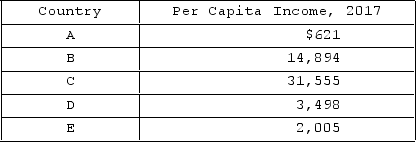 Which of the given nations would be low-income developing countries (DVCs), according to the World Bank?
 (Multiple Choice)
4.7/5 (83)
(83) The capricious universe view is the idea that the IACs are exploiting the DVCs.
(True/False)
4.9/5 (78)
(78) An institutional change that is needed in most developing nations is
(Multiple Choice)
4.8/5 (71)
(71) Increases in the total real output of many DVCs do not increase the nation's standard of living because
(Multiple Choice)
4.8/5 (76)
(76) Assume that the real output of a developing nation increases from $50 billion to $62 billion, while its population expands from 100 to 115 million. As a result, real income per capita has increased by about
(Multiple Choice)
4.8/5 (91)
(91) State industries are notoriously poor "incubators" for the development of profit-focused, entrepreneurial persons who may leave the firm to set up their own businesses. This statement is an argument in favor of
(Multiple Choice)
4.8/5 (72)
(72) 
Filters
- Essay(0)
- Multiple Choice(0)
- Short Answer(0)
- True False(0)
- Matching(0)