



 Chat with AI
Exam 28: The Economics of Developing Countries

Exam 1: Limits, Alternatives, and Choices107 Questions
Exam 2: The Market System and the Circular Flow287 Questions
Exam 3: Demand, Supply, and Market Equilibrium151 Questions
Exam 4: Market Failures Caused by Externalities Asymmetric Information229 Questions
Exam 5: Public Goods, Public Choice, and Government Failure268 Questions
Exam 6: Elasticity399 Questions
Exam 7: Utility Maximization358 Questions
Exam 8: Behavioral Economics311 Questions
Exam 9: Businesses and the Costs of Production445 Questions
Exam 10: Pure Competition in the Short Run342 Questions
Exam 11: Pure Competition in the Long Run250 Questions
Exam 12: Pure Monopoly407 Questions
Exam 13: Monopolistic Competition279 Questions
Exam 14: Oligopoly and Strategic Behavior362 Questions
Exam 15: Technology, RD, and Efficiency309 Questions
Exam 16: The Demand for Resources359 Questions
Exam 17: Wage Determination168 Questions
Exam 18: Rent, Interest, and Profit305 Questions
Exam 19: Natural Resource and Energy Economics337 Questions
Exam 20: Public Finance: Expenditures and Taxes336 Questions
Exam 21: Antitrust Policy and Regulation264 Questions
Exam 22: Agriculture: Economics and Policy265 Questions
Exam 23: Income Inequality, Poverty, and Discrimination324 Questions
Exam 24: Health Care280 Questions
Exam 25: Immigration259 Questions
Exam 26: International Trade347 Questions
Exam 27: The Balance of Payments, Exchange Rates, and Trade Deficits318 Questions
Exam 28: The Economics of Developing Countries277 Questions
Select questions type


If a technological advance expands output and requires a smaller investment in capital goods, this technological advance
(Multiple Choice)
4.8/5  (95)
(95) The demographic transition view of population growth believes that slower population growth will lead to rising incomes.
(True/False)
4.8/5 (72)
(72) Trade barriers that restrict imports from developing countries tend to be
(Multiple Choice)
4.8/5 (74)
(74) Which two of the following countries had the best score in the Corruption Perceptions Index in 2015?
(Multiple Choice)
4.8/5 (82)
(82) Which of the following describes the vicious circle of poverty?
(Multiple Choice)
4.7/5 (86)
(86) The vicious circle of poverty in the poorest DVCs can also be expressed as,
(Multiple Choice)
4.9/5 (79)
(79) 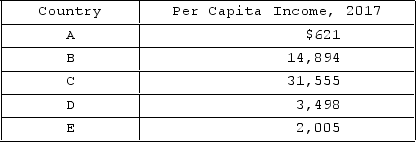 Which of the given nations would be high-income countries (IACs), according to the World Bank?
 (Multiple Choice)
4.9/5 (70)
(70) The industrially advanced countries (IACs)had an average per capita income in 2017 of around
(Multiple Choice)
4.9/5 (81)
(81) Which of the following DVC policies is not likely to increase DVC economic growth?
(Multiple Choice)
4.8/5 (84)
(84) Land reform (or the reform of land ownership)is a relatively minor institutional obstacle to economic growth in many developing countries.
(True/False)
4.8/5 (89)
(89) The demographic transition view of population growth argues that, on average (and as perceived by parents), the opportunity
(Multiple Choice)
4.9/5 (79)
(79) The industrially advanced nations can assist developing nations by reducing trade barriers and by providing both private and public capital.
(True/False)
4.8/5 (84)
(84) Many economists believe that the key to breaking the vicious circle of poverty is to
(Multiple Choice)
4.8/5 (82)
(82) For DVC per capita incomes to rise, birth rates must first be reduced. This statement describes the
(Multiple Choice)
4.9/5 (93)
(93) Describe the main characteristics of direct foreign aid from IACs to DVCs.
(Essay)
4.9/5 (87)
(87) Studies generally show that if there is more investment in capital goods in DVCs, there will be greater
(Multiple Choice)
4.7/5 (76)
(76) Providing poor families with grants if they send their children to school and get proper medical care is known as
(Multiple Choice)
4.8/5 (72)
(72) 
Filters
- Essay(0)
- Multiple Choice(0)
- Short Answer(0)
- True False(0)
- Matching(0)