



 Chat with AI
Exam 5: Public Goods, Public Choice, and Government Failure

Exam 1: Limits, Alternatives, and Choices107 Questions
Exam 2: The Market System and the Circular Flow287 Questions
Exam 3: Demand, Supply, and Market Equilibrium151 Questions
Exam 4: Market Failures Caused by Externalities Asymmetric Information229 Questions
Exam 5: Public Goods, Public Choice, and Government Failure268 Questions
Exam 6: Elasticity399 Questions
Exam 7: Utility Maximization358 Questions
Exam 8: Behavioral Economics311 Questions
Exam 9: Businesses and the Costs of Production445 Questions
Exam 10: Pure Competition in the Short Run342 Questions
Exam 11: Pure Competition in the Long Run250 Questions
Exam 12: Pure Monopoly407 Questions
Exam 13: Monopolistic Competition279 Questions
Exam 14: Oligopoly and Strategic Behavior362 Questions
Exam 15: Technology, RD, and Efficiency309 Questions
Exam 16: The Demand for Resources359 Questions
Exam 17: Wage Determination168 Questions
Exam 18: Rent, Interest, and Profit305 Questions
Exam 19: Natural Resource and Energy Economics337 Questions
Exam 20: Public Finance: Expenditures and Taxes336 Questions
Exam 21: Antitrust Policy and Regulation264 Questions
Exam 22: Agriculture: Economics and Policy265 Questions
Exam 23: Income Inequality, Poverty, and Discrimination324 Questions
Exam 24: Health Care280 Questions
Exam 25: Immigration259 Questions
Exam 26: International Trade347 Questions
Exam 27: The Balance of Payments, Exchange Rates, and Trade Deficits318 Questions
Exam 28: The Economics of Developing Countries277 Questions
Select questions type


If a public good provides social benefits that are greater than its costs, then the majority of voters would always vote in favor of producing the good.
(True/False)
4.9/5  (93)
(93) Suppose that Mick and Cher are the only two members of society and are willing to pay $10 and $12, respectively, for the fifth unit of a public good. Also, assume that the marginal cost of the fifth unit is $23. We can conclude that
(Multiple Choice)
4.8/5 (89)
(89) Regulatory capture in government happens because the people who are most qualified to supervise and regulate an industry oftentimes are or have been the leaders of the industry.
(True/False)
4.8/5 (75)
(75) Suppose that Katie and Kelly each expect to receive $500 worth of marginal benefits from a proposed new recreation center, whereas Kerry expects to receive only $100 worth. If the proposed tax levied on each for the center would be $600, a majority vote will
(Multiple Choice)
4.8/5 (77)
(77) Even if individual voters have clear preferences, and they stay consistent in their preferences, we could still end up with the paradox of voting.
(True/False)
4.7/5 (83)
(83) The Road Runner Club contributes money to Senator Sly's reelection campaign fund, and Senator Sly helps pass legislation to add more jogging paths across the state. From this we can definitively conclude
(Multiple Choice)
4.9/5 (83)
(83) A situation in which society may not be able to rank its preferences consistently through paired-choice majority voting refers to
(Multiple Choice)
4.8/5 (68)
(68)  Refer to the table. In a choice between parks and education,
 (Multiple Choice)
4.8/5 (82)
(82) Given economic research on previous subsidies, should states and local governments subsidize corporate relocations?
(Multiple Choice)
4.8/5 (67)
(67) Which of the following is considered a potential solution to some regulatory capture?
(Multiple Choice)
4.8/5 (94)
(94) Suppose a college economics department decides to use a single economics text for all sections of principles of economics. Also assume that the three individual members of the textbook selection committee have the following preferences.  Assuming all other textbook qualities except analytical level are the same, majority voting will result in the committee
 (Multiple Choice)
4.8/5 (79)
(79) Which of the following statements concerning a public good is false?
(Multiple Choice)
4.9/5 (84)
(84) The study of public choice theory involves the economic analysis of the following, except
(Multiple Choice)
4.8/5 (94)
(94) In which of the following cases has political corruption definitely occurred?
(Multiple Choice)
4.9/5 (71)
(71) Answer the question based on the following information for a public good. Pₐ and Pᵦ are the prices that individuals A and B are willing to pay for the last unit of a public good, rather than do without it. These people are the only two members of society. 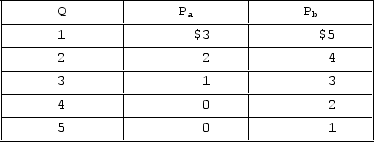 The collective willingness of this society to pay for the second unit of this public good is
 (Multiple Choice)
4.8/5 (85)
(85) An economic analysis of the relationship between proposed legislation affecting major employers in each state and the voting patterns of senators and representatives in Congress on that legislation would fit within the subcategory of economics called
(Multiple Choice)
4.8/5 (72)
(72) 
Filters
- Essay(0)
- Multiple Choice(0)
- Short Answer(0)
- True False(0)
- Matching(0)