



 Chat with AI
Exam 5: Public Goods, Public Choice, and Government Failure

Exam 1: Limits, Alternatives, and Choices107 Questions
Exam 2: The Market System and the Circular Flow287 Questions
Exam 3: Demand, Supply, and Market Equilibrium151 Questions
Exam 4: Market Failures Caused by Externalities Asymmetric Information229 Questions
Exam 5: Public Goods, Public Choice, and Government Failure268 Questions
Exam 6: Elasticity399 Questions
Exam 7: Utility Maximization358 Questions
Exam 8: Behavioral Economics311 Questions
Exam 9: Businesses and the Costs of Production445 Questions
Exam 10: Pure Competition in the Short Run342 Questions
Exam 11: Pure Competition in the Long Run250 Questions
Exam 12: Pure Monopoly407 Questions
Exam 13: Monopolistic Competition279 Questions
Exam 14: Oligopoly and Strategic Behavior362 Questions
Exam 15: Technology, RD, and Efficiency309 Questions
Exam 16: The Demand for Resources359 Questions
Exam 17: Wage Determination168 Questions
Exam 18: Rent, Interest, and Profit305 Questions
Exam 19: Natural Resource and Energy Economics337 Questions
Exam 20: Public Finance: Expenditures and Taxes336 Questions
Exam 21: Antitrust Policy and Regulation264 Questions
Exam 22: Agriculture: Economics and Policy265 Questions
Exam 23: Income Inequality, Poverty, and Discrimination324 Questions
Exam 24: Health Care280 Questions
Exam 25: Immigration259 Questions
Exam 26: International Trade347 Questions
Exam 27: The Balance of Payments, Exchange Rates, and Trade Deficits318 Questions
Exam 28: The Economics of Developing Countries277 Questions
Select questions type


Majority voting produces efficient outcomes because it takes into account the strength of the preferences of individual voters.
(True/False)
4.9/5  (79)
(79) Answer this question based on the following information for a public good. Pₐ and Pᵦ represent the prices that citizens (a)and (b), the only two people in this nation, are willing to pay for additional units of a quantity (Qc )of the public good. Qₛrepresents the quantity of the public good supplied by government at each of the collective prices. 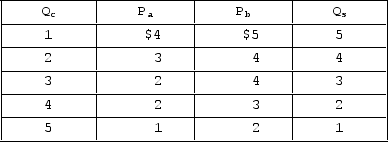 The collective willingness of this nation to pay for the fourth unit of the public good is
 (Multiple Choice)
4.9/5 (80)
(80) Assume that Matt, Joe, and Teresa are the only citizens in a community. A proposed public good has a total cost of $1,000. All three citizens will share an equal portion of this cost in taxes. The benefit of the public good is $500 for Matt, $280 for Joe, and $260 for Teresa. In a majority vote, this proposal will most likely be
(Multiple Choice)
4.8/5 (71)
(71) According to some economists, the private sector is more efficient than the public sector mainly because
(Multiple Choice)
4.9/5 (70)
(70) Majority voting assures that government will provide a public good if it yields total benefits in excess of total costs.
(True/False)
4.9/5 (72)
(72) Among the following examples, the one that best illustrates a public good is the
(Multiple Choice)
4.8/5 (87)
(87) One consequence of the paradox of voting is that whoever sets the agenda of a vote could practically predetermine the results of the vote.
(True/False)
4.8/5 (87)
(87) Rivalry means that when one person buys and consumes a product, it is not available for purchase and consumption by another person.
(True/False)
4.9/5 (76)
(76) As it relates to corporations, the principal-agent problem is that
(Multiple Choice)
4.7/5 (62)
(62) Based on our study of market failure and government failure, the main conclusion that one should arrive at is that
(Multiple Choice)
4.8/5 (75)
(75)  Refer to the table. In a choice between the highway and the lighthouse,
 (Multiple Choice)
4.8/5 (71)
(71) Why are the public sector and private sector "imperfect institutions"?
(Essay)
4.9/5 (77)
(77) Excludability means that when someone is consuming a good, then others are excluded from using the good anymore.
(True/False)
4.9/5 (88)
(88) When voters have different opinions about an issue, the position that is most likely to be adopted is that of the
(Multiple Choice)
4.8/5 (69)
(69) Why are mohair subsidies still being paid although their initial purpose has long expired?
(Essay)
4.9/5 (82)
(82) As it relates to the political process, the principal-agent problem results from the
(Multiple Choice)
4.8/5 (66)
(66) 
Filters
- Essay(0)
- Multiple Choice(0)
- Short Answer(0)
- True False(0)
- Matching(0)