



 Chat with AI
Exam 5: Public Goods, Public Choice, and Government Failure

Exam 1: Limits, Alternatives, and Choices107 Questions
Exam 2: The Market System and the Circular Flow287 Questions
Exam 3: Demand, Supply, and Market Equilibrium151 Questions
Exam 4: Market Failures Caused by Externalities Asymmetric Information229 Questions
Exam 5: Public Goods, Public Choice, and Government Failure268 Questions
Exam 6: Elasticity399 Questions
Exam 7: Utility Maximization358 Questions
Exam 8: Behavioral Economics311 Questions
Exam 9: Businesses and the Costs of Production445 Questions
Exam 10: Pure Competition in the Short Run342 Questions
Exam 11: Pure Competition in the Long Run250 Questions
Exam 12: Pure Monopoly407 Questions
Exam 13: Monopolistic Competition279 Questions
Exam 14: Oligopoly and Strategic Behavior362 Questions
Exam 15: Technology, RD, and Efficiency309 Questions
Exam 16: The Demand for Resources359 Questions
Exam 17: Wage Determination168 Questions
Exam 18: Rent, Interest, and Profit305 Questions
Exam 19: Natural Resource and Energy Economics337 Questions
Exam 20: Public Finance: Expenditures and Taxes336 Questions
Exam 21: Antitrust Policy and Regulation264 Questions
Exam 22: Agriculture: Economics and Policy265 Questions
Exam 23: Income Inequality, Poverty, and Discrimination324 Questions
Exam 24: Health Care280 Questions
Exam 25: Immigration259 Questions
Exam 26: International Trade347 Questions
Exam 27: The Balance of Payments, Exchange Rates, and Trade Deficits318 Questions
Exam 28: The Economics of Developing Countries277 Questions
Select questions type


Assume that Matt, Joe, and Teresa are the only citizens in a community. A proposed public good has a total cost of $1,000. All three citizens will share an equal portion of this cost in taxes. The benefit of the public good is $380 for Matt, $360 for Joe, and $200 for Teresa. In a majority vote, this proposal will most likely be
(Multiple Choice)
5.0/5  (71)
(71) 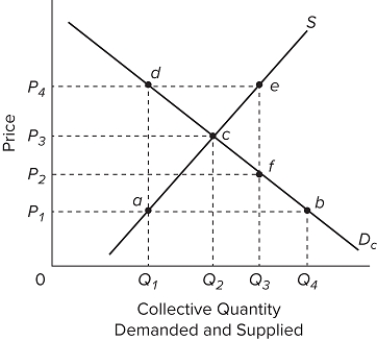 Refer to the provided supply and demand graph for a public good. If Q1 units of the public good are produced, then
 (Multiple Choice)
4.7/5 (78)
(78) Assume that Abby, Ben, Clara, Joe, and Matt are the only citizens in a community. A proposed public good has a total cost of $800. All five citizens will share an equal portion of this cost in taxes. The benefit of the public good is $220 to Abby, $210 to Ben, $210 to Clara, $180 to Joe, and $120 to Matt. In a majority vote, this proposal will most likely be
(Multiple Choice)
4.7/5 (87)
(87) Regulatory capture occurs when government exerts excessive control over an industry.
(True/False)
5.0/5 (72)
(72) "Pork-barrel" legislation that contains funding for hundreds of earmarks throughout numerous states often reflects
(Multiple Choice)
4.9/5 (71)
(71) The paradox of voting is that under majority voting rules, the median voter decides the election outcome.
(True/False)
4.9/5 (77)
(77) Answer the question on the basis of the following table that shows the total costs and total benefits facing a city of five different potential baseball stadiums of increasing size. All figures are in millions of dollars. 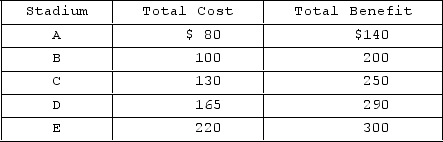 Applying the median-voter model and assuming that there are equal numbers of voters supporting each stadium, we would expect
 (Multiple Choice)
4.8/5 (72)
(72) Some people argue that the three main television networks all have similar programming. If true, this observation might best be explained by the
(Multiple Choice)
4.7/5 (88)
(88) The "principal-agent problem" often arises in public choice when politicians pursue the best interests of their constituents.
(True/False)
4.8/5 (78)
(78) The following data are for a series of increasingly extensive flood-control projects. 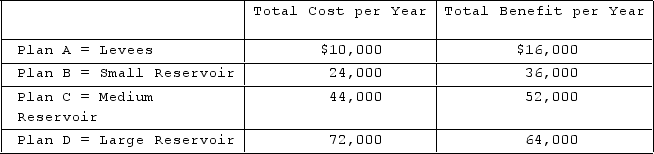 For Plan D marginal costs and marginal benefits are
 (Multiple Choice)
4.9/5 (75)
(75) The trading of votes to secure favorable outcomes on decisions that would otherwise be defeated is called
(Multiple Choice)
4.7/5 (73)
(73) In a sporting goods store, you can buy the equipment you want and forgo the rest. But in an election you "buy" the entire range of the candidate's positions, including some you may not agree with. This difference
(Multiple Choice)
4.8/5 (75)
(75) Inefficiencies associated with majority voting may get resolved through
(Multiple Choice)
4.7/5 (95)
(95) Suppose lawyers seek legislation to limit the use of computer software that enables people to use their personal computers to self-prepare their own wills, trusts, and other legal documents. This is an example of
(Multiple Choice)
4.7/5 (90)
(90) Narrow, specifically designated expenditures that are included in more comprehensive legislation are known as
(Multiple Choice)
4.8/5 (94)
(94) In thinking about the "principal-agent problem" in a democratic government, we assign the role of "principal" to the government.
(True/False)
4.9/5 (90)
(90) Proponents of deregulation point to all of the following industries as examples of successful deregulation except for
(Multiple Choice)
4.7/5 (74)
(74) 
Filters
- Essay(0)
- Multiple Choice(0)
- Short Answer(0)
- True False(0)
- Matching(0)