



 Chat with AI
Exam 5: Public Goods, Public Choice, and Government Failure

Exam 1: Limits, Alternatives, and Choices107 Questions
Exam 2: The Market System and the Circular Flow287 Questions
Exam 3: Demand, Supply, and Market Equilibrium151 Questions
Exam 4: Market Failures Caused by Externalities Asymmetric Information229 Questions
Exam 5: Public Goods, Public Choice, and Government Failure268 Questions
Exam 6: Elasticity399 Questions
Exam 7: Utility Maximization358 Questions
Exam 8: Behavioral Economics311 Questions
Exam 9: Businesses and the Costs of Production445 Questions
Exam 10: Pure Competition in the Short Run342 Questions
Exam 11: Pure Competition in the Long Run250 Questions
Exam 12: Pure Monopoly407 Questions
Exam 13: Monopolistic Competition279 Questions
Exam 14: Oligopoly and Strategic Behavior362 Questions
Exam 15: Technology, RD, and Efficiency309 Questions
Exam 16: The Demand for Resources359 Questions
Exam 17: Wage Determination168 Questions
Exam 18: Rent, Interest, and Profit305 Questions
Exam 19: Natural Resource and Energy Economics337 Questions
Exam 20: Public Finance: Expenditures and Taxes336 Questions
Exam 21: Antitrust Policy and Regulation264 Questions
Exam 22: Agriculture: Economics and Policy265 Questions
Exam 23: Income Inequality, Poverty, and Discrimination324 Questions
Exam 24: Health Care280 Questions
Exam 25: Immigration259 Questions
Exam 26: International Trade347 Questions
Exam 27: The Balance of Payments, Exchange Rates, and Trade Deficits318 Questions
Exam 28: The Economics of Developing Countries277 Questions
Select questions type


In the median-voter model, half the voters have stronger or more positive preferences than the median voter, while half of the voters have weaker or more negative preferences.
(True/False)
4.9/5  (79)
(79) It is observed that the person representing the middle position on an issue will most likely determine the outcome of an election. This view is most closely associated with the
(Multiple Choice)
4.8/5 (86)
(86)  The information contained in the table illustrates
Street entertainers face the free-rider problem when they perform because of the
(Multiple Choice)
5.0/5 (79)
(79) In the median-voter model, the median voter refers to the voter who makes her choice at the midpoint of the voting period.
(True/False)
4.8/5 (89)
(89) What is meant by the term government failure as described in this chapter?
(Essay)
4.8/5 (83)
(83) Political logrolling, or vote trading, can turn a potentially inefficient voting outcome into an efficient one.
(True/False)
4.7/5 (83)
(83) Economists (particularly public choice theorists)point out that the political process
(Multiple Choice)
4.8/5 (63)
(63) Special-interest groups result from people with strong preferences on a particular issue banding together to let policymakers know their preferences and could thereby lead to efficient outcomes.
(True/False)
4.8/5 (93)
(93) Assume there is no way to prevent someone from using an interstate highway, regardless of whether or not he or she helps pay for it. This characteristic is called
(Multiple Choice)
5.0/5 (79)
(79) New Normal University has found it necessary to institute a crime-control program on its campus to deal with the high costs of theft and vandalism. The university is now considering several alternative levels of crime control. This table shows the expected total annual costs and benefits of these alternatives. 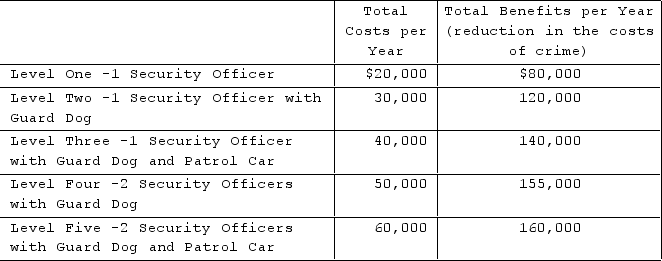 Based on cost-benefit analysis, New Normal University should undertake Level
 (Multiple Choice)
4.7/5 (66)
(66) Assume that Abby, Ben, and Clara are the only citizens in a community. A proposed public good has a total cost of $1,000. All three citizens will share an equal portion of this cost in taxes. The benefit of the public good is $400 each to Abby, Ben, and Clara. In a majority vote, this proposal will most likely be
(Multiple Choice)
4.8/5 (82)
(82) The situation where "the few who yell the loudest get heard" is referred to as the
(Multiple Choice)
4.9/5 (72)
(72) Economists call the pursuit of extra profit or income by influencing government policies,
(Multiple Choice)
4.8/5 (78)
(78) The following data are for a series of increasingly extensive flood-control projects. 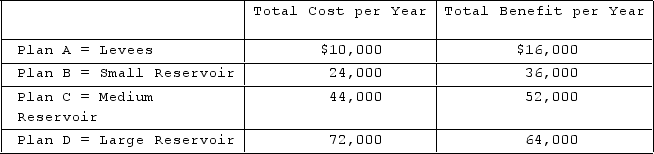 On the basis of cost-benefit analysis, government should undertake
 (Multiple Choice)
4.9/5 (70)
(70) Answer the question based on the following information for a public good. Pₐ and Pᵦ are the prices that individuals A and B are willing to pay for the last unit of a public good, rather than do without it. These people are the only two members of society.  If this good were a private good instead of a public one, the total quantity demanded at a $3 market price would be
 (Multiple Choice)
4.9/5 (75)
(75) The free-rider problem makes a good highly profitable for a private firm to provide.
(True/False)
4.7/5 (94)
(94) 
Filters
- Essay(0)
- Multiple Choice(0)
- Short Answer(0)
- True False(0)
- Matching(0)