



 Chat with AI
Exam 9: Aggregate Expenditures

Exam 1: Economics: the World Around You90 Questions
Exam 2: Choice, Opportunity Costs, and Specialization98 Questions
Exam 3: Markets, Demand and Supply, and the Price System99 Questions
Exam 4: The Market System and the Private and Public Sector100 Questions
Exam 5: National Income Accounting104 Questions
Exam 6: An Introduction to the Foreign Exchange Market and the Balance of Payments90 Questions
Exam 7: Unemployment and Inflation130 Questions
Exam 8: Macroeconomic Equilibrium: Aggregate Demand and Supply123 Questions
Exam 9: Aggregate Expenditures120 Questions
Exam 10: Income and Expenditures Equilibrium135 Questions
Exam 11: Fiscal Policy94 Questions
Exam 12: Money and Banking125 Questions
Exam 13: Monetary Policy138 Questions
Exam 14: Macroeconomic Policy: Tradeoffs, Expectations, Credibility, and Sources of Business Cycles117 Questions
Exam 15: Macroeconomic Viewpoints: New Keynesian, Monetarist, and New Classical103 Questions
Exam 16: Economic Growth99 Questions
Exam 17: Development Economics105 Questions
Exam 18: Globalization85 Questions
Exam 19: World Trade Equilibrium112 Questions
Exam 20: International Trade Restrictions109 Questions
Exam 21: Exchange Rates and Financial Links Between Countries132 Questions
Select questions type


Which of the following is least likely to contribute to the volatility of investment spending?
(Multiple Choice)
4.9/5  (71)
(71) Which of the following will cause the investment function to shift upward?
(Multiple Choice)
4.9/5 (73)
(73) The figure given below represents the saving function of an economy.
Figure 9.1
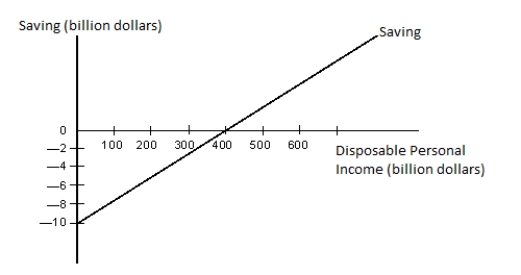 -Refer to Figure 9.1. An increase in autonomous consumption would be illustrated by:
 (Multiple Choice)
4.8/5 (84)
(84) _____ is the primary determinant of consumption and is usually measured in terms of current disposable income.
(Multiple Choice)
5.0/5 (82)
(82) Which of the following variables do not change autonomous consumption?
(Multiple Choice)
4.7/5 (85)
(85) The figure given below represents the consumption function of a country.
Figure 9.3
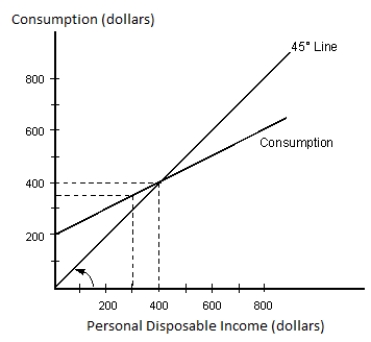 -According to Figure 9.3, autonomous consumption equals:
 (Multiple Choice)
5.0/5 (86)
(86) At the point where consumption equals disposable income, the average propensity to consume equals 1.
(True/False)
4.8/5 (77)
(77) Other things equal, when Europeans want to buy more grain from the United States:
(Multiple Choice)
4.9/5 (78)
(78) In the country of Marzipana, total consumption in Year 1 was $56,000 million and in Year 2 was 60,000 million. It has been observed that each time disposable income changes in this country by $100, consumption changes by $70. Using this information compute the change in disposable income from Year 1 to Year 2.
(Multiple Choice)
4.9/5 (70)
(70) Dissaving occurs when the consumption function lies below the 45-degree line.
(True/False)
4.8/5 (71)
(71) The figure given below shows the consumption function of a household.
Figure 9.2
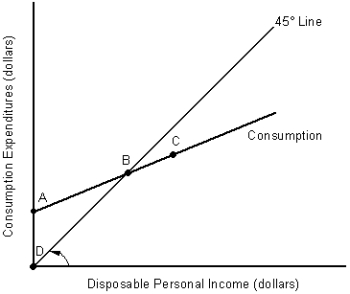 -In Figure 9.2, the line segment AD represents:
 (Multiple Choice)
4.8/5 (70)
(70) Once macroeconomic equilibrium has been established in an economy, there is no tendency for real GDP to change, even if there is a change in autonomous expenditure.
(True/False)
4.9/5 (86)
(86) The table given below reports the consumption expenditure of a nation at different levels of disposable income.
Table 9.1
Disposable Income Consumption (C) \ 0 \ 4,500 \ 10,000 \ 12,000 \ 15,000 \ 15,750 \ 25,000 \ 23,250 \ 30,000 \ 27,000 \ 35,000 \ 30,750 \ 40,000 \ 34,500 \ 50,000 \ 42,000
-Refer to Table 9.1. At an income level of $10,000, the APS equals -0.20. Therefore, the APC has to equal:
(Multiple Choice)
4.8/5 (91)
(91) As disposable income increases, consumption spending will rise, but it will rise by less than disposable income if the MPS is positive.
(True/False)
4.7/5 (84)
(84) The figure given below represents the consumption function of a country.
Figure 9.3
-Refer to Figure 9.3. We can infer that the marginal propensity to save would be _____.
-Refer to Figure 9.3. We can infer that the marginal propensity to save would be _____. (Multiple Choice)
4.8/5 (76)
(76) The figure given below shows the consumption function of a household.
Figure 9.2
-In Figure 9.2, an increase in autonomous consumption would be illustrated by:
-In Figure 9.2, an increase in autonomous consumption would be illustrated by: (Multiple Choice)
4.7/5 (90)
(90) 
Filters
- Essay(0)
- Multiple Choice(0)
- Short Answer(0)
- True False(0)
- Matching(0)