



 Chat with AI
Exam 9: Aggregate Expenditures

Exam 1: Economics: the World Around You90 Questions
Exam 2: Choice, Opportunity Costs, and Specialization98 Questions
Exam 3: Markets, Demand and Supply, and the Price System99 Questions
Exam 4: The Market System and the Private and Public Sector100 Questions
Exam 5: National Income Accounting104 Questions
Exam 6: An Introduction to the Foreign Exchange Market and the Balance of Payments90 Questions
Exam 7: Unemployment and Inflation130 Questions
Exam 8: Macroeconomic Equilibrium: Aggregate Demand and Supply123 Questions
Exam 9: Aggregate Expenditures120 Questions
Exam 10: Income and Expenditures Equilibrium135 Questions
Exam 11: Fiscal Policy94 Questions
Exam 12: Money and Banking125 Questions
Exam 13: Monetary Policy138 Questions
Exam 14: Macroeconomic Policy: Tradeoffs, Expectations, Credibility, and Sources of Business Cycles117 Questions
Exam 15: Macroeconomic Viewpoints: New Keynesian, Monetarist, and New Classical103 Questions
Exam 16: Economic Growth99 Questions
Exam 17: Development Economics105 Questions
Exam 18: Globalization85 Questions
Exam 19: World Trade Equilibrium112 Questions
Exam 20: International Trade Restrictions109 Questions
Exam 21: Exchange Rates and Financial Links Between Countries132 Questions
Select questions type


Households in America tend to consume more and more as they grow older.
(True/False)
4.8/5  (83)
(83) Changes in autonomous consumption will affect the slope of the consumption function.
(True/False)
4.8/5 (98)
(98) The figure given below represents the consumption function of a country.
Figure 9.3
 -Refer to Figure 9.3. If the marginal propensity to consume is equal to 0.3, then:
 (Multiple Choice)
5.0/5 (82)
(82) The part of the disposable income that is not consumed by households is:
(Multiple Choice)
4.7/5 (62)
(62) The figure given below shows the aggregate expenditures function of an economy.
Figure 9.5
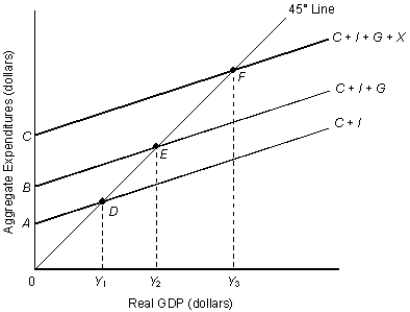 -Refer to Figure 9.5. Which of the following statements is true?
 (Multiple Choice)
5.0/5 (85)
(85) The figure given below shows the consumption function of a household.
Figure 9.2
 -In Figure 9.2, a decrease in disposable income would be illustrated by:
 (Multiple Choice)
4.9/5 (89)
(89) Table 9.2
Cost of machine \ 300,000 Arnual autput from mechine \ 35,000 Arnual interett rate on loans 9\%
-Refer to Table 9.2. If a firm purchases the machine by taking out a one-year loan, what happens to the firm's rate of return on the investment if the interest rate increases to 10 percent?
(Multiple Choice)
4.9/5 (86)
(86) Suppose that the consumption function crosses the 45-degree line at a disposable income level of $800. Assume further that saving equals $200 when disposable income is $1,300. This implies that the MPC must equal 0.6.
(True/False)
4.8/5 (72)
(72) Suppose the Kwik Print Company considers an investment project that involves the purchase of a copier with an expected output of $4,000. If the firm has to borrow $3,000 and the rate of return is 11.1 percent, then the interest rate associated with the loan must be 20 percent.
(True/False)
4.8/5 (85)
(85) Which of the following factors will not affect the profit expectations of business firms and change the level of investment?
(Multiple Choice)
4.7/5 (87)
(87) When government spending is added to consumption and planned investment, the slope of the aggregate expenditure function increases.
(True/False)
4.9/5 (90)
(90) An MPI of 0.4 indicates that for every 100 percent increase in domestic income:
(Multiple Choice)
4.9/5 (86)
(86) Other things equal, an increase in the consumer confidence index tends to raise the average propensity to consume.
(True/False)
4.9/5 (81)
(81) If capacity utilization by businesses remains constant, investment spending is likely to be the most volatile component of aggregate expenditures in the United States.
(True/False)
4.9/5 (74)
(74) The figure given below shows the consumption function of a household.
Figure 9.2
-In Figure 9.2, consumption equals disposable income:
-In Figure 9.2, consumption equals disposable income: (Multiple Choice)
4.9/5 (93)
(93) A key assumption of the Keynesian model of macroeconomics is a fixed _____.
(Multiple Choice)
4.9/5 (83)
(83) 
Filters
- Essay(0)
- Multiple Choice(0)
- Short Answer(0)
- True False(0)
- Matching(0)