



 Chat with AI
Exam 20: International Trade Restrictions

Exam 1: Economics: the World Around You90 Questions
Exam 2: Choice, Opportunity Costs, and Specialization98 Questions
Exam 3: Markets, Demand and Supply, and the Price System99 Questions
Exam 4: The Market System and the Private and Public Sector100 Questions
Exam 5: National Income Accounting104 Questions
Exam 6: An Introduction to the Foreign Exchange Market and the Balance of Payments90 Questions
Exam 7: Unemployment and Inflation130 Questions
Exam 8: Macroeconomic Equilibrium: Aggregate Demand and Supply123 Questions
Exam 9: Aggregate Expenditures120 Questions
Exam 10: Income and Expenditures Equilibrium135 Questions
Exam 11: Fiscal Policy94 Questions
Exam 12: Money and Banking125 Questions
Exam 13: Monetary Policy138 Questions
Exam 14: Macroeconomic Policy: Tradeoffs, Expectations, Credibility, and Sources of Business Cycles117 Questions
Exam 15: Macroeconomic Viewpoints: New Keynesian, Monetarist, and New Classical103 Questions
Exam 16: Economic Growth99 Questions
Exam 17: Development Economics105 Questions
Exam 18: Globalization85 Questions
Exam 19: World Trade Equilibrium112 Questions
Exam 20: International Trade Restrictions109 Questions
Exam 21: Exchange Rates and Financial Links Between Countries132 Questions
Select questions type


One of the negative impacts of export subsidy is that:

Free
(Multiple Choice)
4.8/5  (75)
(75) Correct Answer: Verified
E
The figure below shows the demand (D) and supply (S) curves of corn syrups.
Figure 20.3
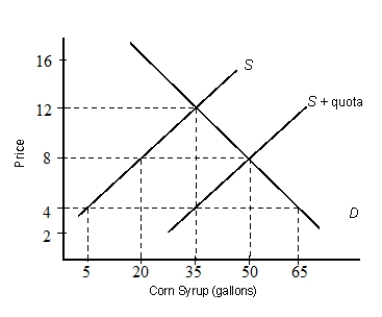 -In Figure 20.3, what are the equilibrium price and quantity in the absence of trade?
Free
(Multiple Choice)
4.9/5 (88)
(88) Correct Answer:Verified
VerifiedB
The figure below shows the demand (D) and supply (S) curves of a good produced domestically in an economy as well as traded in the international market.
Figure 20.1
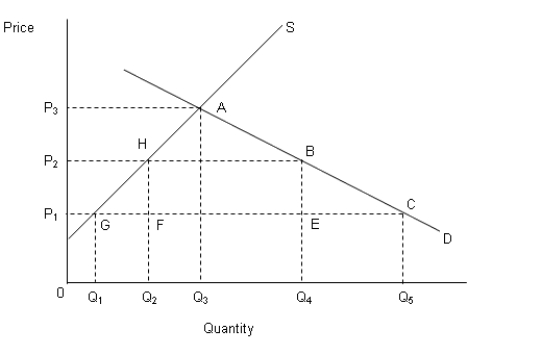 In the figure,
P1: Price of the good in the international market.
P2: Price of the good in the domestic market after the imposition of tariff by the government.
P3: No-trade price of the good in the domestic market.
-According to Figure 20.1, the domestic equilibrium quantity of the good is:
In the figure,
P1: Price of the good in the international market.
P2: Price of the good in the domestic market after the imposition of tariff by the government.
P3: No-trade price of the good in the domestic market.
-According to Figure 20.1, the domestic equilibrium quantity of the good is:Free
(Multiple Choice)
4.9/5 (78)
(78) Correct Answer:Verified
VerifiedD
A monopoly exists when there is only one producer in an industry, and no close substitutes for the product exist.
(True/False)
4.7/5 (73)
(73) Which of the following probably best explains why trade restrictions are imposed even if the costs to consumers are greater than the benefits to protected industries?
(Multiple Choice)
4.8/5 (71)
(71) While it is possible to erect barriers to foreign competition and save domestic jobs, restricting international trade may impose large costs on an economy.
(True/False)
5.0/5 (58)
(58) The figure given below depicts the negatively sloped demand and positively sloped supply curves of wheat in a country.
Figure 20.2
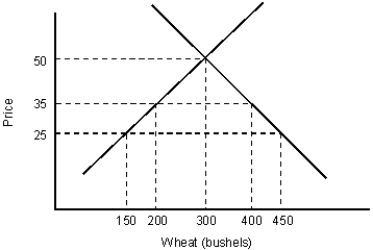 -In Figure 20.2, if the world price per bushel of wheat is $25 and a tariff of $10 is imposed by the domestic government, what is the domestic demand?
 (Multiple Choice)
4.9/5 (83)
(83) As a result of the government procurement policy in the U.S.:
(Multiple Choice)
4.9/5 (81)
(81) According to empirical observations, the cost of restricting international trade in the U.S. is much greater than the benefits generated from restriction. In the light of the above observation, which of the following statements is true?
(Multiple Choice)
4.8/5 (74)
(74) The most successful free trade agreements achieve all of the following goals, except:
(Multiple Choice)
4.9/5 (77)
(77) In reality international trade is determined solely by comparative advantage and the free market forces of supply and demand.
(True/False)
4.8/5 (82)
(82) In the United States, a "buy American" act was passed in 1933 to create larger markets for domestic goods.
(True/False)
4.9/5 (90)
(90) Creating conditions for fair trade by limiting imports will make the domestic consumers better off, as they will be required to pay low prices for the products.
(True/False)
4.8/5 (89)
(89) Protecting infant industries from foreign competition may make sense, but only until the industry matures.
(True/False)
4.8/5 (100)
(100) In the light of the infant industry argument, identify the industry which is likely to have substantially high initial costs.
(Multiple Choice)
4.9/5 (67)
(67) In 1992 the EEC was replaced by the EU with an agreement to:
(Multiple Choice)
4.8/5 (82)
(82) Protection provided to the infant industries is rarely withdrawn because:
(Multiple Choice)
4.9/5 (81)
(81) Which of the following can be considered as a cultural barrier to trade?
(Multiple Choice)
4.9/5 (82)
(82) 
Filters
- Essay(0)
- Multiple Choice(0)
- Short Answer(0)
- True False(0)
- Matching(0)