



 Chat with AI
Exam 20: International Trade Restrictions

Exam 1: Economics: the World Around You90 Questions
Exam 2: Choice, Opportunity Costs, and Specialization98 Questions
Exam 3: Markets, Demand and Supply, and the Price System99 Questions
Exam 4: The Market System and the Private and Public Sector100 Questions
Exam 5: National Income Accounting104 Questions
Exam 6: An Introduction to the Foreign Exchange Market and the Balance of Payments90 Questions
Exam 7: Unemployment and Inflation130 Questions
Exam 8: Macroeconomic Equilibrium: Aggregate Demand and Supply123 Questions
Exam 9: Aggregate Expenditures120 Questions
Exam 10: Income and Expenditures Equilibrium135 Questions
Exam 11: Fiscal Policy94 Questions
Exam 12: Money and Banking125 Questions
Exam 13: Monetary Policy138 Questions
Exam 14: Macroeconomic Policy: Tradeoffs, Expectations, Credibility, and Sources of Business Cycles117 Questions
Exam 15: Macroeconomic Viewpoints: New Keynesian, Monetarist, and New Classical103 Questions
Exam 16: Economic Growth99 Questions
Exam 17: Development Economics105 Questions
Exam 18: Globalization85 Questions
Exam 19: World Trade Equilibrium112 Questions
Exam 20: International Trade Restrictions109 Questions
Exam 21: Exchange Rates and Financial Links Between Countries132 Questions
Select questions type


The total tariff revenue to the government of an imported good is found by adding the tariff to the quantity of the good imported.
(True/False)
4.8/5  (73)
(73) The effect of an import quota on the domestic market is to shift the:
(Multiple Choice)
4.9/5 (63)
(63) Suppose the production of helicopters is an industry characterized by increasing returns to scale and an Argentine firm, Cicare, is the only player in this market. The firm caters to the global market and earns a profit of $10 million. Flettner, a German firm has been considering entering this market for a while, but it is aware that its entry will cause each firm to lose about $4 million. Although a government subsidy allows Flettner to enter the helicopter market, the company is unable to reap profits in the long run. Which of the following could have led to this outcome?
(Multiple Choice)
4.8/5 (81)
(81) The figure given below depicts the negatively sloped demand and positively sloped supply curves of wheat in a country.
Figure 20.2
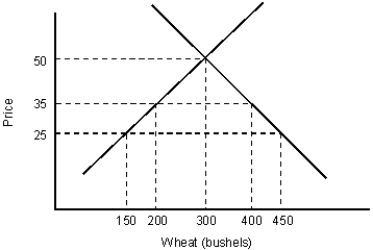 -Refer to Figure 20.2. In the absence of international trade, what are the domestic equilibrium price and quantity?
 (Multiple Choice)
4.8/5 (82)
(82) In order to protect key industries, some countries impose taxes on their exports instead of imports, mainly because it is easier to collect taxes from the export industry.
(True/False)
4.8/5 (67)
(67) The figure below shows the demand (D) and supply (S) curves of cocoa in the U.S.
Figure 20.4
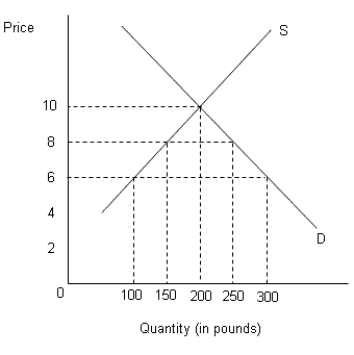 -Refer to Figure 20.4. If cocoa sells for $6 per pound in the world market, determine the volume of U.S. cocoa imports.
 (Multiple Choice)
4.8/5 (81)
(81) Domestic firms often claim that foreign firms have an unfair advantage because foreign workers are willing to work for very low wages.
(True/False)
4.9/5 (83)
(83) The figure below shows the demand (D) and supply (S) curves of a good produced domestically in an economy as well as traded in the international market.
Figure 20.1
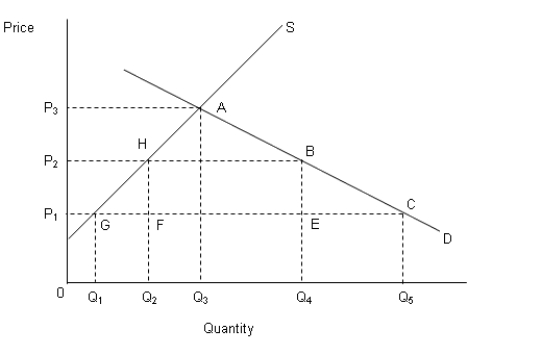 In the figure,
P1: Price of the good in the international market.
P2: Price of the good in the domestic market after the imposition of tariff by the government.
P3: No-trade price of the good in the domestic market.
-According to Figure 20.1, if the international price of the good is P1, which of the following statements is true?
In the figure,
P1: Price of the good in the international market.
P2: Price of the good in the domestic market after the imposition of tariff by the government.
P3: No-trade price of the good in the domestic market.
-According to Figure 20.1, if the international price of the good is P1, which of the following statements is true? (Multiple Choice)
4.9/5 (78)
(78) If the average costs of production decline with increases in output, then the larger a firm is, the lower its per unit costs will be.
(True/False)
4.9/5 (64)
(64) One danger associated with calls for fairness based on reciprocity is that, calls for fair trade may be invoked in cases where, foreign restrictions on U.S. imports do not actually exist.
(True/False)
4.9/5 (97)
(97) The figure below shows the demand (D) and supply (S) curves of cocoa in the U.S.
Figure 20.4
-Refer to Figure 20.4. Assume that Ghana is the only cocoa exporter supplying cocoa in the world market at $6 per pound. If the U.S. enters into a free trade agreement (FTA) with Ghana, what would be its total cocoa imports?
-Refer to Figure 20.4. Assume that Ghana is the only cocoa exporter supplying cocoa in the world market at $6 per pound. If the U.S. enters into a free trade agreement (FTA) with Ghana, what would be its total cocoa imports? (Multiple Choice)
4.9/5 (83)
(83) The figure below shows the demand (D) and supply (S) curves of a good produced domestically in an economy as well as traded in the international market.
Figure 20.1
In the figure,
P1: Price of the good in the international market.
P2: Price of the good in the domestic market after the imposition of tariff by the government.
P3: No-trade price of the good in the domestic market.
-Refer to Figure 20.1. If the government imposes a tariff such that the price of the good in the domestic market is P2 while the international price is P1, the dollar value of the tariff is equal to:
In the figure,
P1: Price of the good in the international market.
P2: Price of the good in the domestic market after the imposition of tariff by the government.
P3: No-trade price of the good in the domestic market.
-Refer to Figure 20.1. If the government imposes a tariff such that the price of the good in the domestic market is P2 while the international price is P1, the dollar value of the tariff is equal to: (Multiple Choice)
4.8/5 (73)
(73) The figure given below depicts the negatively sloped demand and positively sloped supply curves of wheat in a country.
Figure 20.2
-According to Figure 20.2, if the world price of wheat is $25 and a tariff of $25 is imposed by the domestic government, the total tariff revenue collected by the government is:
-According to Figure 20.2, if the world price of wheat is $25 and a tariff of $25 is imposed by the domestic government, the total tariff revenue collected by the government is: (Multiple Choice)
4.8/5 (72)
(72) Preferential trade agreements have a beneficial trade-diversion effect when they reduce prices for traded goods and stimulate the volume of international trade.
(True/False)
4.9/5 (91)
(91) Protection from foreign competition benefits domestic producers in the protected industry at the expense of domestic consumers.
(True/False)
4.8/5 (86)
(86) When barriers to trade are imposed, we should expect some groups to be harmed at the expense of other groups.
(True/False)
4.8/5 (80)
(80) The figure below shows the demand (D) and supply (S) curves of cocoa in the U.S.
Figure 20.4
-From Figure 20.4, determine the total volume of U.S. cocoa imports if its government imposes tariff at the rate of $2 per pound on cocoa.
-From Figure 20.4, determine the total volume of U.S. cocoa imports if its government imposes tariff at the rate of $2 per pound on cocoa. (Multiple Choice)
4.7/5 (94)
(94) 
Filters
- Essay(0)
- Multiple Choice(0)
- Short Answer(0)
- True False(0)
- Matching(0)