



 Chat with AI
Exam 20: International Trade Restrictions

Exam 1: Economics: the World Around You90 Questions
Exam 2: Choice, Opportunity Costs, and Specialization98 Questions
Exam 3: Markets, Demand and Supply, and the Price System99 Questions
Exam 4: The Market System and the Private and Public Sector100 Questions
Exam 5: National Income Accounting104 Questions
Exam 6: An Introduction to the Foreign Exchange Market and the Balance of Payments90 Questions
Exam 7: Unemployment and Inflation130 Questions
Exam 8: Macroeconomic Equilibrium: Aggregate Demand and Supply123 Questions
Exam 9: Aggregate Expenditures120 Questions
Exam 10: Income and Expenditures Equilibrium135 Questions
Exam 11: Fiscal Policy94 Questions
Exam 12: Money and Banking125 Questions
Exam 13: Monetary Policy138 Questions
Exam 14: Macroeconomic Policy: Tradeoffs, Expectations, Credibility, and Sources of Business Cycles117 Questions
Exam 15: Macroeconomic Viewpoints: New Keynesian, Monetarist, and New Classical103 Questions
Exam 16: Economic Growth99 Questions
Exam 17: Development Economics105 Questions
Exam 18: Globalization85 Questions
Exam 19: World Trade Equilibrium112 Questions
Exam 20: International Trade Restrictions109 Questions
Exam 21: Exchange Rates and Financial Links Between Countries132 Questions
Select questions type


The figure given below depicts the negatively sloped demand and positively sloped supply curves of wheat in a country.
Figure 20.2
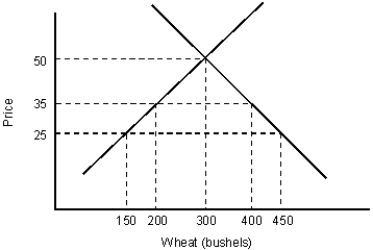 -According to Figure 20.2, if the world price per bushel of wheat is $25, how much is the domestic demand?
 (Multiple Choice)
4.7/5  (93)
(93) Which of the following tools of commercial policy acts as a quantitative restriction on imports?
(Multiple Choice)
4.9/5 (71)
(71) Which of the following statements about an increasing-returns-to-scale industry is not true?
(Multiple Choice)
4.9/5 (74)
(74) The figure given below depicts the negatively sloped demand and positively sloped supply curves of wheat in a country.
Figure 20.2
-In Figure 20.2, if the world price of wheat is $35 and a $15 tariff is imposed:
-In Figure 20.2, if the world price of wheat is $35 and a $15 tariff is imposed: (Multiple Choice)
4.8/5 (87)
(87) When dealing with strategic trade policy, one practical problem for government is the likelihood of retaliation by the foreign government.
(True/False)
4.8/5 (79)
(79) Many economists believe that the collapse of world trade and the depression in the 1930s were linked by a decrease in real income caused by producing on the basis of comparative advantage.
(True/False)
4.7/5 (76)
(76) It is often argued that if foreign goods are kept out of the domestic economy:
(Multiple Choice)
4.8/5 (88)
(88) Developing countries often justify imposition of tariffs because:
(Multiple Choice)
4.9/5 (91)
(91) Suppose that the world price of kiwi fruit ($10 per box) is below the domestic price ($12 per box). A tariff of $1 per box would:
(Multiple Choice)
4.9/5 (93)
(93) Employers and workers in the protected industry know that the consequences of protection are principally:
(Multiple Choice)
4.8/5 (76)
(76) The figure given below depicts the negatively sloped demand and positively sloped supply curves of wheat in a country.
Figure 20.2
-According to Figure 20.2, if the world price of wheat is $25 and a tariff of $10 is imposed by the domestic government, the total tariff revenue collected by the government is:
-According to Figure 20.2, if the world price of wheat is $25 and a tariff of $10 is imposed by the domestic government, the total tariff revenue collected by the government is: (Multiple Choice)
4.9/5 (64)
(64) Suppose, in the United States, each farmer is given a federal agricultural subsidy worth $30,000. What will be the effect of such subsidy?
(Multiple Choice)
4.7/5 (81)
(81) Industries that are truly critical to the national defense should be protected from foreign competition if that is the only way to ensure their existence.
(True/False)
4.9/5 (68)
(68) The figure given below depicts the negatively sloped demand and positively sloped supply curves of wheat in a country.
Figure 20.2
-In Figure 20.2, if the world price per bushel of wheat is $25, and a tariff of $10 is imposed, what is the domestic production?
-In Figure 20.2, if the world price per bushel of wheat is $25, and a tariff of $10 is imposed, what is the domestic production? (Multiple Choice)
4.9/5 (78)
(78) People who call for creating a "level playing field" believe that:
(Multiple Choice)
4.8/5 (86)
(86) When the world price of the traded good is lower than the domestic no-trade equilibrium price, free trade causes domestic production to fall and domestic consumption to rise.
(True/False)
4.8/5 (71)
(71) 
Filters
- Essay(0)
- Multiple Choice(0)
- Short Answer(0)
- True False(0)
- Matching(0)