



 Chat with AI
Exam 20: International Trade Restrictions

Exam 1: Economics: the World Around You90 Questions
Exam 2: Choice, Opportunity Costs, and Specialization98 Questions
Exam 3: Markets, Demand and Supply, and the Price System99 Questions
Exam 4: The Market System and the Private and Public Sector100 Questions
Exam 5: National Income Accounting104 Questions
Exam 6: An Introduction to the Foreign Exchange Market and the Balance of Payments90 Questions
Exam 7: Unemployment and Inflation130 Questions
Exam 8: Macroeconomic Equilibrium: Aggregate Demand and Supply123 Questions
Exam 9: Aggregate Expenditures120 Questions
Exam 10: Income and Expenditures Equilibrium135 Questions
Exam 11: Fiscal Policy94 Questions
Exam 12: Money and Banking125 Questions
Exam 13: Monetary Policy138 Questions
Exam 14: Macroeconomic Policy: Tradeoffs, Expectations, Credibility, and Sources of Business Cycles117 Questions
Exam 15: Macroeconomic Viewpoints: New Keynesian, Monetarist, and New Classical103 Questions
Exam 16: Economic Growth99 Questions
Exam 17: Development Economics105 Questions
Exam 18: Globalization85 Questions
Exam 19: World Trade Equilibrium112 Questions
Exam 20: International Trade Restrictions109 Questions
Exam 21: Exchange Rates and Financial Links Between Countries132 Questions
Select questions type


Since individual consumers do not know how much of the price they pay for a commodity is due to protection, consumers rarely lobby their political representatives to eliminate protection and reduce prices.
(True/False)
5.0/5  (79)
(79) Tariff accounts for 32% of the total government revenue in the U.K. and only 1.2% in India.
(True/False)
4.8/5 (96)
(96) Nascent industries require adequate protection from foreign competition because:
(Multiple Choice)
4.7/5 (87)
(87) The world output is higher if the countries follow restrictive trade policies rather than free trade.
(True/False)
4.7/5 (82)
(82) If an infant industry truly has a good chance to become competitive and produce profitably once it is well established, it is not at all clear that government should even offer protection to reduce short-run losses.
(True/False)
4.8/5 (69)
(69) After the U.S. government had approved the feeding of hormones to U.S. beef cattle, several western European nations restricted the import of beef from the U.S. Which of the following tools of commercial policy had been put to use in this situation?
(Multiple Choice)
4.7/5 (94)
(94) The United States has no comparative advantage in shipping, so a domestic shipping industry has no reason to exist.
(True/False)
4.8/5 (79)
(79) Subsidies are payments made by the government of a country to:
(Multiple Choice)
4.9/5 (87)
(87) Protection is rarely withdrawn from infant industries because such firms are necessary to ensure creation of domestic jobs.
(True/False)
4.8/5 (84)
(84) Tariffs are considered to be a popular tax in the first world countries, who justify them on the basis of the revenue they generate for government spending.
(True/False)
4.7/5 (80)
(80) According to economists, which of the following acts was partially responsible for the Great Depression of the 1930s?
(Multiple Choice)
5.0/5 (86)
(86) If average costs of production decline with increases in output for a particular firm:
(Multiple Choice)
4.8/5 (76)
(76) International trade on the basis of comparative advantage maximizes world output and allows consumers to access better-quality products at lower prices than would be available in the domestic market alone.
(True/False)
4.8/5 (91)
(91) In a free trade area, member nations have no trade barriers among themselves but are free to set their own trade policies toward nonmembers.
(True/False)
4.9/5 (90)
(90) The figure given below depicts the negatively sloped demand and positively sloped supply curves of wheat in a country.
Figure 20.2
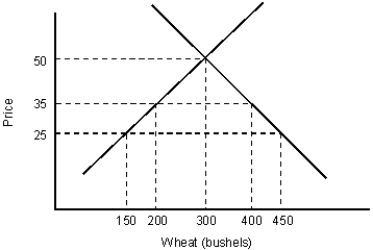 -In Figure 20.2, if the world price per bushel of wheat is $25, how much wheat will be imported?
 (Multiple Choice)
4.7/5 (78)
(78) One important unintended consequence of the Smoot-Hawley Tariff Act was to:
(Multiple Choice)
4.9/5 (90)
(90) Steel producers in the United States observe that foreign sales of U.S. steel has drastically declined due to stringent trade policies adopted by the foreign governments and unfair treatment of U.S. steel exports in foreign countries. The lobbying efforts of such loss making U.S. steel manufacturers induces the domestic government to restrict the entry of imported steel and help stimulate the sales of domestically produced steel. Which of the following is most similar to the example mentioned above?
(Multiple Choice)
4.7/5 (87)
(87) Agreements to abolish most barriers to trade among nations are known as:
(Multiple Choice)
4.8/5 (74)
(74) 
Filters
- Essay(0)
- Multiple Choice(0)
- Short Answer(0)
- True False(0)
- Matching(0)