



 Chat with AI
Exam 9: Aggregate Expenditures

Exam 1: Economics: the World Around You90 Questions
Exam 2: Choice, Opportunity Costs, and Specialization98 Questions
Exam 3: Markets, Demand and Supply, and the Price System99 Questions
Exam 4: The Market System and the Private and Public Sector100 Questions
Exam 5: National Income Accounting104 Questions
Exam 6: An Introduction to the Foreign Exchange Market and the Balance of Payments90 Questions
Exam 7: Unemployment and Inflation130 Questions
Exam 8: Macroeconomic Equilibrium: Aggregate Demand and Supply123 Questions
Exam 9: Aggregate Expenditures120 Questions
Exam 10: Income and Expenditures Equilibrium135 Questions
Exam 11: Fiscal Policy94 Questions
Exam 12: Money and Banking125 Questions
Exam 13: Monetary Policy138 Questions
Exam 14: Macroeconomic Policy: Tradeoffs, Expectations, Credibility, and Sources of Business Cycles117 Questions
Exam 15: Macroeconomic Viewpoints: New Keynesian, Monetarist, and New Classical103 Questions
Exam 16: Economic Growth99 Questions
Exam 17: Development Economics105 Questions
Exam 18: Globalization85 Questions
Exam 19: World Trade Equilibrium112 Questions
Exam 20: International Trade Restrictions109 Questions
Exam 21: Exchange Rates and Financial Links Between Countries132 Questions
Select questions type


If disposable income rises from $15,000 to $20,000 and the marginal propensity to consume equals 0.9, then saving must increase by $500.
(True/False)
4.8/5  (78)
(78) The amount of autonomous consumption in an economy is measured by the:
(Multiple Choice)
4.8/5 (96)
(96) Other things equal, when the U.S. dollar depreciates, domestic exports rise at every level of domestic income.
(True/False)
4.8/5 (79)
(79) The United States introduced investment tax credit in 1962 and has continued to offer it till date. This has reduced the volatility of investments in the country.
(True/False)
4.8/5 (70)
(70) A change in the marginal propensity to save can be graphically represented by:
(Multiple Choice)
5.0/5 (82)
(82) The figure given below represents the consumption function of a country.
Figure 9.3
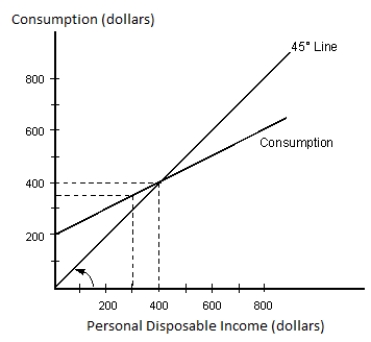 -According to Figure 9.3, saving is zero when disposable income is _____.
 (Multiple Choice)
4.7/5 (81)
(81) Suppose total disposable income in Country X rises by $500 billion while total consumption rises by $50 billion. What would be the slope of the consumption function for this nation?
(Multiple Choice)
4.9/5 (72)
(72) A change in consumption caused by a change in disposable income is shown by:
(Multiple Choice)
5.0/5 (85)
(85) The figure given below shows the consumption functions of an economy.
Figure 9.4
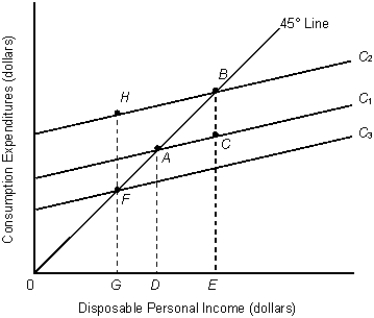 -Refer to the Figure 9.4. If the economy is in equilibrium at A, which of the following is most likely to occur if consumers expect a period of rapid economic expansion?
 (Multiple Choice)
4.8/5 (67)
(67) In the table given below Y represent the aggregate expenditure of the economy on C = consumption, I = investment, G = government projects, and X = net exports.
Table 9.3
Aggregate Expenditures \ 0 \ 50 \ 75 \ 150 \ 40 \ 150 \ 125 \ 75 \ 150 \ 10 \ 300 \ 200 \ 75 \ 150 -\ 20 \ 450 \ 275 \ 75 \ 150 -\ 50 \ 600 \ 350 \ 75 \ 150 -\ 80
-Refer to Table 9.3. At an income level of $300, the average propensity to save equals:
(Multiple Choice)
4.8/5 (80)
(80) The table given below reports the consumption expenditure of a nation at different levels of disposable income.
Table 9.1
Disposable Income Consumption (C) \ 0 \ 4,500 \ 10,000 \ 12,000 \ 15,000 \ 15,750 \ 25,000 \ 23,250 \ 30,000 \ 27,000 \ 35,000 \ 30,750 \ 40,000 \ 34,500 \ 50,000 \ 42,000
-Refer to Table 9.1. Autonomous consumption expenditure in this nation will equal:
(Multiple Choice)
4.9/5 (75)
(75) As a function of real GDP (real GDP being measured on the horizontal axis), autonomous investment is represented by a(n):
(Multiple Choice)
4.8/5 (75)
(75) The net export function is negatively sloped because exports are inversely related to domestic income.
(True/False)
4.9/5 (68)
(68) All of the following would cause exports to decline, except:
(Multiple Choice)
4.7/5 (77)
(77) In the table given below Y represent the aggregate expenditure of the economy on C = consumption, I = investment, G = government projects, and X = net exports.
Table 9.3
Aggregate Expenditures \ 0 \ 50 \ 75 \ 150 \ 40 \ 150 \ 125 \ 75 \ 150 \ 10 \ 300 \ 200 \ 75 \ 150 -\ 20 \ 450 \ 275 \ 75 \ 150 -\ 50 \ 600 \ 350 \ 75 \ 150 -\ 80
-Refer to Table 9.3. Calculate the marginal propensity to consume in the economy.
(Multiple Choice)
4.8/5 (88)
(88) The slope of the aggregate expenditures function (AE) is flatter than the C+I+G function because:
(Multiple Choice)
4.8/5 (94)
(94) Which of the following will cause the net export function to shift?
(Multiple Choice)
4.8/5 (85)
(85) 
Filters
- Essay(0)
- Multiple Choice(0)
- Short Answer(0)
- True False(0)
- Matching(0)