



 Chat with AI
Exam 14: Macroeconomic Policy: Tradeoffs, Expectations, Credibility, and Sources of Business Cycles

Exam 1: Economics: the World Around You90 Questions
Exam 2: Choice, Opportunity Costs, and Specialization98 Questions
Exam 3: Markets, Demand and Supply, and the Price System99 Questions
Exam 4: The Market System and the Private and Public Sector100 Questions
Exam 5: National Income Accounting104 Questions
Exam 6: An Introduction to the Foreign Exchange Market and the Balance of Payments90 Questions
Exam 7: Unemployment and Inflation130 Questions
Exam 8: Macroeconomic Equilibrium: Aggregate Demand and Supply123 Questions
Exam 9: Aggregate Expenditures120 Questions
Exam 10: Income and Expenditures Equilibrium135 Questions
Exam 11: Fiscal Policy94 Questions
Exam 12: Money and Banking125 Questions
Exam 13: Monetary Policy138 Questions
Exam 14: Macroeconomic Policy: Tradeoffs, Expectations, Credibility, and Sources of Business Cycles117 Questions
Exam 15: Macroeconomic Viewpoints: New Keynesian, Monetarist, and New Classical103 Questions
Exam 16: Economic Growth99 Questions
Exam 17: Development Economics105 Questions
Exam 18: Globalization85 Questions
Exam 19: World Trade Equilibrium112 Questions
Exam 20: International Trade Restrictions109 Questions
Exam 21: Exchange Rates and Financial Links Between Countries132 Questions
Select questions type


A decline in aggregate demand is analogous to an upward movement along the short-run Phillips curve.
(True/False)
4.8/5  (83)
(83) The natural rate of unemployment is defined as the unemployment rate that exists in the absence of:
(Multiple Choice)
4.8/5 (71)
(71) If the actual unemployment rate is below the natural rate of unemployment, then the actual inflation rate must exceed the expected inflation rate, and the economy will be operating along the short-run Phillips curve.
(True/False)
4.9/5 (88)
(88) According to the regulation Q, the maximum interest rate that the U.S. banks could pay on deposits were limited by the Federal Reserve. This reduced volatility in the financial markets and largely benefited the U.S. banks.
(True/False)
4.9/5 (81)
(81) When aggregate demand declines unexpectedly and wage contracts are fixed, then the average price level will:
(Multiple Choice)
4.8/5 (95)
(95) Assume that taxes are constant. If the government borrows $17 billion in new funds and has a budget deficit of $35 billion, then the central bank has to:
(Multiple Choice)
4.8/5 (73)
(73) According to the theory of adaptive expectations, if the inflation rate has been 4.2 percent for the last ten years, people will expect next year's inflation rate to be:
(Multiple Choice)
4.8/5 (85)
(85) The figure given below represents the short run and long run Phillips curve.
Figure 14.4
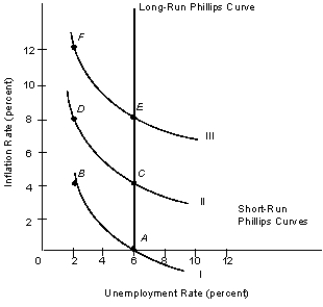 -Refer to Figure 14.4. If the observed unemployment rate equals the natural rate, and the expected rate of inflation equals zero, the economy will be located at:
 (Multiple Choice)
4.9/5 (89)
(89) U.S. economic data from 1955 to 2000 show that both unemployment and inflation rates increased during that period.
(True/False)
4.7/5 (78)
(78) What is the difference between the short-run Phillips curve and the long-run Phillips curve?
(Multiple Choice)
4.9/5 (71)
(71) The figure given below shows the Phillips curves of the U.S. economy during early 1960s to late 1970s.
Figure 14.2
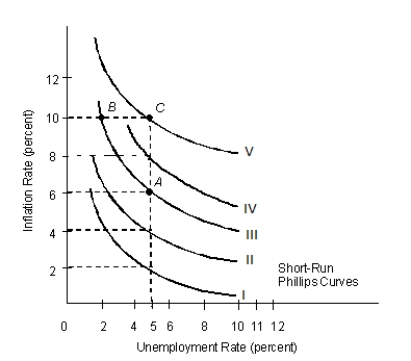 -Refer to Figure 14.2. Phillips curve II is associated with the late 1980s in the United States and indicates that 5 percent unemployment was consistent with 4 percent inflation. Which curve would be associated with the late 1970s in the United States?
 (Multiple Choice)
4.8/5 (91)
(91) A look at macroeconomic data across countries reveals that when economies experience recessions, unemployment rates rise, but wages fall very little, if at all. Which of the following is most likely to support the above observation?
(Multiple Choice)
4.8/5 (80)
(80) The figure given below shows the Phillips curves of the U.S. economy during early 1960s to late 1970s.
Figure 14.2
-Refer to Figure 14.2. Following the movement from point A to point B on Phillips curve III, what would cause the Phillips curve to shift up so that 5 percent unemployment is associated with 10 percent inflation?
-Refer to Figure 14.2. Following the movement from point A to point B on Phillips curve III, what would cause the Phillips curve to shift up so that 5 percent unemployment is associated with 10 percent inflation? (Multiple Choice)
4.8/5 (87)
(87) According to the theory of rational expectations, the economy always remains at the natural rate of unemployment, irrespective of policy changes.
(True/False)
4.9/5 (99)
(99) The slope of the short-run Phillips curve is consistent with:
(Multiple Choice)
4.7/5 (78)
(78) The hypothesis of political business cycles is based on the assumption that a vertical Phillips curve always holds.
(True/False)
4.9/5 (85)
(85) One of the most important factors in determining the natural rate of unemployment is demographic change, such as a change in the age of the labor force.
(True/False)
4.8/5 (81)
(81) If the public expects the incumbent administration to stimulate the economy shortly before an election:
(Multiple Choice)
5.0/5 (76)
(76) Which of the following shifts the aggregate supply curve to the left?
(Multiple Choice)
4.8/5 (94)
(94) 
Filters
- Essay(0)
- Multiple Choice(0)
- Short Answer(0)
- True False(0)
- Matching(0)