



 Chat with AI
Exam 14: Macroeconomic Policy: Tradeoffs, Expectations, Credibility, and Sources of Business Cycles

Exam 1: Economics: the World Around You90 Questions
Exam 2: Choice, Opportunity Costs, and Specialization98 Questions
Exam 3: Markets, Demand and Supply, and the Price System99 Questions
Exam 4: The Market System and the Private and Public Sector100 Questions
Exam 5: National Income Accounting104 Questions
Exam 6: An Introduction to the Foreign Exchange Market and the Balance of Payments90 Questions
Exam 7: Unemployment and Inflation130 Questions
Exam 8: Macroeconomic Equilibrium: Aggregate Demand and Supply123 Questions
Exam 9: Aggregate Expenditures120 Questions
Exam 10: Income and Expenditures Equilibrium135 Questions
Exam 11: Fiscal Policy94 Questions
Exam 12: Money and Banking125 Questions
Exam 13: Monetary Policy138 Questions
Exam 14: Macroeconomic Policy: Tradeoffs, Expectations, Credibility, and Sources of Business Cycles117 Questions
Exam 15: Macroeconomic Viewpoints: New Keynesian, Monetarist, and New Classical103 Questions
Exam 16: Economic Growth99 Questions
Exam 17: Development Economics105 Questions
Exam 18: Globalization85 Questions
Exam 19: World Trade Equilibrium112 Questions
Exam 20: International Trade Restrictions109 Questions
Exam 21: Exchange Rates and Financial Links Between Countries132 Questions
Select questions type


In the long run, the economy is better off if policymakers exploit the short-run tradeoff between inflation and the unemployment rate.
(True/False)
4.7/5  (63)
(63) If credible low-money-growth policies were continually pursued by the Fed, nominal wages and prices would eventually fall as the economic agents would expect lower inflation rates over time.
(True/False)
4.9/5 (60)
(60) Wages are said to be "sticky downwards" because this promotes good work effort and ensures that workers and firms share the same goals of efficient production and profit maximization.
(True/False)
4.9/5 (77)
(77) Which of the following gives the Fed a credibility problem because the Fed may change its planned policies in light of new economic developments?
(Multiple Choice)
4.7/5 (91)
(91) The figure given below represents the short run and long run Phillips curve.
Figure 14.4
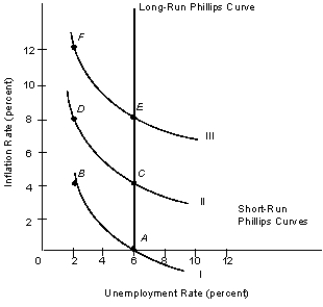 -Refer to Figure 14.4. Suppose the rational expectations hypothesis holds, and the Fed implements a fully expected increase in money supply growth. Starting from point C in the short run, the economy will tend to move to:
 (Multiple Choice)
4.9/5 (83)
(83) The long-run Phillips curve corresponds to the vertical region of the aggregate supply curve.
(True/False)
4.8/5 (66)
(66) If nominal wage rates are contractually determined and cannot change in the short run, then an unexpected increase in the inflation rate will:
(Multiple Choice)
4.7/5 (92)
(92) When the reservation wage is adjusted to account for a higher inflation rate:
(Multiple Choice)
4.9/5 (99)
(99) The figure given below represents the short run and long run Phillips curve.
Figure 14.4
-Refer to Figure 14.4. If the adaptive expectations hypothesis holds, and the economy moves from point C to point D because of expansionary fiscal policy, what rate of inflation are people expecting at point D?
-Refer to Figure 14.4. If the adaptive expectations hypothesis holds, and the economy moves from point C to point D because of expansionary fiscal policy, what rate of inflation are people expecting at point D? (Multiple Choice)
4.8/5 (74)
(74) Suppose the inflation rate has been 6 percent over the past four years. If the Federal Reserve announces an increase in the growth of the money supply, adaptive expectations would predict an inflation rate of 6 percent.
(True/False)
4.8/5 (72)
(72) Worldwide statistics prove that, when economies experience recessions, unemployment rates rise and wages fall.
(True/False)
4.9/5 (87)
(87) Which of the following is most likely to increase the natural rate of unemployment?
(Multiple Choice)
4.9/5 (78)
(78) Suppose the inflation rate has risen 0.5 percent a year for the past three years. Using this experience an individual forecasts a 0.5 percent rise in the coming year's inflation rate. This is an example of:
(Multiple Choice)
4.9/5 (69)
(69) Since the growth in the money supply is unrelated to government spending, fiscal policy and monetary policy can be conducted independently.
(True/False)
5.0/5 (83)
(83) The shape of the long-run Phillips curve suggests that over a long time horizon there is a magnified tradeoff between the unemployment rate and inflation.
(True/False)
4.9/5 (81)
(81) Suppose that a labor union negotiates an increase in wages of 4 percent for the coming year because annual inflation for the past five years has been 4 percent. The expectations formed by the union are:
(Multiple Choice)
4.9/5 (85)
(85) If the percentage increase in nominal wage rates is less than the percentage increase in the price level, then:
(Multiple Choice)
4.8/5 (76)
(76) Suppose that an increase in aggregate demand causes an unplanned depletion in business inventories. Which of the following situations will result from this?
(Multiple Choice)
4.8/5 (74)
(74) 
Filters
- Essay(0)
- Multiple Choice(0)
- Short Answer(0)
- True False(0)
- Matching(0)