



 Chat with AI
Exam 14: Macroeconomic Policy: Tradeoffs, Expectations, Credibility, and Sources of Business Cycles

Exam 1: Economics: the World Around You90 Questions
Exam 2: Choice, Opportunity Costs, and Specialization98 Questions
Exam 3: Markets, Demand and Supply, and the Price System99 Questions
Exam 4: The Market System and the Private and Public Sector100 Questions
Exam 5: National Income Accounting104 Questions
Exam 6: An Introduction to the Foreign Exchange Market and the Balance of Payments90 Questions
Exam 7: Unemployment and Inflation130 Questions
Exam 8: Macroeconomic Equilibrium: Aggregate Demand and Supply123 Questions
Exam 9: Aggregate Expenditures120 Questions
Exam 10: Income and Expenditures Equilibrium135 Questions
Exam 11: Fiscal Policy94 Questions
Exam 12: Money and Banking125 Questions
Exam 13: Monetary Policy138 Questions
Exam 14: Macroeconomic Policy: Tradeoffs, Expectations, Credibility, and Sources of Business Cycles117 Questions
Exam 15: Macroeconomic Viewpoints: New Keynesian, Monetarist, and New Classical103 Questions
Exam 16: Economic Growth99 Questions
Exam 17: Development Economics105 Questions
Exam 18: Globalization85 Questions
Exam 19: World Trade Equilibrium112 Questions
Exam 20: International Trade Restrictions109 Questions
Exam 21: Exchange Rates and Financial Links Between Countries132 Questions
Select questions type


A fiscal policy that changes over time as economic conditions change is considered to be time inconsistent.
(True/False)
4.7/5  (82)
(82) Critics of the Federal Reserve maintain that, to correct the credibility problem of monetary policy, the Fed should:
(Multiple Choice)
4.9/5 (79)
(79) Following a decline in the inflation rate, once long-term wage contracts are renegotiated and all prices in the economy adjust to their new equilibrium:
(Multiple Choice)
4.8/5 (78)
(78) Irrespective of whether the inflation rate is high or low, if the inflation rate is above the expected level, the unemployment rate in the economy will remain stable.
(True/False)
4.9/5 (89)
(89) Suppose that the economy has witnessed an 8 percent increase in its money supply over the last few years and the Fed now announces a plan to increase the money supply by 4 percent per year. What will be the public response, assuming that the Fed has a reputation for always implementing its announced plans?
(Multiple Choice)
4.9/5 (74)
(74) The change in the money supply in an economy is measured as:
(Multiple Choice)
4.9/5 (89)
(89) The reservation wage is the minimum wage rate that an unemployed worker must receive before employment is accepted.
(True/False)
4.9/5 (67)
(67) Other things equal, the higher the fiscal deficit, the higher the required increase in base money.
(True/False)
4.8/5 (93)
(93) The long-run Phillips curve indicates that the consequences of trying to reduce unemployment below its natural rate would be:
(Multiple Choice)
4.7/5 (80)
(80) If the government fiscal deficit equals $240 million and government borrowing equals $120 million, what is the change in the money supply in the economy?
(Multiple Choice)
4.8/5 (81)
(81) The Phillips curve based on the unemployment and inflation rates in the U.S. between 1961 and 1969 was:
(Multiple Choice)
4.8/5 (78)
(78) The figure given below represents the short run and long run Phillips curve.
Figure 14.4
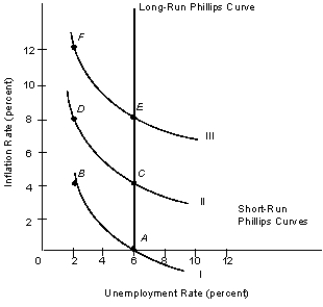 -Refer to Figure 14.4. Suppose the economy is located at point A, but the government increases spending because it believes that 6 percent unemployment is unacceptably high. If the adaptive expectations hypothesis holds, in the short run, the economy will move to:
 (Multiple Choice)
4.7/5 (82)
(82) Which of the following will be a short run impact of a pre-election expansionary fiscal policy, public expectations remaining constant?
(Multiple Choice)
5.0/5 (89)
(89) Wage contracts force businesses to adjust wages rather than employment in response to an unexpected change in aggregate demand.
(True/False)
4.7/5 (72)
(72) Which of the following is most likely to have contributed to better inventory management?
(Multiple Choice)
4.8/5 (86)
(86) If nominal wages are contractually fixed and cannot change in the short run, then an unexpected decline in the inflation rate will reduce business revenues and lower the unemployment rate.
(True/False)
4.9/5 (74)
(74) If the government fiscal deficit equals $78 billion, government borrowing equals $38 million, and tax revenue equals $92 billion, what is the value of the change in the money supply?
(Multiple Choice)
4.8/5 (79)
(79) 
Filters
- Essay(0)
- Multiple Choice(0)
- Short Answer(0)
- True False(0)
- Matching(0)