



 Chat with AI
Exam 19: World Trade Equilibrium

Exam 1: Economics: the World Around You90 Questions
Exam 2: Choice, Opportunity Costs, and Specialization98 Questions
Exam 3: Markets, Demand and Supply, and the Price System99 Questions
Exam 4: The Market System and the Private and Public Sector100 Questions
Exam 5: National Income Accounting104 Questions
Exam 6: An Introduction to the Foreign Exchange Market and the Balance of Payments90 Questions
Exam 7: Unemployment and Inflation130 Questions
Exam 8: Macroeconomic Equilibrium: Aggregate Demand and Supply123 Questions
Exam 9: Aggregate Expenditures120 Questions
Exam 10: Income and Expenditures Equilibrium135 Questions
Exam 11: Fiscal Policy94 Questions
Exam 12: Money and Banking125 Questions
Exam 13: Monetary Policy138 Questions
Exam 14: Macroeconomic Policy: Tradeoffs, Expectations, Credibility, and Sources of Business Cycles117 Questions
Exam 15: Macroeconomic Viewpoints: New Keynesian, Monetarist, and New Classical103 Questions
Exam 16: Economic Growth99 Questions
Exam 17: Development Economics105 Questions
Exam 18: Globalization85 Questions
Exam 19: World Trade Equilibrium112 Questions
Exam 20: International Trade Restrictions109 Questions
Exam 21: Exchange Rates and Financial Links Between Countries132 Questions
Select questions type


Absolute advantage is determined by comparing the opportunity costs of producing each good in different countries.
(True/False)
4.9/5  (83)
(83) The first panel in the following figure shows the domestic demand (D) and supply (S) curves of Columbian coffee and the second panel shows the import demand and export supply of Columbian coffee in the international market.
Figure 20.1
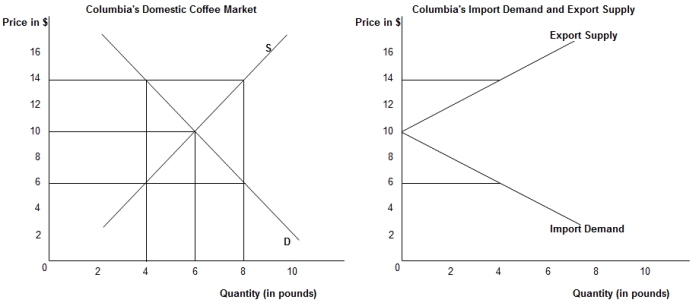 -Refer to Figure 20.1. If the price of coffee in the international market is $14:
 (Multiple Choice)
4.9/5 (79)
(79) The data in the table below assumes that with the same quantity of resources, both Australia and Philippines produces food and computers. Australia can make 1,000 computers or 2,000 units of food in a day, and the Philippines can make 200 computers or 1,200 units of food in a day.
Table 20.2
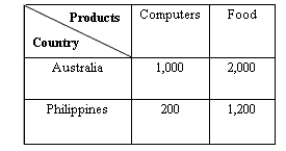 -According to Table 20.2, Australia has:
 (Multiple Choice)
4.9/5 (74)
(74) The simultaneous import and export of goods in the same industry by a particular country is known as interindustry trade.
(True/False)
4.9/5 (84)
(84) Which of the following countries receives the largest share of U.S. exports?
(Multiple Choice)
4.9/5 (75)
(75) The table below shows units of wheat and cloth produced by each worker per day in both the countries.
Table 20.1
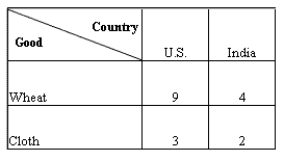 -Which of the following can be inferred from the information provided in Table 20.1?
 (Multiple Choice)
4.9/5 (63)
(63) The following table shows that in one day poultry farmers in Arkansas can produce 3 cartons of eggs, while poultry farmers in Idaho can produce 2 cartons of eggs. It takes Arkansas potato farmers one day to produce 30 tons of potatoes, while Idaho potato farmers produce 10 tons of potatoes in that same time.
Table 20.4
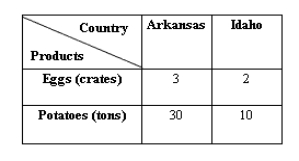 -According to Table 20.4, what is the opportunity cost of 1 crate of eggs in Idaho?
 (Multiple Choice)
5.0/5 (95)
(95) According to the Ricardian model, the source of comparative advantage is:
(Multiple Choice)
5.0/5 (71)
(71) The data in the table below assumes that with the same quantity of resources, both Australia and Philippines produces food and computers. Australia can make 1,000 computers or 2,000 units of food in a day, and the Philippines can make 200 computers or 1,200 units of food in a day.
Table 20.2
-According to Table 20.2, what is the opportunity cost of 1 computer in the Philippines?
-According to Table 20.2, what is the opportunity cost of 1 computer in the Philippines? (Multiple Choice)
4.7/5 (81)
(81) Which of the following factors are least likely to affect what countries end up trading in the international market?
(Multiple Choice)
5.0/5 (81)
(81) The following table shows that in one day poultry farmers in Arkansas can produce 3 cartons of eggs, while poultry farmers in Idaho can produce 2 cartons of eggs. It takes Arkansas potato farmers one day to produce 30 tons of potatoes, while Idaho potato farmers produce 10 tons of potatoes in that same time.
Table 20.4
-According to Table 20.4, the limits to the terms of trade in eggs are 1 carton of eggs in exchange for:
-According to Table 20.4, the limits to the terms of trade in eggs are 1 carton of eggs in exchange for: (Multiple Choice)
4.8/5 (64)
(64) A country has a comparative advantage when the opportunity cost of producing a good in terms of:
(Multiple Choice)
4.8/5 (81)
(81) 
Filters
- Essay(0)
- Multiple Choice(0)
- Short Answer(0)
- True False(0)
- Matching(0)