



 Chat with AI
Exam 21: Exchange Rates and Financial Links Between Countries

Exam 1: Economics: the World Around You90 Questions
Exam 2: Choice, Opportunity Costs, and Specialization98 Questions
Exam 3: Markets, Demand and Supply, and the Price System99 Questions
Exam 4: The Market System and the Private and Public Sector100 Questions
Exam 5: National Income Accounting104 Questions
Exam 6: An Introduction to the Foreign Exchange Market and the Balance of Payments90 Questions
Exam 7: Unemployment and Inflation130 Questions
Exam 8: Macroeconomic Equilibrium: Aggregate Demand and Supply123 Questions
Exam 9: Aggregate Expenditures120 Questions
Exam 10: Income and Expenditures Equilibrium135 Questions
Exam 11: Fiscal Policy94 Questions
Exam 12: Money and Banking125 Questions
Exam 13: Monetary Policy138 Questions
Exam 14: Macroeconomic Policy: Tradeoffs, Expectations, Credibility, and Sources of Business Cycles117 Questions
Exam 15: Macroeconomic Viewpoints: New Keynesian, Monetarist, and New Classical103 Questions
Exam 16: Economic Growth99 Questions
Exam 17: Development Economics105 Questions
Exam 18: Globalization85 Questions
Exam 19: World Trade Equilibrium112 Questions
Exam 20: International Trade Restrictions109 Questions
Exam 21: Exchange Rates and Financial Links Between Countries132 Questions
Select questions type


The euro floats against other currencies, but the member nations of the euro have no separate national money. For this reason, Spain, that uses the euro as its currency is listed under the managed float arrangement.
(True/False)
4.7/5  (85)
(85) Other things equal, an appreciation of the Algerian dinar in relation to the euro will act to increase Algerian demand for European goods and to decrease European demand for Algerian goods.
(True/False)
4.9/5 (79)
(79) When the exchange rate fluctuates around a fixed central target, allowing for a moderate amount of fluctuation, while tying the currency to the target central rate, the exchange rate is under:
(Multiple Choice)
4.8/5 (79)
(79) Which of the following can be categorized as a commodity money standard?
(Multiple Choice)
4.8/5 (73)
(73) Fixed exchange rates require the economic policies of countries linked by the exchange rate to be:
(Multiple Choice)
4.9/5 (74)
(74) The dollar return on a foreign investment is less than the interest rate on the foreign asset, if the foreign currency depreciates against the U.S. dollar between the purchase date and the maturity date.
(True/False)
4.7/5 (67)
(67) The IMF comprises of 50 member countries including all developed countries, and a few countries of Asia and Latin America.
(True/False)
4.9/5 (79)
(79) An upward-sloping supply curve of Korean won in terms of Canadian dollars indicates that:
(Multiple Choice)
4.7/5 (85)
(85) Suppose a 10-mile taxi ride costs £6.50 in London and $10.00 in Los Angeles. If the exchange rate is £1 = $1.70 purchasing power parity holds.
(True/False)
4.8/5 (71)
(71) Suppose you observe that with a given supply curve, the Peruvian demand for Argentinean pesos steadily decreases. This will most likely mean:
(Multiple Choice)
4.8/5 (77)
(77) The figure given below depicts the demand and supply of Brazilian reals in the foreign exchange market. Assume that the market operates under a flexible exchange rate regime.
Figure 21.1
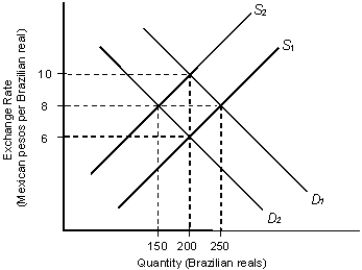 In the figure:
D1 and D2: Demand for Brazilian reals
S1 and S2: Supply of Brazilian reals
-Refer to Figure 21.1. Suppose the initial equilibrium exchange rate is 10 pesos per real. A decrease in the Mexican demand for Brazilian coffee, other things equal, is most likely to result in a new equilibrium exchange rate of:
In the figure:
D1 and D2: Demand for Brazilian reals
S1 and S2: Supply of Brazilian reals
-Refer to Figure 21.1. Suppose the initial equilibrium exchange rate is 10 pesos per real. A decrease in the Mexican demand for Brazilian coffee, other things equal, is most likely to result in a new equilibrium exchange rate of: (Multiple Choice)
4.9/5 (71)
(71) The World Bank was created to help finance economic development in poor countries.
(True/False)
4.9/5 (69)
(69) Countries that maintain a constant gold value for their currencies are said to be on a gold standard.
(True/False)
4.8/5 (85)
(85) The exchange-rate arrangement that emerged from the Bretton Woods conference is often called a managed float standard.
(True/False)
4.8/5 (85)
(85) In the foreign exchange market where French francs are traded for Japanese yen, a decrease in the interest rate in France is most likely to cause:
(Multiple Choice)
4.9/5 (91)
(91) When the exchange rate moves from $1 = CAD1.5 to $1 = CAD1.66, it implies:
(Multiple Choice)
5.0/5 (92)
(92) The Bretton Woods system required countries to actively buy and sell dollars to maintain fixed exchange rates when:
(Multiple Choice)
4.9/5 (76)
(76) When the domestic currency depreciates, domestic goods become more expensive to foreign buyers.
(True/False)
4.9/5 (62)
(62) Under a floating exchange-rate system, a country needs to pay more attention to the economic policies of the rest of the world.
(True/False)
4.9/5 (80)
(80) 
Filters
- Essay(0)
- Multiple Choice(0)
- Short Answer(0)
- True False(0)
- Matching(0)