



 Chat with AI
Exam 21: Exchange Rates and Financial Links Between Countries

Exam 1: Economics: the World Around You90 Questions
Exam 2: Choice, Opportunity Costs, and Specialization98 Questions
Exam 3: Markets, Demand and Supply, and the Price System99 Questions
Exam 4: The Market System and the Private and Public Sector100 Questions
Exam 5: National Income Accounting104 Questions
Exam 6: An Introduction to the Foreign Exchange Market and the Balance of Payments90 Questions
Exam 7: Unemployment and Inflation130 Questions
Exam 8: Macroeconomic Equilibrium: Aggregate Demand and Supply123 Questions
Exam 9: Aggregate Expenditures120 Questions
Exam 10: Income and Expenditures Equilibrium135 Questions
Exam 11: Fiscal Policy94 Questions
Exam 12: Money and Banking125 Questions
Exam 13: Monetary Policy138 Questions
Exam 14: Macroeconomic Policy: Tradeoffs, Expectations, Credibility, and Sources of Business Cycles117 Questions
Exam 15: Macroeconomic Viewpoints: New Keynesian, Monetarist, and New Classical103 Questions
Exam 16: Economic Growth99 Questions
Exam 17: Development Economics105 Questions
Exam 18: Globalization85 Questions
Exam 19: World Trade Equilibrium112 Questions
Exam 20: International Trade Restrictions109 Questions
Exam 21: Exchange Rates and Financial Links Between Countries132 Questions
Select questions type


If prices rise within a country, then, other things equal, the value of a unit of domestic currency will:
(Multiple Choice)
4.9/5  (76)
(76) Which of the following statements concerning the International Monetary Fund is true?
(Multiple Choice)
4.9/5 (95)
(95) The figure given below depicts the foreign exchange market for British pounds traded for U.S. dollars.
Figure 21.2
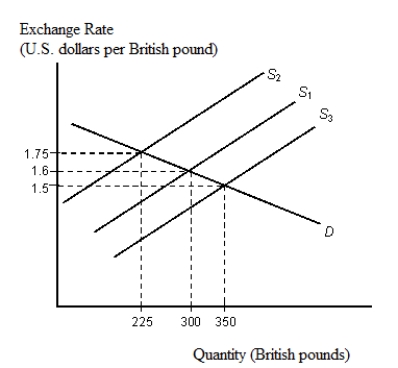 -Refer to Figure 21.2. At the initial equilibrium point, with demand curve D and supply curve S1:
 (Multiple Choice)
4.7/5 (78)
(78) Suppose the price of an ounce of silver is 100 nuevos soles in Peru and $400 in the United States. This implies:
(Multiple Choice)
4.8/5 (100)
(100) World Bank funds are largely acquired through interest earned on the deposits of member nations.
(True/False)
4.8/5 (83)
(83) Because of their greediness, speculators are considered bad for exchange-rate markets.
(True/False)
4.8/5 (79)
(79) Under the flexible exchange rate system, when a country tries to stimulate economic growth and improve its employment rates, it is likely to cause:
(Multiple Choice)
4.9/5 (76)
(76) To ensure interest rate parity, a decrease in the interest rate on Euroyen relative to Eurodollar deposits will require a greater expected appreciation of the Japanese yen against the U.S. dollar.
(True/False)
5.0/5 (87)
(87) When an exchange rate is established as a fixed peg, active intervention may be required to maintain the target-pegged rate.
(True/False)
4.8/5 (84)
(84) If you receive a dollar return of 6 percent on a one-year Korean bond that yields 10 percent annually, this means that between the purchase date and the time of maturity:
(Multiple Choice)
4.8/5 (71)
(71) Suppose that the price of an ounce of gold is 120 pesos in Mexico and 2,400 yen in Japan. Then the Japanese yen is worth two hundred times the value of a Mexican peso.
(True/False)
4.8/5 (83)
(83) Given a one-year Canadian bond with a yield of 8 percent, what will be the U.S. investor's rate of return at maturity if the Canadian dollar appreciates 10 percent against the U.S. dollar?
(Multiple Choice)
4.8/5 (82)
(82) Assume that a country's government influences the exchange rate through active central bank intervention, with no pre-announced path. This policy is known as a(n):
(Multiple Choice)
4.9/5 (82)
(82) Suppose a U.S. firm buys a one-year U.K. bond for 6,000 British pounds when 1 British pound is worth $1.50 on the foreign exchange market. What is the firm's approximate rate of return on the bond if the interest rate on the bond is 15 percent and the exchange rate is 1 British pound is worth $1.93 at maturity?
(Multiple Choice)
4.9/5 (87)
(87) If a dollar invested in the United States yields the same return as a dollar's worth of yen invested in Japan, then it implies that:
(Multiple Choice)
5.0/5 (95)
(95) The figure given below depicts the demand and supply of Brazilian reals in the foreign exchange market. Assume that the market operates under a flexible exchange rate regime.
Figure 21.1
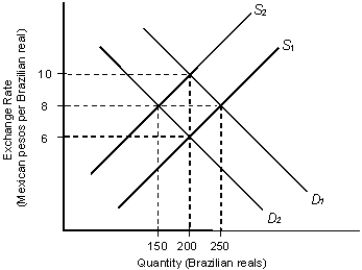 In the figure:
D1 and D2: Demand for Brazilian reals
S1 and S2: Supply of Brazilian reals
-Refer to Figure 21.1. The demand curves shown for Brazilian reals are based on:
In the figure:
D1 and D2: Demand for Brazilian reals
S1 and S2: Supply of Brazilian reals
-Refer to Figure 21.1. The demand curves shown for Brazilian reals are based on: (Multiple Choice)
4.9/5 (64)
(64) The annual membership fees of the 185 member countries of the IMF are called:
(Multiple Choice)
4.8/5 (81)
(81) An Australian investor buys a U.S. Treasury bond that has a price of $10,000, pays 5 percent interest, and matures in a year. Between the purchase date and the maturity date, the exchange rate changes from $1 = AUD 5.0 to $1= AUD 5.2. What will be the Australian investor's rate of return from the U.S. bond?
(Multiple Choice)
5.0/5 (98)
(98) In effect, during the period immediately following World War II, the world was on a(n):
(Multiple Choice)
4.8/5 (74)
(74) 
Filters
- Essay(0)
- Multiple Choice(0)
- Short Answer(0)
- True False(0)
- Matching(0)