



 Chat with AI
Exam 21: Exchange Rates and Financial Links Between Countries

Exam 1: Economics: the World Around You90 Questions
Exam 2: Choice, Opportunity Costs, and Specialization98 Questions
Exam 3: Markets, Demand and Supply, and the Price System99 Questions
Exam 4: The Market System and the Private and Public Sector100 Questions
Exam 5: National Income Accounting104 Questions
Exam 6: An Introduction to the Foreign Exchange Market and the Balance of Payments90 Questions
Exam 7: Unemployment and Inflation130 Questions
Exam 8: Macroeconomic Equilibrium: Aggregate Demand and Supply123 Questions
Exam 9: Aggregate Expenditures120 Questions
Exam 10: Income and Expenditures Equilibrium135 Questions
Exam 11: Fiscal Policy94 Questions
Exam 12: Money and Banking125 Questions
Exam 13: Monetary Policy138 Questions
Exam 14: Macroeconomic Policy: Tradeoffs, Expectations, Credibility, and Sources of Business Cycles117 Questions
Exam 15: Macroeconomic Viewpoints: New Keynesian, Monetarist, and New Classical103 Questions
Exam 16: Economic Growth99 Questions
Exam 17: Development Economics105 Questions
Exam 18: Globalization85 Questions
Exam 19: World Trade Equilibrium112 Questions
Exam 20: International Trade Restrictions109 Questions
Exam 21: Exchange Rates and Financial Links Between Countries132 Questions
Select questions type


Purchasing power parity holds when the exchange rate is equal to the product of the foreign price level and the domestic price level.
(True/False)
4.8/5  (65)
(65) Carlos Silva, a Colombian singer, goes on tour to the United States for one month, following high American demand for his live shows. Assuming that all the show's expenses are paid by the U.S. promoters, other things equal, the U.S. tour will bring about:
(Multiple Choice)
4.8/5 (88)
(88) If the price of an ounce of gold is 200 ZARs in South Africa and $75 in Canada, what will be the South African Rand (ZAR) per Canadian dollar (C$) exchange rate?
(Multiple Choice)
4.8/5 (85)
(85) The figure given below depicts the foreign exchange market for British pounds traded for U.S. dollars.
Figure 21.2
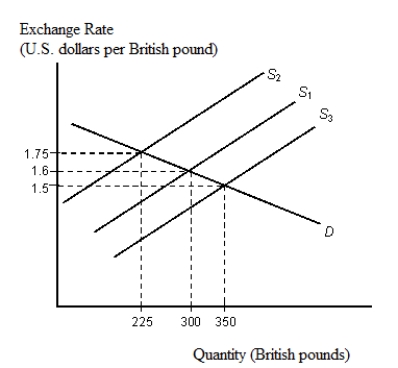 -Refer to Figure 21.2. An increase in the equilibrium quantity of British pounds from 300 to 350 would most likely mean that:
 (Multiple Choice)
4.8/5 (69)
(69) The figure given below depicts the foreign exchange market for British pounds traded for U.S. dollars.
Figure 21.2
-Refer to Figure 21.2. Suppose the British central bank is committed to maintaining an exchange rate of £1 = $1.50, but there is a permanent shift in supply from S1 to S3. According to the Bretton Woods agreement:
-Refer to Figure 21.2. Suppose the British central bank is committed to maintaining an exchange rate of £1 = $1.50, but there is a permanent shift in supply from S1 to S3. According to the Bretton Woods agreement: (Multiple Choice)
4.9/5 (76)
(76) If $1 was equivalent to 120 Japanese yen in 2008 and 125 Japanese yen in 2010, it implies in 2010, there was:
(Multiple Choice)
4.9/5 (87)
(87) Suppose a permanent increase in demand for the Argentinean peso causes a chronic shortage of this currency in the foreign exchange market. The Argentinean government should then:
(Multiple Choice)
4.9/5 (84)
(84) When a U.S. importer needs $22,000 to settle an invoice for 25,520 Swiss francs, the exchange rate must be:
(Multiple Choice)
4.9/5 (76)
(76) Assume a U.S. investor buys a Mexican bond with a face value of MXP 1,000 and a 20 percent annual interest yield while the exchange rate is MXP 10 per dollar. What is the dollar return from the bond if the exchange rate at the end of the year is MXP 11 per dollar?
(Multiple Choice)
4.7/5 (78)
(78) The supply of Thai baht in the foreign exchange market originates with:
(Multiple Choice)
4.8/5 (89)
(89) Appreciation of the dollar means that now it takes more dollars to buy one unit of foreign currency.
(True/False)
4.8/5 (83)
(83) The figure given below depicts the foreign exchange market for British pounds traded for U.S. dollars.
Figure 21.2
-Refer to Figure 21.2. Suppose that the British central bank wishes to maintain a fixed exchange rate of £1 = $1.60. If supply decreases from S1 to S2, the bank must:
-Refer to Figure 21.2. Suppose that the British central bank wishes to maintain a fixed exchange rate of £1 = $1.60. If supply decreases from S1 to S2, the bank must: (Multiple Choice)
4.9/5 (73)
(73) Which of the following had resulted from the Smithsonian agreement of 1971?
(Multiple Choice)
4.9/5 (63)
(63) Deviations from purchasing power parity will be increasingly higher as international trade tariffs become more restrictive. The main reason for this phenomenon is that:
(Multiple Choice)
4.7/5 (94)
(94) Demand for U.S. dollars by speculators is likely to increase if the dollar is expected to depreciate in the near future.
(True/False)
4.8/5 (77)
(77) Assume that a Chrysler automobile sells for $15,000 in the United States and that the exchange rate is $1 = €1.3. For purchasing power parity to hold, the same car should sell in Germany for:
(Multiple Choice)
4.9/5 (92)
(92) Suppose a U.S. citizen invests $1,000 to purchase a one-year Japanese bond that has an interest yield of 10 percent. If the dollar appreciates 20 percent against the Japanese yen by the maturity date, the dollar value of the proceeds is _____.
(Multiple Choice)
4.9/5 (80)
(80) The Bretton Woods System of exchange rates was established:
(Multiple Choice)
4.9/5 (85)
(85) 
Filters
- Essay(0)
- Multiple Choice(0)
- Short Answer(0)
- True False(0)
- Matching(0)