



 Chat with AI
Exam 5: Photosynthesis

Exam 1: Invitation to Biology99 Questions
Exam 2: Molecules of Life98 Questions
Exam 3: Cell Structure101 Questions
Exam 4: Energy and Metabolism95 Questions
Exam 5: Photosynthesis93 Questions
Exam 6: Releasing Chemical Energy77 Questions
Exam 7: Dna Structure and Function99 Questions
Exam 8: Gene Expression and Control96 Questions
Exam 9: How Cells Reproduce99 Questions
Exam 10: Patterns of Inheritance88 Questions
Exam 11: Biotechnology100 Questions
Exam 12: Evidence of Evolution85 Questions
Exam 13: Processes of Evolution99 Questions
Exam 14: Prokaryotes, Protists, and Viruses95 Questions
Exam 15: Plants and Fungi100 Questions
Exam 16: Animal Evolution100 Questions
Exam 17: Population Ecology94 Questions
Exam 18: Communities and Ecosystems100 Questions
Exam 19: The Biosphere and Human Effects100 Questions
Exam 20: Animal Tissues and Organs97 Questions
Exam 21: How Animals Move100 Questions
Exam 22: Circulation and Respiration100 Questions
Exam 23: Immunity100 Questions
Exam 24: Digestion and Excretion100 Questions
Exam 25: Neural Control and the Senses100 Questions
Exam 26: Endocrine Control100 Questions
Exam 27: Animal Reproduction and Development101 Questions
Exam 28: Plant Form and Function100 Questions
Exam 29: Life Cycles of Flowering Plants100 Questions
Select questions type


The purpose of closing stomata in plants is to prevent ____.
(Multiple Choice)
4.7/5  (96)
(96) The processes described below represent major chemical pathways in the photosynthetic process. Match each description to the corresponding process.
-Which process is catalyzed by an enzyme called rubisco?
A)light-dependent reactions
B)electron transfer phosphorylation
C)carbon dioxide fixation
D)Calvin-Benson cycle
E)photosynthesis
(Short Answer)
4.8/5 (81)
(81) Why does the efficiency of sugar production decrease when stomata are closed in C3 plants?
(Multiple Choice)
4.9/5 (81)
(81) In the light-dependent reactions of photosynthesis, what is the ultimate fate of the electrons released from photosystem absorption of light energy?
(Multiple Choice)
4.9/5 (70)
(70) Early organisms were anaerobic. As early organisms evolved the ability to harness energy from the sun, other organisms began to die out because they were ____.
(Multiple Choice)
4.9/5 (66)
(66) Matching
During the light-dependent reactions in the thylakoid membrane, light energy is converted to ATP.Match the specified labels in the diagram with their corresponding functions. 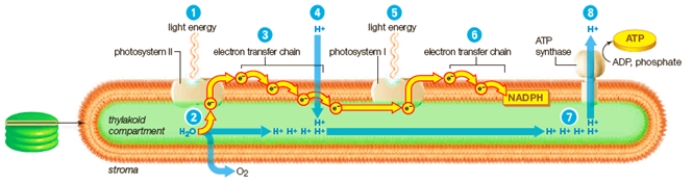 a.final acceptor of electrons
b.transfer of electrons between molecules
c.release of electrons into the photosystem
d.active transport of hydrogen ions to establish gradient
e.passive transport of hydrogen ions down a gradient
f.enzymatic phosphorylation
g.replacement of electrons by hydrolysis
-Which process is indicated by labels 1 and 5?
a.final acceptor of electrons
b.transfer of electrons between molecules
c.release of electrons into the photosystem
d.active transport of hydrogen ions to establish gradient
e.passive transport of hydrogen ions down a gradient
f.enzymatic phosphorylation
g.replacement of electrons by hydrolysis
-Which process is indicated by labels 1 and 5? (Short Answer)
4.8/5 (60)
(60) The primary purpose of splitting the water in the light-dependent reactions of photosynthesis is to ____.
(Multiple Choice)
4.8/5 (77)
(77) Match each description with the corresponding term.
-a process resulting in the formation of ATP and NADH
A)carbon fixation
B)light-dependent reactions
C)photosystem II
D)light-independent reactions
E)electron transfer phosphorylation
(Short Answer)
4.8/5 (87)
(87) In the thylakoid membrane, potential energy can be used to make ____.
(Multiple Choice)
4.7/5 (76)
(76) Match each description with the corresponding term.
-electron transfer chains that drive the formation of ATP
A)carbon fixation
B)light-dependent reactions
C)photosynthesis
D)Calvin-Benson cycle
E)electron transfer phosphorylation
(Short Answer)
4.9/5 (83)
(83) You are a botanist living in the desert. A friend asks you which plant would be most practical to plant in his or her yard. What is your answer?
(Multiple Choice)
5.0/5 (73)
(73) Matching
During the light-dependent reactions in the thylakoid membrane, light energy is converted to ATP.Match the specified labels in the diagram with their corresponding functions. a.final acceptor of electrons
b.transfer of electrons between molecules
c.release of electrons into the photosystem
d.active transport of hydrogen ions to establish gradient
e.passive transport of hydrogen ions down a gradient
f.enzymatic phosphorylation
g.replacement of electrons by hydrolysis
-Which process is indicated by label 3?
a.final acceptor of electrons
b.transfer of electrons between molecules
c.release of electrons into the photosystem
d.active transport of hydrogen ions to establish gradient
e.passive transport of hydrogen ions down a gradient
f.enzymatic phosphorylation
g.replacement of electrons by hydrolysis
-Which process is indicated by label 3? (Short Answer)
4.8/5 (74)
(74) How many carbon dioxide molecules does it take to synthesize one molecule of glucose?
(Multiple Choice)
4.9/5 (68)
(68) Which photosynthetic pigment is most efficient at absorbing near-infrared light?
(Multiple Choice)
4.8/5 (87)
(87) In cyanobacteria, light-dependent reactions are carried out by molecules in ____.
(Multiple Choice)
4.8/5 (75)
(75) 
Filters
- Essay(0)
- Multiple Choice(0)
- Short Answer(0)
- True False(0)
- Matching(0)