



 Chat with AI
Exam 5: Photosynthesis

Exam 1: Invitation to Biology99 Questions
Exam 2: Molecules of Life98 Questions
Exam 3: Cell Structure101 Questions
Exam 4: Energy and Metabolism95 Questions
Exam 5: Photosynthesis93 Questions
Exam 6: Releasing Chemical Energy77 Questions
Exam 7: Dna Structure and Function99 Questions
Exam 8: Gene Expression and Control96 Questions
Exam 9: How Cells Reproduce99 Questions
Exam 10: Patterns of Inheritance88 Questions
Exam 11: Biotechnology100 Questions
Exam 12: Evidence of Evolution85 Questions
Exam 13: Processes of Evolution99 Questions
Exam 14: Prokaryotes, Protists, and Viruses95 Questions
Exam 15: Plants and Fungi100 Questions
Exam 16: Animal Evolution100 Questions
Exam 17: Population Ecology94 Questions
Exam 18: Communities and Ecosystems100 Questions
Exam 19: The Biosphere and Human Effects100 Questions
Exam 20: Animal Tissues and Organs97 Questions
Exam 21: How Animals Move100 Questions
Exam 22: Circulation and Respiration100 Questions
Exam 23: Immunity100 Questions
Exam 24: Digestion and Excretion100 Questions
Exam 25: Neural Control and the Senses100 Questions
Exam 26: Endocrine Control100 Questions
Exam 27: Animal Reproduction and Development101 Questions
Exam 28: Plant Form and Function100 Questions
Exam 29: Life Cycles of Flowering Plants100 Questions
Select questions type


How do plants compensate for rubisco's inefficiency at sugar production?
(Multiple Choice)
4.7/5  (81)
(81) Which source of energy powers the light-independent reactions of photosynthesis?
(Multiple Choice)
4.8/5 (81)
(81) In which of the following do the light-dependent reactions of photosynthesis take place?
(Multiple Choice)
4.8/5 (85)
(85) When organic molecules are broken and carbon dioxide is released into the atmosphere through burning, this is essentially the reverse of____.
(Multiple Choice)
4.8/5 (70)
(70) Which of the following is the correct order of wavelengths from lowest to highest energy?
(Multiple Choice)
4.8/5 (86)
(86) The energy generated in the first electron transfer chain in the light-dependent reactions of photosynthesis is used to ____.
(Multiple Choice)
4.8/5 (79)
(79) What powers the ATP synthase enzyme in the light-dependent reactions of photosynthesis?
(Multiple Choice)
4.9/5 (81)
(81) Which five-carbon molecule is the starting compound of the Calvin-Benson cycle?
(Multiple Choice)
5.0/5 (77)
(77) The conversion of solar energy into chemical energy occurs during ____.
(Multiple Choice)
4.9/5 (77)
(77) Which enzyme carries out carbon fixation during the Calvin-Benson cycle?
(Multiple Choice)
5.0/5 (74)
(74) Visible light comprises wavelengths that vary between ____ nanometers.
(Multiple Choice)
4.9/5 (83)
(83) Matching
During the light-dependent reactions in the thylakoid membrane, light energy is converted to ATP.Match the specified labels in the diagram with their corresponding functions. 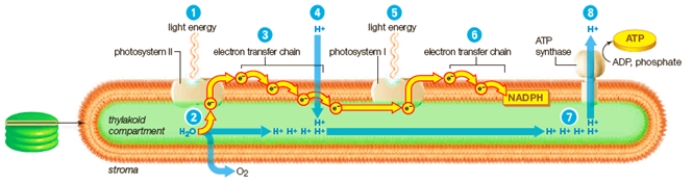 a.final acceptor of electrons
b.transfer of electrons between molecules
c.release of electrons into the photosystem
d.active transport of hydrogen ions to establish gradient
e.passive transport of hydrogen ions down a gradient
f.enzymatic phosphorylation
g.replacement of electrons by hydrolysis
-Which process is indicated by label 4?
a.final acceptor of electrons
b.transfer of electrons between molecules
c.release of electrons into the photosystem
d.active transport of hydrogen ions to establish gradient
e.passive transport of hydrogen ions down a gradient
f.enzymatic phosphorylation
g.replacement of electrons by hydrolysis
-Which process is indicated by label 4? (Short Answer)
4.9/5 (75)
(75) What are the advantages of plants that minimize photorespiration?
(Multiple Choice)
4.9/5 (68)
(68) Matching
During the light-dependent reactions in the thylakoid membrane, light energy is converted to ATP.Match the specified labels in the diagram with their corresponding functions. a.final acceptor of electrons
b.transfer of electrons between molecules
c.release of electrons into the photosystem
d.active transport of hydrogen ions to establish gradient
e.passive transport of hydrogen ions down a gradient
f.enzymatic phosphorylation
g.replacement of electrons by hydrolysis
-What occurs at the end of the process indicated by label 6?
a.final acceptor of electrons
b.transfer of electrons between molecules
c.release of electrons into the photosystem
d.active transport of hydrogen ions to establish gradient
e.passive transport of hydrogen ions down a gradient
f.enzymatic phosphorylation
g.replacement of electrons by hydrolysis
-What occurs at the end of the process indicated by label 6? (Short Answer)
4.8/5 (75)
(75) The carbon dioxide acceptor in the Calvin-Benson cycle of photosynthesis is ____.
(Multiple Choice)
4.8/5 (76)
(76) In the fall, ____ become(s) visible in plants that are preparing for dormancy.
(Multiple Choice)
5.0/5 (84)
(84) 
Filters
- Essay(0)
- Multiple Choice(0)
- Short Answer(0)
- True False(0)
- Matching(0)