



 Chat with AI
Exam 5: Photosynthesis

Exam 1: Invitation to Biology99 Questions
Exam 2: Molecules of Life98 Questions
Exam 3: Cell Structure101 Questions
Exam 4: Energy and Metabolism95 Questions
Exam 5: Photosynthesis93 Questions
Exam 6: Releasing Chemical Energy77 Questions
Exam 7: Dna Structure and Function99 Questions
Exam 8: Gene Expression and Control96 Questions
Exam 9: How Cells Reproduce99 Questions
Exam 10: Patterns of Inheritance88 Questions
Exam 11: Biotechnology100 Questions
Exam 12: Evidence of Evolution85 Questions
Exam 13: Processes of Evolution99 Questions
Exam 14: Prokaryotes, Protists, and Viruses95 Questions
Exam 15: Plants and Fungi100 Questions
Exam 16: Animal Evolution100 Questions
Exam 17: Population Ecology94 Questions
Exam 18: Communities and Ecosystems100 Questions
Exam 19: The Biosphere and Human Effects100 Questions
Exam 20: Animal Tissues and Organs97 Questions
Exam 21: How Animals Move100 Questions
Exam 22: Circulation and Respiration100 Questions
Exam 23: Immunity100 Questions
Exam 24: Digestion and Excretion100 Questions
Exam 25: Neural Control and the Senses100 Questions
Exam 26: Endocrine Control100 Questions
Exam 27: Animal Reproduction and Development101 Questions
Exam 28: Plant Form and Function100 Questions
Exam 29: Life Cycles of Flowering Plants100 Questions
Select questions type


The processes described represent major chemical pathways in the photosynthetic process. Match each description to the corresponding process.
-Water is split in which process?
A)light-dependent reactions
B)electron transfer phosphorylation
C)carbon dioxide fixation
D)Calvin-Benson cycle
E)light-independent reactions
(Short Answer)
4.9/5  (76)
(76) The processes described represent major chemical pathways in the photosynthetic process. Match each description to the corresponding process.
-Electron transfer drives ATP formation in which process?
A)light-dependent reactions
B)electron transfer phosphorylation
C)carbon dioxide fixation
D)Calvin-Benson cycle
E)light-independent reactions
(Short Answer)
4.8/5 (61)
(61) Matching
During the light-dependent reactions in the thylakoid membrane, light energy is converted to ATP.Match the specified labels in the diagram with their corresponding functions. 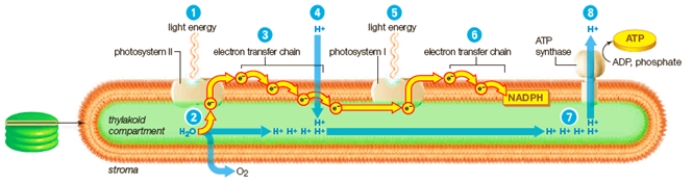 a.final acceptor of electrons
b.transfer of electrons between molecules
c.release of electrons into the photosystem
d.active transport of hydrogen ions to establish gradient
e.passive transport of hydrogen ions down a gradient
f.enzymatic phosphorylation
g.replacement of electrons by hydrolysis
-Which process is indicated by label 8?
a.final acceptor of electrons
b.transfer of electrons between molecules
c.release of electrons into the photosystem
d.active transport of hydrogen ions to establish gradient
e.passive transport of hydrogen ions down a gradient
f.enzymatic phosphorylation
g.replacement of electrons by hydrolysis
-Which process is indicated by label 8? (Short Answer)
4.9/5 (72)
(72) The Calvin-Benson cycle is a cyclical pathway of reactions that use ____.
(Multiple Choice)
4.9/5 (70)
(70) For six molecules of carbon dioxide fixed in the light-independent reaction, how many molecules of PGA are produced?
(Multiple Choice)
4.8/5 (74)
(74) In light-dependent reactions, hydrogen ions are transported into the thylakoid membrane. What drives the movement of these ions?
(Multiple Choice)
4.9/5 (82)
(82) Photorespiration ____ the efficiency of sugar production and ____ the amount of carbon fixation.
(Multiple Choice)
4.8/5 (85)
(85) In which cellular organelle does photosynthesis take place?
(Multiple Choice)
4.8/5 (67)
(67) The most direct product of the Calvin-Benson cycle, which can be used to continue to cycle but which is also exported for other uses such as glucose synthesis, is ____.
(Multiple Choice)
4.9/5 (85)
(85) In the thylakoid membrane, photosynthetic pigments are held together by ____.
(Multiple Choice)
4.9/5 (73)
(73) Match each description with the corresponding term.
-the first part of the Calvin-Benson cycle
A)carbon fixation
B)light-dependent reactions
C)photosystem II
D)light-independent reactions
E)electron transfer phosphorylation
(Short Answer)
4.8/5 (75)
(75) In a noncyclic pathway, ____ provides replacement electrons for photosystem I.
(Multiple Choice)
4.8/5 (72)
(72) The products of light-dependent reactions of photosynthesis are ____.
(Multiple Choice)
4.8/5 (91)
(91) Consider Calvin-Benson cycle. What is the correct sequence in the series of reactions? I.
Carbon fixation
II.
Regeneration
III.
Reduction
(Multiple Choice)
4.9/5 (89)
(89) How many PGA molecules (net yield) are produced per molecule of CO2 during carbon fixation?
(Multiple Choice)
4.8/5 (69)
(69) The electrons that are passed to NADP+ at the end of the electron transfer chain were obtained from ____.
(Multiple Choice)
4.8/5 (72)
(72) 
Filters
- Essay(0)
- Multiple Choice(0)
- Short Answer(0)
- True False(0)
- Matching(0)