



 Chat with AI
Exam 15: Infectious Diseases: Traditional and Alternate Diagnostic Techniques

Exam 1: An Overview of Immunology27 Questions
Exam 2: Antigens and Antibodies50 Questions
Exam 3: Cells and Cellular Activities of the Immune System: Granulocytes and Mononuclear Cells30 Questions
Exam 4: Cells and Cellular Activities of the Immune System: Lymphocytes and Plasma Cells25 Questions
Exam 5: Soluble Mediators of the Immune System23 Questions
Exam 6: Safety in the Immunology-Serology Laboratory24 Questions
Exam 7: Quality Assurance and Quality Control25 Questions
Exam 8: Basic Serologic Laboratory Techniques17 Questions
Exam 9: Rapid Testing16 Questions
Exam 10: Precipitation and Particle Agglutination Methods36 Questions
Exam 11: Electrophoresis Techniques13 Questions
Exam 12: Labeling Techniques in Immunoassay24 Questions
Exam 13: Flow Cytometry18 Questions
Exam 14: Molecular Laboratory Techniques28 Questions
Exam 15: Infectious Diseases: Traditional and Alternate Diagnostic Techniques31 Questions
Exam 16: Streptococcal Infections27 Questions
Exam 17: Syphilis26 Questions
Exam 18: Vector-Borne Diseases23 Questions
Exam 19: Toxoplasmosis16 Questions
Exam 20: Cytomegalovirus27 Questions
Exam 21: Infectious Mononucleosis23 Questions
Exam 22: Viral Hepatitis23 Questions
Exam 23: Rubella and Rubeola Infections24 Questions
Exam 24: Primary and Acquired Immune Deficiency Syndromes31 Questions
Exam 25: Hypersensitivity Reactions14 Questions
Exam 26: Immunoproliferative Disorders24 Questions
Exam 27: Tolerance, Autoimmunity, and Autoimmune Diseases25 Questions
Exam 28: Systemic Lupus Erythematosus20 Questions
Exam 29: Rheumatoid Arthritis19 Questions
Exam 30: Transplantation: Hla, Solid Organ, and Hematopoietic Stem Cells30 Questions
Exam 31: Tumor Immunology and Up-To-Date Applications of Next-Generation Sequencing26 Questions
Exam 32: Primer on Vaccines14 Questions
Select questions type


A microorganism can survive phagocytosis if it possesses a

Free
(Multiple Choice)
4.9/5  (83)
(83) Correct Answer: Verified
B
Match the microorganism with the appropriate procedural method (use an answer only once).
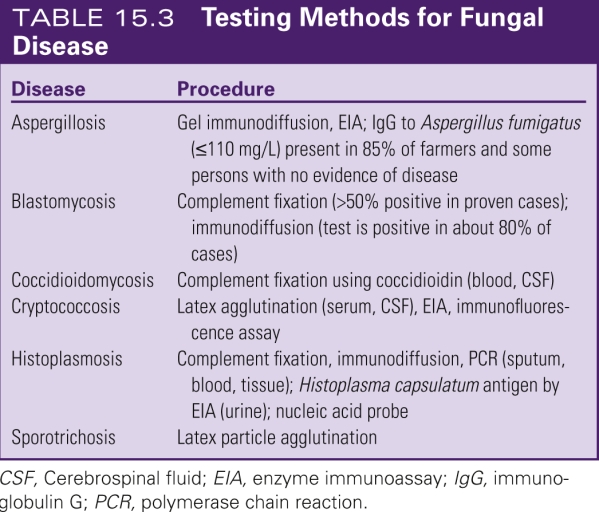 -Aspergillosis
Free
(Multiple Choice)
4.7/5 (78)
(78) Correct Answer:Verified
VerifiedB
The TORCH immunoglobulin M (IgM) and IgG assay includes detection of all the following except
Free
(Multiple Choice)
4.7/5 (85)
(85) Correct Answer:Verified
VerifiedD
Factors that can influence exposure to, or actual development of, an infectious disease include all the following factors except the
(Multiple Choice)
4.9/5 (66)
(66) Fungal infections can be opportunistic infections in patients who:
(Multiple Choice)
4.8/5 (74)
(74)
Match the microorganism with the appropriate procedural method (use an answer only once).
-Sporotrichosis
-Sporotrichosis (Multiple Choice)
4.9/5 (74)
(74) The burden of adaptive immunity in preventing the spread of viruses rests on
(Multiple Choice)
5.0/5 (78)
(78) Match the infectious diseases with the appropriate description.
-Reactivation of the virus results in the characteristic clinical manifestation of __________.
(Multiple Choice)
4.9/5 (86)
(86) Major immunologic defense mechanisms against bacteria include
(Multiple Choice)
4.9/5 (76)
(76) Match the traditional immunohistochemistry technique with the correct characteristic.
-Direct Immunohistochemistry Protocol _____.
(Multiple Choice)
4.9/5 (66)
(66) Match the infectious diseases with the appropriate description.
-Primary infection with the virus results in the clinical manifestations of __________.
(Multiple Choice)
4.8/5 (62)
(62) Match the infectious diseases with the appropriate description.
-Toxoplasmosis
(Multiple Choice)
4.9/5 (77)
(77) The most frequent manifestation of herpes simplex virus (HSV) is
(Multiple Choice)
4.8/5 (85)
(85) High levels of circulating ________ may cause hypersensitivity reactions in helminth and cestode infections.
(Multiple Choice)
4.8/5 (73)
(73) Antibodies associated with body defenses against parasites include _______-type antibodies.
(Multiple Choice)
4.8/5 (71)
(71) The incidence of antibody to herpes simplex virus (HSV) is __________ in adults of higher socioeconomic class compared with those in lower socioeconomic classes.
(Multiple Choice)
4.9/5 (76)
(76) Survival mechanisms of fungi that successfully invade the body include:
(Multiple Choice)
4.9/5 (76)
(76) 
Filters
- Essay(0)
- Multiple Choice(0)
- Short Answer(0)
- True False(0)
- Matching(0)