



 Chat with AI
Exam 3: Forecasting

Exam 1: Introduction to Operations Management78 Questions
Exam 2: Competitiveness, Strategy, and Productivity75 Questions
Exam 3: Forecasting144 Questions
Exam 4: Product and Service Design100 Questions
Exam 5: Strategic Capacity Planning for Products and Services210 Questions
Exam 6: Process Selection and Facility Layout137 Questions
Exam 7: Work Design and Measurement200 Questions
Exam 8: Location Planning and Analysis65 Questions
Exam 9: Management of Quality101 Questions
Exam 10: Quality Control117 Questions
Exam 11: Aggregate Planning and Master Scheduling80 Questions
Exam 12: Inventory Management134 Questions
Exam 13: MRP and ERP85 Questions
Exam 14: Jit and Lean Operations126 Questions
Exam 15: Supply Chain Management91 Questions
Exam 16: Scheduling102 Questions
Exam 17: Project Management118 Questions
Exam 18: Management of Waiting Lines68 Questions
Exam 19: Linear Programming98 Questions
Select questions type


Forecasting techniques that are based on time-series data assume that future values of the series will duplicate past values.
(True/False)
4.7/5  (85)
(85) Which of the following mechanisms for enhancing profitability is most likely to result from improving short-term forecast performance?
(Multiple Choice)
4.8/5 (69)
(69) Bias is measured by the ratio of the cumulative sum of forecast errors to the mean absolute deviation (MAD).
(True/False)
4.8/5 (65)
(65) The more novel a new product or service design is, the more forecasters have to rely on
(Multiple Choice)
4.9/5 (79)
(79) The use of a control chart assumes that random errors are normally distributed about a mean of zero.
(True/False)
4.8/5 (80)
(80) Given the following historical data and weights of 0.5, 0.3, and 0.2, what is the three-period moving average forecast for period 5?

(Multiple Choice)
4.8/5 (59)
(59) The naive forecast is limited in its application to series that reflect no trend or seasonality.
(True/False)
4.8/5 (86)
(86) A forecast based on the previous forecast plus a percentage of the forecast error is:
(Multiple Choice)
4.8/5 (69)
(69) A control chart involves setting action limits for cumulative forecast error.
(True/False)
4.8/5 (86)
(86) A concert promoter is forecasting this year's attendance for one of his concerts based on the following historical data:
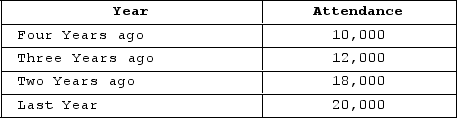 What is this year's forecast using the naive approach?
 (Multiple Choice)
4.8/5 (91)
(91) Given an actual demand of 59, a previous forecast of 64, and an alpha of 0.3, what would the forecast for the next period be using simple exponential smoothing?
(Multiple Choice)
4.8/5 (86)
(86) Exponential smoothing adds a percentage (called alpha)of the last period's forecast to estimate the next period's demand.
(True/False)
4.7/5 (75)
(75) The owner of Darkest Tans Unlimited in a local mall is forecasting this month's (October's)demand for the one new tanning booth based on the following historical data:
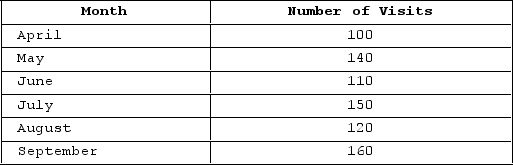 What is the monthly rate of change (slope)of the least squares trend line for these data?
 (Multiple Choice)
4.9/5 (72)
(72) Which of the following is not a type of judgmental forecasting?
(Multiple Choice)
4.8/5 (80)
(80) A manager uses the following equation to predict monthly receipts: Y t = 40,000 + 150t. What is the forecast for July if t = 0 in April of this year?
(Multiple Choice)
4.8/5 (78)
(78) 
Filters
- Essay(0)
- Multiple Choice(0)
- Short Answer(0)
- True False(0)
- Matching(0)