



 Chat with AI
Exam 3: Forecasting

Exam 1: Introduction to Operations Management78 Questions
Exam 2: Competitiveness, Strategy, and Productivity75 Questions
Exam 3: Forecasting144 Questions
Exam 4: Product and Service Design100 Questions
Exam 5: Strategic Capacity Planning for Products and Services210 Questions
Exam 6: Process Selection and Facility Layout137 Questions
Exam 7: Work Design and Measurement200 Questions
Exam 8: Location Planning and Analysis65 Questions
Exam 9: Management of Quality101 Questions
Exam 10: Quality Control117 Questions
Exam 11: Aggregate Planning and Master Scheduling80 Questions
Exam 12: Inventory Management134 Questions
Exam 13: MRP and ERP85 Questions
Exam 14: Jit and Lean Operations126 Questions
Exam 15: Supply Chain Management91 Questions
Exam 16: Scheduling102 Questions
Exam 17: Project Management118 Questions
Exam 18: Management of Waiting Lines68 Questions
Exam 19: Linear Programming98 Questions
Select questions type


A seasonal relative (or seasonal indexes)is expressed as a percentage of average or trend.
(True/False)
5.0/5  (92)
(92) A concert promoter is forecasting this year's attendance for one of his concerts based on the following historical data:
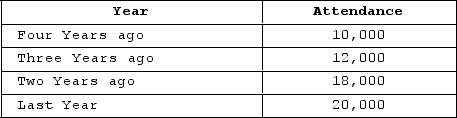 What is this year's forecast using a two-year weighted moving average with weights of 0.7 and 0.3?
 (Multiple Choice)
4.8/5 (77)
(77) The owner of Yummy Yummy Catering needs to ensure she has enough employees scheduled for the upcoming week to assist with cooking. She needs to forecast the number of clients that will book her services. She has the following historical data:
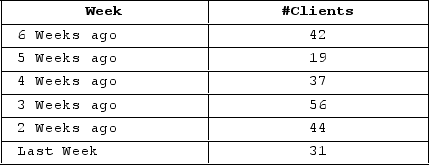 What is the forecast for this week using weighted moving average with weights of 0.5, 0.3, and 0.2?
 (Multiple Choice)
4.8/5 (82)
(82) When new products or services are introduced, focus forecasting models are an attractive option.
(True/False)
4.7/5 (84)
(84) The president of State University wants to forecast student enrollments for this academic year based on the following historical data:
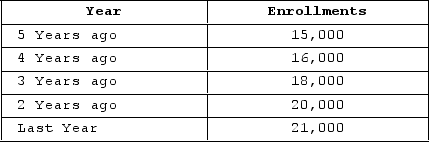 What is the forecast for this year using the naive approach?
 (Multiple Choice)
4.8/5 (98)
(98) Time-series techniques involve the identification of explanatory variables that can be used to predict future demand.
(True/False)
4.9/5 (74)
(74) The president of State University wants to forecast student enrollments for this academic year based on the following historical data:
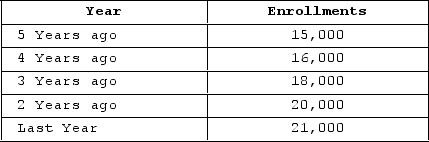 What is the forecast for this year using a four-year simple moving average?
 (Multiple Choice)
4.8/5 (81)
(81) For new products in a strong growth mode, a low alpha will minimize forecast errors when using exponential smoothing techniques.
(True/False)
4.7/5 (88)
(88) The dean of a school of business is forecasting total student enrollment for this year's summer session classes based on the following historical data:
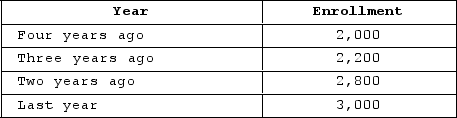 What is this year's forecast using the least squares trend line for these data?
 (Multiple Choice)
4.9/5 (79)
(79) A tracking signal focuses on the ratio of cumulative forecast error to the corresponding value of MAD.
(True/False)
4.8/5 (87)
(87) Forecasts help managers both to plan the system itself and to provide valuable information for using the system.
(True/False)
4.9/5 (87)
(87) The naive forecast can serve as a quick and easy standard of comparison against which to judge the cost and accuracy of other techniques.
(True/False)
4.9/5 (85)
(85) Given forecast errors of 4, 8, and −3, what is the mean absolute deviation?
(Multiple Choice)
5.0/5 (78)
(78) Which of the following possible values of alpha would cause exponential smoothing to respond the most quickly to forecast errors?
(Multiple Choice)
4.8/5 (72)
(72) Given forecast errors of 5, 0,−4, and 3, what is the mean absolute deviation?
(Multiple Choice)
4.9/5 (77)
(77) Suppose a three-period weighted average is being used to forecast demand. Weights for the periods are as follows: w t-3 = 0.2, w t-2 = 0.3 and w t-1 = 0.5. Demand observed in the previous three periods was as follows: A t-3 = 2,200, A t-2 = 1,950, and A t-1 = 2,050. What will be the demand forecast for period t?
(Multiple Choice)
4.8/5 (82)
(82) Bias exists when forecasts tend to be greater or less than the actual values of time series.
(True/False)
4.9/5 (84)
(84) The dean of a school of business is forecasting total student enrollment for this year's summer session classes based on the following historical data:
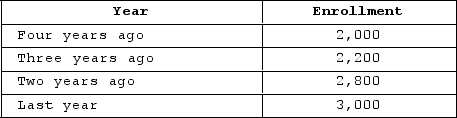 What is this year's forecast using a three-year simple moving average?
 (Multiple Choice)
4.7/5 (78)
(78) 
Filters
- Essay(0)
- Multiple Choice(0)
- Short Answer(0)
- True False(0)
- Matching(0)