



 Chat with AI
Exam 28: Embryology and Human Development

Exam 1: Foundations: An Introduction to Anatomy124 Questions
Exam 2: Foundations: The Cell117 Questions
Exam 3: Foundations: Tissues and Early Embryology127 Questions
Exam 4: The Integumentary System127 Questions
Exam 5: The Skeletal System: Osseous Tissue and Skeletal Structure142 Questions
Exam 6: The Skeletal System: Axial Division150 Questions
Exam 7: The Skeletal System: Appendicular Division131 Questions
Exam 8: The Skeletal System: Articulations131 Questions
Exam 9: The Muscular System: Skeletal Muscle Tissue and Muscle Organization145 Questions
Exam 10: The Muscular System: Axial Musculature142 Questions
Exam 11: The Muscular System: Appendicular Musculature135 Questions
Exam 12: Surface Anatomy and Cross-Sectional Anatomy129 Questions
Exam 13: The Nervous System: Neural Tissue127 Questions
Exam 14: The Nervous System: The Spinal Cord and Spinal Nerves131 Questions
Exam 15: The Nervous System: Sensory and Motor Tracts of the Spinal Cord81 Questions
Exam 16: The Nervous System: The Brain and Cranial Nerves132 Questions
Exam 17: The Nervous System: Autonomic Nervous System115 Questions
Exam 18: The Nervous System: General and Special Senses127 Questions
Exam 19: The Endocrine System102 Questions
Exam 20: The Cardiovascular System: Blood71 Questions
Exam 21: The Cardiovascular System: The Heart150 Questions
Exam 22: The Cardiovascular System: Vessels and Circulation129 Questions
Exam 23: The Lymphatic System105 Questions
Exam 24: The Respiratory System128 Questions
Exam 25: The Digestive System132 Questions
Exam 26: The Urinary System135 Questions
Exam 27: The Reproductive System134 Questions
Exam 28: Embryology and Human Development140 Questions
Select questions type


Figure 28.5
 Identify the labeled structure(s) in each of the following questions.
-Identify the structure indicated by Label E.
Identify the labeled structure(s) in each of the following questions.
-Identify the structure indicated by Label E. (Multiple Choice)
4.8/5  (67)
(67) The relatively thin portion of the endometrium that covers the embryo and separates it from the uterine cavity is called the ________.
(Multiple Choice)
4.9/5 (68)
(68) The two systems with related functions that will change the most rapidly at birth, but that are still undergoing some differentiation shortly before birth, are the circulatory and ________ systems.
(Multiple Choice)
5.0/5 (81)
(81) If two sperm penetrate two different oocytes, the two resulting offspring would be ________.
(Multiple Choice)
4.8/5 (83)
(83) Figure 28.3
 Identify the labeled structure(s) in each of the following questions.
-Identify the structure indicated by Label K
Identify the labeled structure(s) in each of the following questions.
-Identify the structure indicated by Label K (Multiple Choice)
4.9/5 (86)
(86) Problems with the formation of the chorion would affect ________.
(Multiple Choice)
4.9/5 (74)
(74) The heart begins pumping and circulating blood in the ________ week.
(Multiple Choice)
4.8/5 (81)
(81) In the axial skeleton, most muscle, cartilage, and connective tissues are derived from a series of mesenchymal blocks called ________.
(Multiple Choice)
4.9/5 (76)
(76) The blastodisc of the early embryo consists of the ________.
(Multiple Choice)
4.8/5 (89)
(89) In what developmental stage does the human embryo implant in the wall of the uterus?
(Multiple Choice)
4.7/5 (74)
(74) Figure 28.1
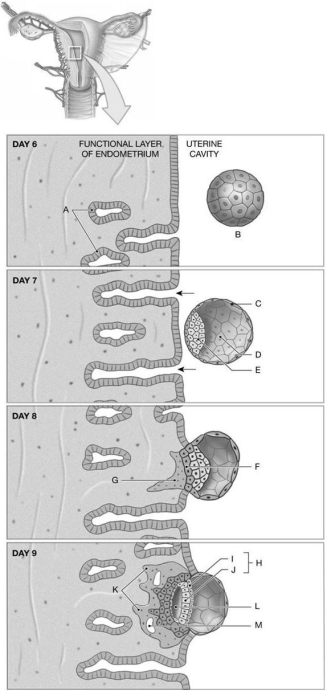 Identify the labeled structure(s) in each of the following questions.
-Identify the structure indicated by Label K.
Identify the labeled structure(s) in each of the following questions.
-Identify the structure indicated by Label K. (Multiple Choice)
4.7/5 (72)
(72) The amnionic cavity is filled with fluid, which functions to ________.
(Multiple Choice)
4.9/5 (79)
(79) The neural plate is the first stage of development in the nervous system.
(True/False)
4.8/5 (79)
(79) Figure 28.4
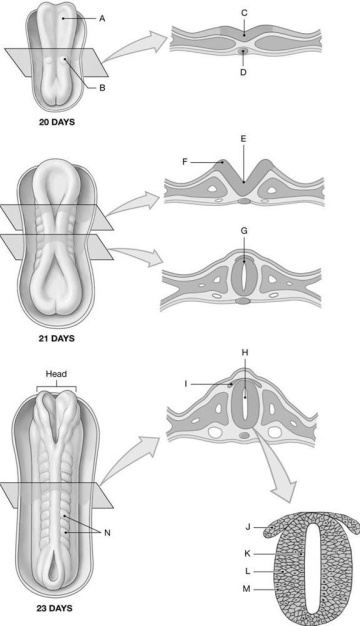 Identify the labeled structure(s) in each of the following questions.
-Identify the structure indicated by Label B.
Identify the labeled structure(s) in each of the following questions.
-Identify the structure indicated by Label B. (Multiple Choice)
4.8/5 (79)
(79) Figure 28.5
Identify the labeled structure(s) in each of the following questions.
-Identify the structure indicated by Label C.
Identify the labeled structure(s) in each of the following questions.
-Identify the structure indicated by Label C. (Multiple Choice)
4.8/5 (88)
(88) During implantation, the developing blastocyst receives nutrients from the nutrients released from the disruption and enzymatic digestion of ________.
(Multiple Choice)
4.8/5 (97)
(97) 
Filters
- Essay(0)
- Multiple Choice(0)
- Short Answer(0)
- True False(0)
- Matching(0)