



 Chat with AI
Exam 20: The Cardiovascular System: Blood

Exam 1: Foundations: An Introduction to Anatomy124 Questions
Exam 2: Foundations: The Cell117 Questions
Exam 3: Foundations: Tissues and Early Embryology127 Questions
Exam 4: The Integumentary System127 Questions
Exam 5: The Skeletal System: Osseous Tissue and Skeletal Structure142 Questions
Exam 6: The Skeletal System: Axial Division150 Questions
Exam 7: The Skeletal System: Appendicular Division131 Questions
Exam 8: The Skeletal System: Articulations131 Questions
Exam 9: The Muscular System: Skeletal Muscle Tissue and Muscle Organization145 Questions
Exam 10: The Muscular System: Axial Musculature142 Questions
Exam 11: The Muscular System: Appendicular Musculature135 Questions
Exam 12: Surface Anatomy and Cross-Sectional Anatomy129 Questions
Exam 13: The Nervous System: Neural Tissue127 Questions
Exam 14: The Nervous System: The Spinal Cord and Spinal Nerves131 Questions
Exam 15: The Nervous System: Sensory and Motor Tracts of the Spinal Cord81 Questions
Exam 16: The Nervous System: The Brain and Cranial Nerves132 Questions
Exam 17: The Nervous System: Autonomic Nervous System115 Questions
Exam 18: The Nervous System: General and Special Senses127 Questions
Exam 19: The Endocrine System102 Questions
Exam 20: The Cardiovascular System: Blood71 Questions
Exam 21: The Cardiovascular System: The Heart150 Questions
Exam 22: The Cardiovascular System: Vessels and Circulation129 Questions
Exam 23: The Lymphatic System105 Questions
Exam 24: The Respiratory System128 Questions
Exam 25: The Digestive System132 Questions
Exam 26: The Urinary System135 Questions
Exam 27: The Reproductive System134 Questions
Exam 28: Embryology and Human Development140 Questions
Select questions type


Figure 20.2
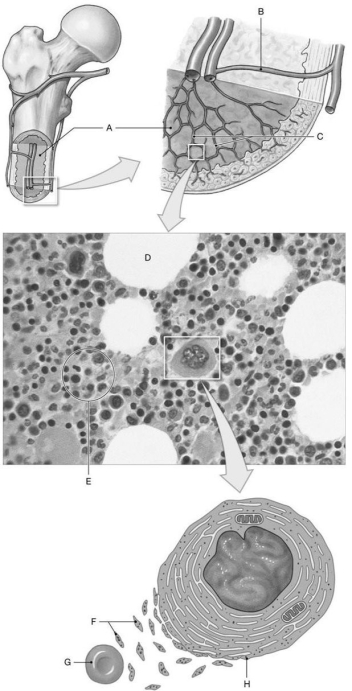 Identify the labeled structure(s) in each of the following questions.
-Identify the structure(s) indicated by Label F.
Identify the labeled structure(s) in each of the following questions.
-Identify the structure(s) indicated by Label F. (Multiple Choice)
4.9/5  (88)
(88) As a megakaryocyte develops and grows, what happens to its nucleus?
(Multiple Choice)
4.8/5 (77)
(77) For erythropoiesis to proceed normally, the progenitor cells must receive adequate supplies of which of the following?
(1)amino acids
(2)calcium
(3)iron
(4)vitamin B₁₂
(5)vitamin K
(6)vitamin A
(Multiple Choice)
4.9/5 (71)
(71) A condition related to the insufficient production of clotting factors is known as ________.
(Multiple Choice)
4.9/5 (63)
(63) The concentration of ________ in interstitial fluid is much higher than that of plasma.
(Multiple Choice)
4.8/5 (88)
(88) Figure 20.1
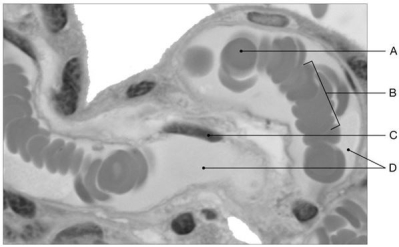 Identify the labeled structure(s) in each of the following questions.
-Identify the structure(s) indicated by Label C.
Identify the labeled structure(s) in each of the following questions.
-Identify the structure(s) indicated by Label C. (Multiple Choice)
4.7/5 (71)
(71) The ________ synthesize(s)and release(s)more than 90% of the plasma proteins.
(Multiple Choice)
4.8/5 (78)
(78) The leukocyte that releases histamine to enhance inflammation is the ________.
(Multiple Choice)
4.9/5 (83)
(83) In the adult, red blood cells are produced in areas of the ________.
(Multiple Choice)
4.7/5 (83)
(83) A person who is Rh-positive has the Rh antigen on the plasma membrane of his or her ________.
(Multiple Choice)
4.8/5 (77)
(77) Erythrocytes are the most abundant formed elements in the blood.
(True/False)
4.7/5 (71)
(71) 
Filters
- Essay(0)
- Multiple Choice(0)
- Short Answer(0)
- True False(0)
- Matching(0)