



 Chat with AI
Exam 14: The Nervous System: The Spinal Cord and Spinal Nerves

Exam 1: Foundations: An Introduction to Anatomy124 Questions
Exam 2: Foundations: The Cell117 Questions
Exam 3: Foundations: Tissues and Early Embryology127 Questions
Exam 4: The Integumentary System127 Questions
Exam 5: The Skeletal System: Osseous Tissue and Skeletal Structure142 Questions
Exam 6: The Skeletal System: Axial Division150 Questions
Exam 7: The Skeletal System: Appendicular Division131 Questions
Exam 8: The Skeletal System: Articulations131 Questions
Exam 9: The Muscular System: Skeletal Muscle Tissue and Muscle Organization145 Questions
Exam 10: The Muscular System: Axial Musculature142 Questions
Exam 11: The Muscular System: Appendicular Musculature135 Questions
Exam 12: Surface Anatomy and Cross-Sectional Anatomy129 Questions
Exam 13: The Nervous System: Neural Tissue127 Questions
Exam 14: The Nervous System: The Spinal Cord and Spinal Nerves131 Questions
Exam 15: The Nervous System: Sensory and Motor Tracts of the Spinal Cord81 Questions
Exam 16: The Nervous System: The Brain and Cranial Nerves132 Questions
Exam 17: The Nervous System: Autonomic Nervous System115 Questions
Exam 18: The Nervous System: General and Special Senses127 Questions
Exam 19: The Endocrine System102 Questions
Exam 20: The Cardiovascular System: Blood71 Questions
Exam 21: The Cardiovascular System: The Heart150 Questions
Exam 22: The Cardiovascular System: Vessels and Circulation129 Questions
Exam 23: The Lymphatic System105 Questions
Exam 24: The Respiratory System128 Questions
Exam 25: The Digestive System132 Questions
Exam 26: The Urinary System135 Questions
Exam 27: The Reproductive System134 Questions
Exam 28: Embryology and Human Development140 Questions
Select questions type


Figure 14.4
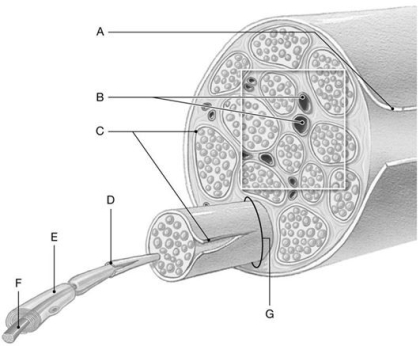 Using the above-referenced diagram of a typical peripheral nerve and its connective tissue wrappings, identify the specified labeled structure(s) in each of the following questions.
-Identify the structure(s) indicated by Label B.
Using the above-referenced diagram of a typical peripheral nerve and its connective tissue wrappings, identify the specified labeled structure(s) in each of the following questions.
-Identify the structure(s) indicated by Label B. (Multiple Choice)
4.7/5  (82)
(82) The largest nerve in the body that is formed from L4-S3 is the ________.
(Multiple Choice)
4.9/5 (72)
(72) Figure 14.8
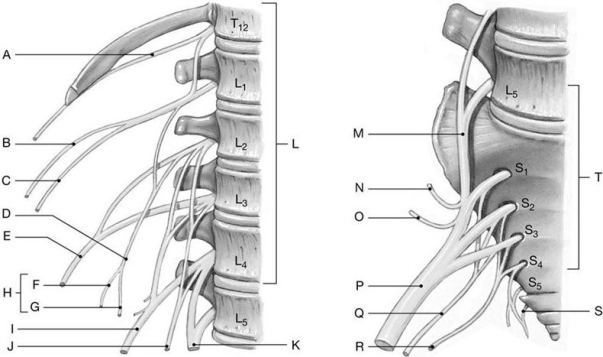 Using the above-referenced diagrams of the lumbar and sacral plexuses, identify the specified labeled structure(s) in each of the following questions.
-Identify the structure(s) indicated by Label D.
Using the above-referenced diagrams of the lumbar and sacral plexuses, identify the specified labeled structure(s) in each of the following questions.
-Identify the structure(s) indicated by Label D. (Multiple Choice)
4.7/5 (85)
(85) Figure 14.7
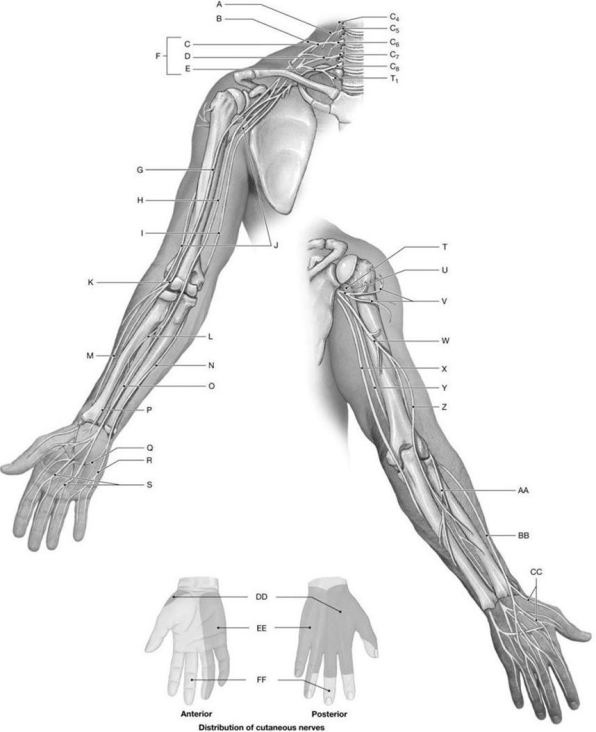 Using the above-referenced diagrams of the anterior and posterior views of the upper limb, identify the specified labeled structure(s) in each of the following questions.
-Identify the structure(s) indicated by Label EE.
Using the above-referenced diagrams of the anterior and posterior views of the upper limb, identify the specified labeled structure(s) in each of the following questions.
-Identify the structure(s) indicated by Label EE. (Multiple Choice)
4.9/5 (96)
(96) The ________ nerve of the lumbar plexus is formed by ventral rami of T12 and L1, and innervates the internal and external oblique muscles.
(Multiple Choice)
5.0/5 (76)
(76) Activation of a sensory neuron results in the conduction of action potentials into the spinal cord along a(n)________.
(Multiple Choice)
4.8/5 (82)
(82) Figure 14.3
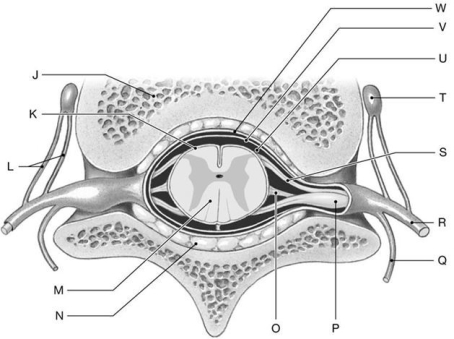 Using the above-referenced diagram of a sectional view through the spinal cord and meninges showing the peripheral distribution of the spinal nerves, identify the specified labeled structure(s) in each of the following questions.
-Identify the structure(s) indicated by Label P.
Using the above-referenced diagram of a sectional view through the spinal cord and meninges showing the peripheral distribution of the spinal nerves, identify the specified labeled structure(s) in each of the following questions.
-Identify the structure(s) indicated by Label P. (Multiple Choice)
4.9/5 (87)
(87) Figure 14.2
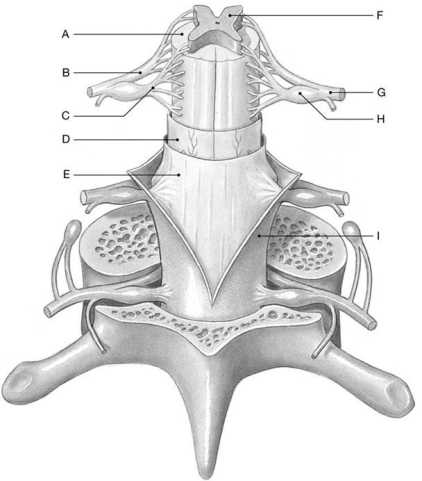 Using the above-referenced diagram of a posterior view of the spinal cord showing the meningeal layers, superficial landmarks, and distribution of gray and white matter, identify the specified labeled structure(s) in each of the following questions.
-Identify the structure(s) indicated by Label H.
Using the above-referenced diagram of a posterior view of the spinal cord showing the meningeal layers, superficial landmarks, and distribution of gray and white matter, identify the specified labeled structure(s) in each of the following questions.
-Identify the structure(s) indicated by Label H. (Multiple Choice)
4.9/5 (79)
(79) Figure 14.8
Using the above-referenced diagrams of the lumbar and sacral plexuses, identify the specified labeled structure(s) in each of the following questions.
-Identify the structure(s) indicated by Label B.
Using the above-referenced diagrams of the lumbar and sacral plexuses, identify the specified labeled structure(s) in each of the following questions.
-Identify the structure(s) indicated by Label B. (Multiple Choice)
4.7/5 (76)
(76) Figure 14.1
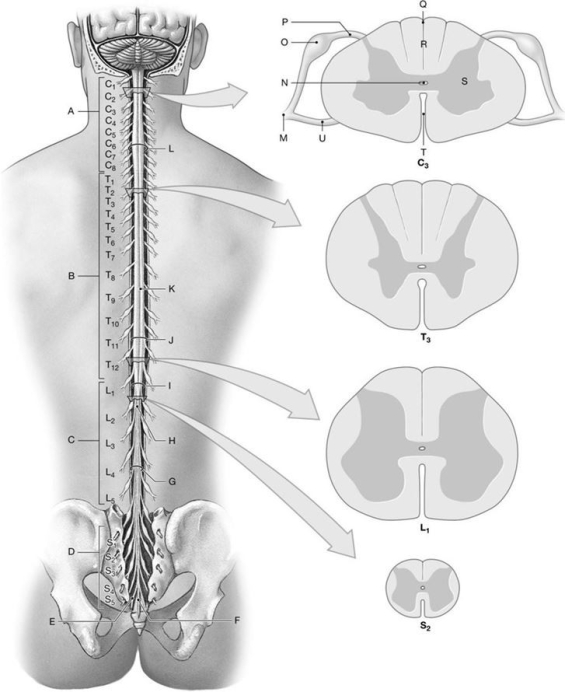 Using the above- referenced diagrams of the superficial anatomy and orientation of the adult spinal cord (posterior view)and inferior views of cross-sections through representative segments of the spinal cord, showing the arrangement of gray and white matter, identify the specified labeled structure(s) in each of the following questions.
-Identify the structure(s) indicated by Label O.
Using the above- referenced diagrams of the superficial anatomy and orientation of the adult spinal cord (posterior view)and inferior views of cross-sections through representative segments of the spinal cord, showing the arrangement of gray and white matter, identify the specified labeled structure(s) in each of the following questions.
-Identify the structure(s) indicated by Label O. (Multiple Choice)
4.8/5 (89)
(89) The short head of the biceps femoris and the tibialis anterior muscles are innervated by the ________ nerve.
(Multiple Choice)
4.8/5 (72)
(72) The brachial plexus is composed of cutaneous and muscular branches of the ventral rami of spinal nerves C1-C4.
(True/False)
4.9/5 (69)
(69) The ________ arises from the posterior cord of the brachial plexus.
(Multiple Choice)
5.0/5 (67)
(67) All of the following are true of fiber tracts in the spinal cord except ________.
(Multiple Choice)
4.8/5 (75)
(75) The blood vessels that supply the spinal cord are found in the ________.
(Multiple Choice)
4.8/5 (85)
(85) Figure 14.4
Using the above-referenced diagram of a typical peripheral nerve and its connective tissue wrappings, identify the specified labeled structure(s) in each of the following questions.
-Identify the structure(s) indicated by Label C.
Using the above-referenced diagram of a typical peripheral nerve and its connective tissue wrappings, identify the specified labeled structure(s) in each of the following questions.
-Identify the structure(s) indicated by Label C. (Multiple Choice)
4.8/5 (85)
(85) If you bump the "funny bone" which nerve function is interrupted?
(Multiple Choice)
4.8/5 (82)
(82) Figure 14.2
Using the above-referenced diagram of a posterior view of the spinal cord showing the meningeal layers, superficial landmarks, and distribution of gray and white matter, identify the specified labeled structure(s) in each of the following questions.
-Identify the structure(s) indicated by Label F.
Using the above-referenced diagram of a posterior view of the spinal cord showing the meningeal layers, superficial landmarks, and distribution of gray and white matter, identify the specified labeled structure(s) in each of the following questions.
-Identify the structure(s) indicated by Label F. (Multiple Choice)
4.7/5 (80)
(80) 
Filters
- Essay(0)
- Multiple Choice(0)
- Short Answer(0)
- True False(0)
- Matching(0)