



 Chat with AI
Exam 10: Organizing Production

Exam 1: What Is Economics483 Questions
Exam 2: The Economic Problem440 Questions
Exam 3: Demand and Supply515 Questions
Exam 4: Elasticity530 Questions
Exam 5: Efficiency and Equity450 Questions
Exam 6: Government Actions in Markets412 Questions
Exam 7: Global Markets in Action205 Questions
Exam 8: Utility and Demand366 Questions
Exam 10: Organizing Production385 Questions
Exam 11: Output and Costs493 Questions
Exam 12: Perfect Competition487 Questions
Exam 13: Monopoly599 Questions
Exam 14: Monopolistic Competition318 Questions
Exam 15: Oligopoly276 Questions
Exam 16: Public Choices, Public Goods, and Healthcare205 Questions
Exam 17: Externalities437 Questions
Exam 18: Markets for Factors of Production382 Questions
Exam 19: Economic Inequality351 Questions
Exam 20: Uncertainty and Information233 Questions
Select questions type


A corporation ________ taxes on its profits and its stockholders ________ taxes on any dividends made to them by the company.
(Multiple Choice)
4.9/5  (71)
(71) It was more than a century ago that an engineer named Frederick Taylor walked into factories and starting timing workers with a stop watch. He dissected their movements, and organized them more efficiently. He turned factory production into a science. Suppose workers were paid a wage based on how much they produced. How does this firm organize production?
(Multiple Choice)
4.9/5 (78)
(78) Techniques for making 100 pizzas
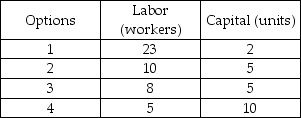 -Labor costs $20 per worker and capital costs $100 per unit. Then, according to the above table, which of the following options for pizza production is economically efficient?
 (Multiple Choice)
4.9/5 (88)
(88) A golf club manufacturer pays its workers based on the number of sets of clubs they produce. This firm
(Multiple Choice)
4.9/5 (68)
(68) What are three major ways that corporations can cope with the principal-agent problem?
(Essay)
4.9/5 (82)
(82) A principal-agent problem occurs when hiring workers to work for a firm because
(Multiple Choice)
4.8/5 (77)
(77) If the four-firm concentration ratio is a very small number, then
(Multiple Choice)
4.7/5 (76)
(76) If a firm chooses to produce 100 units of output for $150 with 10 units of labor and 12 units of capital, when they could produce the same 100 units for $120 with 10 units of labor and 8 units of capital, the firm is technologically ________ and economically ________.
(Multiple Choice)
4.9/5 (86)
(86) The principal-agent problem refers to the fact that firms must
(Multiple Choice)
4.9/5 (67)
(67) According to Nobel laureate Ronald Coase, firms exist in order to
(Multiple Choice)
4.9/5 (75)
(75) A firm has achieved technological efficiency whenever it has
(Multiple Choice)
4.8/5 (87)
(87) Among the opportunity costs of a firm are all of the following EXCEPT
(Multiple Choice)
4.9/5 (76)
(76) A chief purpose of long-term contracts is to improve agents'
(Multiple Choice)
4.9/5 (83)
(83) The CORRECT ranking of the four basic market structures from low (Herfindahl-Hirschman Index) HHI to high HHI is
(Multiple Choice)
4.8/5 (79)
(79) Compared to corporations, businesses that are proprietorships
(Multiple Choice)
4.8/5 (84)
(84) Gilda's Art Gallery pays a commission to her sales people when they sell a painting. This practice is known as
(Multiple Choice)
4.7/5 (98)
(98) What are the four types of markets? Give a brief description of each type.
(Essay)
4.8/5 (93)
(93) The air travel market, which is dominated by a few large firms, is an example of
(Multiple Choice)
4.8/5 (96)
(96) 
Filters
- Essay(0)
- Multiple Choice(0)
- Short Answer(0)
- True False(0)
- Matching(0)