



 Chat with AI
Exam 10: Organizing Production

Exam 1: What Is Economics483 Questions
Exam 2: The Economic Problem440 Questions
Exam 3: Demand and Supply515 Questions
Exam 4: Elasticity530 Questions
Exam 5: Efficiency and Equity450 Questions
Exam 6: Government Actions in Markets412 Questions
Exam 7: Global Markets in Action205 Questions
Exam 8: Utility and Demand366 Questions
Exam 10: Organizing Production385 Questions
Exam 11: Output and Costs493 Questions
Exam 12: Perfect Competition487 Questions
Exam 13: Monopoly599 Questions
Exam 14: Monopolistic Competition318 Questions
Exam 15: Oligopoly276 Questions
Exam 16: Public Choices, Public Goods, and Healthcare205 Questions
Exam 17: Externalities437 Questions
Exam 18: Markets for Factors of Production382 Questions
Exam 19: Economic Inequality351 Questions
Exam 20: Uncertainty and Information233 Questions
Select questions type


Much of the outcry in the 2008 fight over a fat bailout for Wall Street focused on the size of Wall Street's fat paychecks. The real problem, according to corporate governance researchers, isn't the amount executives receive, it's how companies pay them. Most companies link compensation to quarterly performance, encouraging short-term gambles. One way to align pay with long-term incentives and discourage risky bets would be to stretch compensation over more years. What is a suggested solution to the principal-agent problem?
(Multiple Choice)
4.8/5  (75)
(75) Kris wants to purchase a house. She buys newspapers to read the classified advertisements and spends her evenings with realtors looking at houses. Kris has incurred the ________ costs of making a purchase.
(Multiple Choice)
4.8/5 (85)
(85) Which of the following compensation schemes can be explained as an attempt to solve a principal-agent problem?
(Multiple Choice)
4.8/5 (76)
(76) 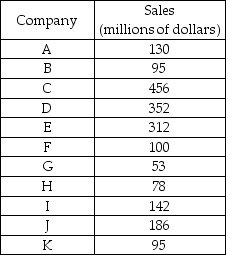 -The table above shows sales of the firms in the chocolate industry. The four-firm concentration ratio in the industry is
 (Multiple Choice)
4.9/5 (86)
(86) Which of the following are two components of the opportunity cost of using capital already owned by the firm?
(Multiple Choice)
4.8/5 (77)
(77) In their calculation, concentration ratios take barriers to entry into a market into consideration.
(True/False)
4.9/5 (76)
(76) The Herfindahl-Hirschman Index is definitely larger in a ________ market than in a ________ market.
(Multiple Choice)
4.9/5 (87)
(87) Techniques that produce 100 sweaters
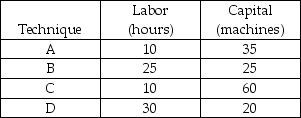 -Using the data in the above table, if the price of an hour of labor is $20 and the price of a unit of capital is $10, then the most economically efficient technique for producing 100 sweaters is
 (Multiple Choice)
4.8/5 (84)
(84) Which of the following forms of business organization is likely to suffer most from the principal agent problem between the owners and managers of the business?
(Multiple Choice)
4.8/5 (92)
(92) In September 2008, Toyota Motor's share of the U.S. auto sales market was 15 percent, Ford's market share was 12.1 percent, GM's was 29.1 percent, Honda's was 10 percent, Nissan's share was 6.2 percent, and Chrysler's market share was 11.1 percent. What is the four-firm concentration ratio in the auto market?
(Multiple Choice)
4.9/5 (84)
(84) Even though the market for bricks has a low concentration ratio nationally, the U.S. Justice Department might still scrutinize any mergers in this industry because the
(Multiple Choice)
4.9/5 (96)
(96) 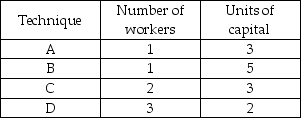 -The table above shows four methods for producing 10 computer desks a day. If the cost of a worker is $100 a day and the cost of capital is $100 a day, the method that is economically efficient is
 (Multiple Choice)
4.7/5 (89)
(89) Firms organize production by using a mixture of two systems: (1) command systems and (2) incentive systems.
(True/False)
4.9/5 (84)
(84) The Herfindahl-Hirschman Index measures an industry's concentration of
(Multiple Choice)
4.8/5 (84)
(84)
-The table above shows four methods for producing 10 computer desks a day. Of the four methods, ________ technologically inefficient.
-The table above shows four methods for producing 10 computer desks a day. Of the four methods, ________ technologically inefficient. (Multiple Choice)
4.8/5 (90)
(90) It was more than a century ago that an engineer named Frederick Taylor walked into factories and starting timing workers with a stop watch. He dissected their movements, and organized them more efficiently. He turned factory production into a science. Suppose work was completed in the factory based on what the floor manager decided and workers were paid a base daily wage plus a bonus when they produced more than expected. How does this firm organize production?
(Multiple Choice)
4.8/5 (77)
(77) 
Filters
- Essay(0)
- Multiple Choice(0)
- Short Answer(0)
- True False(0)
- Matching(0)