



 Chat with AI
Exam 2: The Economic Problem

Exam 1: What Is Economics483 Questions
Exam 2: The Economic Problem440 Questions
Exam 3: Demand and Supply515 Questions
Exam 4: Elasticity530 Questions
Exam 5: Efficiency and Equity450 Questions
Exam 6: Government Actions in Markets412 Questions
Exam 7: Global Markets in Action205 Questions
Exam 8: Utility and Demand366 Questions
Exam 10: Organizing Production385 Questions
Exam 11: Output and Costs493 Questions
Exam 12: Perfect Competition487 Questions
Exam 13: Monopoly599 Questions
Exam 14: Monopolistic Competition318 Questions
Exam 15: Oligopoly276 Questions
Exam 16: Public Choices, Public Goods, and Healthcare205 Questions
Exam 17: Externalities437 Questions
Exam 18: Markets for Factors of Production382 Questions
Exam 19: Economic Inequality351 Questions
Exam 20: Uncertainty and Information233 Questions
Select questions type


The more we have of a good or service, the smaller is its marginal benefit and the less we are willing to pay for an additional unit of it.
(True/False)
4.9/5  (77)
(77) When a nation has a comparative advantage in the production of a particular good
(Multiple Choice)
4.9/5 (78)
(78) A point outside a production possibilities frontier indicates
(Multiple Choice)
4.9/5 (69)
(69) 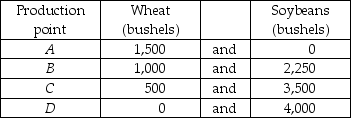 -The table above gives the production possibilities frontier for a nation that produces wheat and soybeans. Use the information in that table to complete the table below, which has in it the opportunity costs of moving from one production point to another. Do not forget to note the units of the opportunity costs.
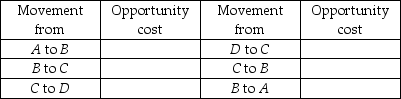
-The table above gives the production possibilities frontier for a nation that produces wheat and soybeans. Use the information in that table to complete the table below, which has in it the opportunity costs of moving from one production point to another. Do not forget to note the units of the opportunity costs.
(Essay)
4.7/5 (61)
(61) In order to achieve the maximum gains from trade, people should specialize according to
(Multiple Choice)
4.7/5 (82)
(82) 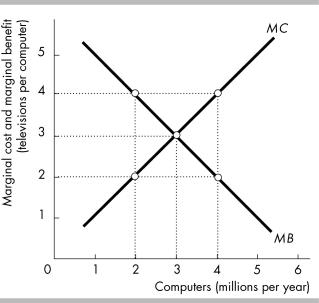 -In the figure above, at the allocatively efficient level of computer production consumers are willing to give up
 (Multiple Choice)
4.9/5 (87)
(87) Suppose the country of Popcorn produces only jets and corn. If Popcorn cannot produce any more jets without giving up corn, we say that Popcorn has achieved
(Multiple Choice)
4.8/5 (84)
(84) A production point beyond the production possibilities frontier represents what?
(Essay)
4.8/5 (72)
(72) When producing goods and services along a PPF, tradeoffs exist because
(Multiple Choice)
4.7/5 (82)
(82) One of the largest categories of exports from the United States is now pop culture: movies, music, TV programming, and videos. A direct conclusion from this information is that, compared to other countries, the United States has
(Multiple Choice)
4.9/5 (89)
(89) Generally, opportunity costs increase and the production possibilities frontier bows outward. Why?
(Multiple Choice)
4.8/5 (92)
(92) When the opportunity cost of producing more of a good is increasing, the marginal cost of producing more of the good is
(Multiple Choice)
4.8/5 (89)
(89) 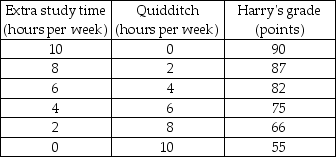
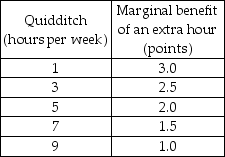 -Harry usually spends 10 hours a week playing Quidditch. However, his Defense Against the Dark Arts exam is coming and he needs more time to study for the exam. If he does not study at all, the lowest grade he will receive is 55. But Harry realizes that this grade is unacceptable and so he has to give up some of his Quidditch time. But how much? He asks his friend Hermione, who is very good at Magical Economics, to help him figure this out. Together, they come up with the schedules of Harry's possibilities and values in the tables above. Then Hermione quickly finds the solution. But Harry still looks puzzled. Help Hermione to explain her solution to Harry.
a) Draw Harry's production possibilities frontier with the Quidditch hours on the horizontal axis and Harry's grade, starting at 55, on the vertical axis.
b) What is the opportunity cost of the first two hours of Quidditch? What is the marginal cost of the 5th hour?
c) What is Harry's opportunity cost of raising his grade from 82 points to 87 points?
d) Draw Harry's marginal cost of playing Quidditch curve. What happens to the marginal cost if Harry spends more time playing Quidditch?
e) Draw Harry's marginal benefit from playing Quidditch curve. Describe the relationship between Harry's time spent playing Quidditch and the marginal benefit from playing Quidditch.
f) For how many extra hours did Hermione recommend Harry to study? Why? If Harry follows her advice, what grade will he expect? What do you think Hermione said when Harry asked why he should not spend more time playing Quidditch?
-Harry usually spends 10 hours a week playing Quidditch. However, his Defense Against the Dark Arts exam is coming and he needs more time to study for the exam. If he does not study at all, the lowest grade he will receive is 55. But Harry realizes that this grade is unacceptable and so he has to give up some of his Quidditch time. But how much? He asks his friend Hermione, who is very good at Magical Economics, to help him figure this out. Together, they come up with the schedules of Harry's possibilities and values in the tables above. Then Hermione quickly finds the solution. But Harry still looks puzzled. Help Hermione to explain her solution to Harry.
a) Draw Harry's production possibilities frontier with the Quidditch hours on the horizontal axis and Harry's grade, starting at 55, on the vertical axis.
b) What is the opportunity cost of the first two hours of Quidditch? What is the marginal cost of the 5th hour?
c) What is Harry's opportunity cost of raising his grade from 82 points to 87 points?
d) Draw Harry's marginal cost of playing Quidditch curve. What happens to the marginal cost if Harry spends more time playing Quidditch?
e) Draw Harry's marginal benefit from playing Quidditch curve. Describe the relationship between Harry's time spent playing Quidditch and the marginal benefit from playing Quidditch.
f) For how many extra hours did Hermione recommend Harry to study? Why? If Harry follows her advice, what grade will he expect? What do you think Hermione said when Harry asked why he should not spend more time playing Quidditch? (Essay)
4.9/5 (73)
(73) Considering a PPF with health care services on the vertical axis and other goods and services on the horizontal axis, the increasing production of health care services in the United States as a result of the aging population represents
(Multiple Choice)
4.8/5 (82)
(82) Technological progress makes the production possibilities frontier
(Multiple Choice)
4.7/5 (82)
(82) If marginal benefit is greater than marginal cost for the production of cars, to reach the allocative efficient quantity of cars, the production of cars must be increased.
(True/False)
4.9/5 (83)
(83) Using the production possibilities frontier model, unemployment is described as producing at a point
(Multiple Choice)
4.9/5 (74)
(74) The idea of comparative advantage implies that people or countries
(Multiple Choice)
4.8/5 (87)
(87) 
Filters
- Essay(0)
- Multiple Choice(0)
- Short Answer(0)
- True False(0)
- Matching(0)