



 Chat with AI
Exam 6: Government Actions in Markets

Exam 1: What Is Economics483 Questions
Exam 2: The Economic Problem440 Questions
Exam 3: Demand and Supply515 Questions
Exam 4: Elasticity530 Questions
Exam 5: Efficiency and Equity450 Questions
Exam 6: Government Actions in Markets412 Questions
Exam 7: Global Markets in Action205 Questions
Exam 8: Utility and Demand366 Questions
Exam 10: Organizing Production385 Questions
Exam 11: Output and Costs493 Questions
Exam 12: Perfect Competition487 Questions
Exam 13: Monopoly599 Questions
Exam 14: Monopolistic Competition318 Questions
Exam 15: Oligopoly276 Questions
Exam 16: Public Choices, Public Goods, and Healthcare205 Questions
Exam 17: Externalities437 Questions
Exam 18: Markets for Factors of Production382 Questions
Exam 19: Economic Inequality351 Questions
Exam 20: Uncertainty and Information233 Questions
Select questions type


The Volumetric Ethanol Excise Tax Credit (VEETC) is a tax credit for registered ethanol-gasoline blenders. Qualified blenders receive $0.51 for each gallon of pure ethanol they blend into gasoline. VEETC is an example of a
(Multiple Choice)
5.0/5  (80)
(80) A good has a downward-sloping demand curve and a perfectly elastic supply. Imposing a sales tax of $1 per unit on the sellers of the good
(Multiple Choice)
5.0/5 (88)
(88) 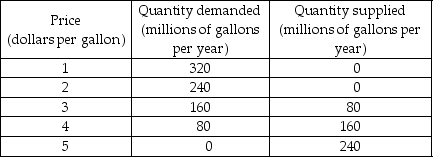 -The table above shows the demand and supply schedules for milk in Cowland. A subsidy on milk of $1 per gallon is proposed and the government asks you to examine the effects of the subsidy.
a) Draw the demand and supply curves. If there is no subsidy, what is the price of milk and how many gallons are sold?
b) With the subsidy, what is the price that consumers pay? What is the price that sellers receive? How many gallons of milk are sold?
c) Assuming no external costs and benefits, what is the efficient level of milk production? Explain.
d) With the subsidy, what is the marginal social benefit from milk? What is the marginal social cost of milk? If the subsidy is introduced, will the level of production be efficient? Why or why not?
-The table above shows the demand and supply schedules for milk in Cowland. A subsidy on milk of $1 per gallon is proposed and the government asks you to examine the effects of the subsidy.
a) Draw the demand and supply curves. If there is no subsidy, what is the price of milk and how many gallons are sold?
b) With the subsidy, what is the price that consumers pay? What is the price that sellers receive? How many gallons of milk are sold?
c) Assuming no external costs and benefits, what is the efficient level of milk production? Explain.
d) With the subsidy, what is the marginal social benefit from milk? What is the marginal social cost of milk? If the subsidy is introduced, will the level of production be efficient? Why or why not? (Essay)
4.9/5 (76)
(76) The demand and the supply for a good are each neither perfectly elastic nor perfectly inelastic. If a sales tax on sellers of the good is imposed, the tax is paid by
(Multiple Choice)
4.9/5 (73)
(73) The more ________, the larger is the amount of the tax on the good that the ________ pays.
(Multiple Choice)
4.8/5 (91)
(91) How a sales tax is divided between buyers and sellers is determined by
(Multiple Choice)
5.0/5 (77)
(77) 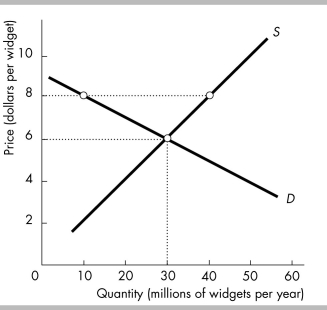 -In the figure above, if a tax of $2 per widget is imposed on sellers, then the price of widgets paid by the buyer will be
 (Multiple Choice)
4.8/5 (80)
(80) The government imposes a sales tax on hot dogs. The tax would be paid entirely by hot dog sellers if the
(Multiple Choice)
4.8/5 (88)
(88) 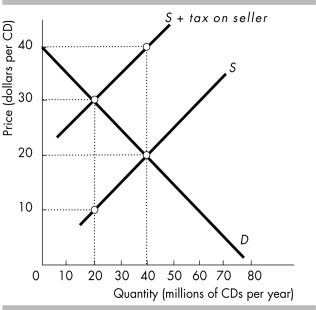 -In the above figure, what is the amount of the tax per CD?
 (Multiple Choice)
4.8/5 (68)
(68) The buyers pay the entire sales tax levied on a good when demand is perfectly ________ or supply is perfectly ________.
(Multiple Choice)
4.8/5 (66)
(66) A minimum wage set above the equilibrium wage rate for low-skilled workers
(Multiple Choice)
4.7/5 (82)
(82) The amount of a tax paid by the sellers will be larger the more ________ the demand and the more ________ the supply.
(Multiple Choice)
4.9/5 (85)
(85) 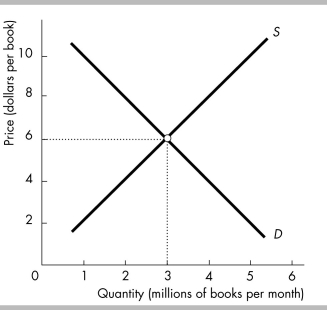 -In the above figure, the equilibrium price of a paperback book is $6 per book and the equilibrium quantity is 3 million books. The National Literature Board convinces the government to impose a price ceiling of $6 per book. At this price, the quantity of books supplied to the market will be
 (Multiple Choice)
4.8/5 (81)
(81) Rent controls and the minimum wage are both examples of price ceilings.
(True/False)
4.9/5 (73)
(73) 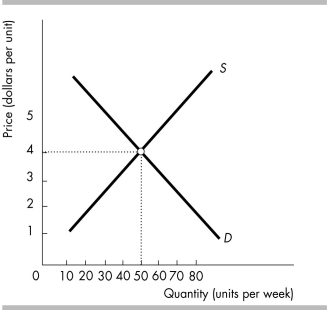 -In the above figure, a sales tax of $1 per unit imposed on sellers shifts the
 (Multiple Choice)
4.9/5 (79)
(79) Suppose a $1 tax is placed on a good. The more elastic the supply of the good, the
(Multiple Choice)
5.0/5 (75)
(75) If penalties are imposed on the sellers of illegal goods or services, then the equilibrium price ________ and the equilibrium quantity ________.
(Multiple Choice)
4.9/5 (85)
(85) 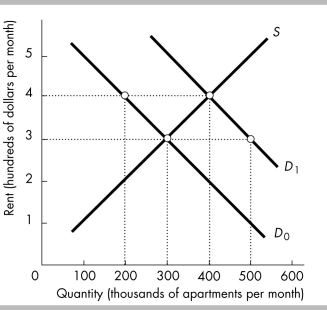 -In the figure above, the demand curve shifts rightward from D0 to D1 so that D1 is the relevant demand curve. Suppose the government imposes a rent ceiling of $300 per month. In the short run there will be
 (Multiple Choice)
4.8/5 (92)
(92) A sales tax on sellers of a good shifts the demand curve leftward because the tax raises the price that consumers must pay.
(True/False)
4.9/5 (74)
(74) 
Filters
- Essay(0)
- Multiple Choice(0)
- Short Answer(0)
- True False(0)
- Matching(0)